









From National Taiwan Normal University and Kyushu University, One Material With Two Functions Could Lead to Faster Memory
Results are promising for faster data storage and reading in future electronic devices and open new avenue of applications for perovskite optoelectronics.
This is a Press Release edited by StorageNewsletter.com on September 30, 2021 at 1:31 pmResearchers from National Taiwan Normal University and Kyushu University (Japan) have developed a new light-emitting memory device by integrating a resistive random-access memory (RRAM) with a light-emitting electrochemical cell that are both based on perovskite.
Click to enlarge
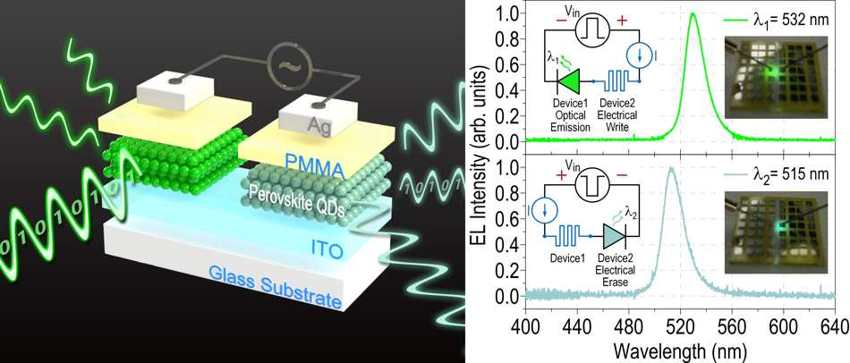
The results are promising for faster data storage and reading in future electronic devices and open a new avenue of applications for perovskite optoelectronics.
In a step toward a future of higher performance memory devices, researchers from National Taiwan Normal University and Kyushu University have developed a new device that needs only a single semiconductor known as perovskite to simultaneously store and visually transmit data.
By integrating a light-emitting electrochemical cell with a resistive random-access memory that are both based on perovskite, the team achieved parallel and synchronous reading of data both electrically and optically in a ‘light-emitting memory.’
At the most fundamental level, digital data is stored as a basic unit of information known as a bit, which is often represented as either a one or a zero. Thus, the pursuit of better data storage comes down to finding more efficient ways to store and read these ones and zeros.
While flash memory has become popular, researchers have been searching for alternatives that could further improve speed and simplify fabrication.
One candidate is RRAM. Instead of storing charge in transistors like in flash memory, resistive memory uses materials that can switch between states of high and low resistance to represent ones and zeros.
‘However, the electrical measurements needed to check the resistance and read zeros and ones from RRAM can limit the overall speed,‘ explains Chun-Chieh Chang, professor, National Taiwan Normal University, and one of the corresponding authors of the study published in Nature Communications.
‘Recently, to overcome this issue, RRAMs have been combined with LEDs to develop something called light-emitting memories. In this case, the data can also be read by checking if the LED is on or off. This additional optical reading also opens new routes for carrying large amounts of information.‘
However, previous versions of light-emitting memories required the integration of two separate devices with differing materials, complicating fabrication.
To overcome this, the researchers turned to perovskite, a type of material in which the ions migrate in a crystalline structure that gives it unique physical, optical, and even electrical properties. By controlling the ions migration, perovskite researchers have been constructing new materials with unique properties.
“Using just one perovskite layer between contacts, we could fabricate a device that works both as a RRAM and a light-emitting electrochemical cell,'” explains Ya-Ju Lee, National Taiwan Normal University, who also led the study. ‘By taking advantage of the fast, electrically switchable ionic motion that enables this dual functionality in a single layer of perovskite, we were able to connect two devices together and develop an all-inorganic perovskite light-emitting memory.”
Using perovskite consisting of cesium lead bromide (CsPbBr3), the team demonstrated that data can be electrically written, erased, and read in one of the perovskite devices acting as an RRAM. Simultaneously, the second perovskite device can optically transmit whether data is being written or erased through light emission by working as a light-emitting electrochemical cell with a high transmission speed.
Furthermore, the researchers used perovskite quantum dots of two different sizes for the two devices in the light-emitting memory to achieve different emission colors depending on whether the memory was being written or erased, providing a real-time indicator of the one or zero status.
Kaoru Tamada, distinguished professor, Institute for Materials Chemistry and Engineering, Kyushu University, Japan, who was also involved in the project, sees many opportunities for this new technology going forward.
“This demonstration significantly broadens the scope of applications of the developed all-perovskite light-emitting memory and can serve as a new paradigm of synergistic combination between electronic and photonic degrees of freedom in perovskite materials,” says Tamada. “From multicast mesh network to data encryption systems, these findings have the potential for numerous applications in next-generation technologies.“
Article : All-inorganic perovskite quantum dot light-emitting memories
Nature Communications has published an article written by Meng-Cheng Yen, Chia-Jung Lee, Kang-Hsiang Liu, Yi Peng, Institute of Electro-Optical Engineering, National Taiwan Normal University, Taipei, Taiwan, Junfu Leng, Institute for Materials Chemistry and Engineering (IMCE), Kyushu University, Fukuoka, Japan, Tzu-Hsuan Chang, Graduate Institute of Electronics Engineering, National Taiwan University, Taipei, Taiwan, Chun-Chieh Chang, Institute of Electro-Optical Engineering, National Taiwan Normal University, Taipei, Taiwan, Kaoru Tamada, Institute for Materials Chemistry and Engineering (IMCE), Kyushu University, Fukuoka, Japan, and Advanced Institute for Materials Research (AIMR), Tohoku University, Sendai, Japan, and Ya-Ju Lee, Institute of Electro-Optical Engineering, National Taiwan Normal University, Taipei, Taiwan.
Abstract: “Field-induced ionic motions in all-inorganic CsPbBr3 perovskite quantum dots (QDs) strongly dictate not only their electro-optical characteristics but also the ultimate optoelectronic device performance. Here, we show that the functionality of a single Ag/CsPbBr3/ITO device can be actively switched on a sub-millisecond scale from a RRAM to a light-emitting electrochemical cell (LEC), or vice versa, by simply modulating its bias polarity. We then realize for the first time a fast, all-perovskite light-emitting memory (LEM) operating at 5 kHz by pairing such two identical devices in series, in which one functions as an RRAM to electrically read the encoded data while the other simultaneously as an LEC for a parallel, non-contact optical reading. We further show that the digital status of the LEM can be perceived in real time from its emission color. Our work opens up a completely new horizon for more advanced all-inorganic perovskite optoelectronic technologies.“








 Subscribe to our free daily newsletter