








History (1993): IBM Storage Business With $6 Billion 1992 Sales
But only 7% from outside company
By Jean Jacques Maleval | August 19, 2020 at 2:13 pmFor the first time, Adstar, one of the dozen new independent operations of IBM, entirely focused on data storage products, is opening its accounting books.
We expected better.
At Hannover’s CeBIT, the business unit will show one of the first 5.25-inch double-density magneto-optical drives, a 1GB Winchester unit in a 1-inch high 3.5-inch form factor, plus other disk drives.
Adstar (San Jose, CA) is in charge of all Big Blue’s storage products. But its results were not stunning. Its sales dropped 13%, from $7.18 million in 1991 to $6.26 billion in 1992. The unit reported a net loss of $265 million last year, but net income was $247 million before charges for massive restructuration.
Adstar recently closed down its Berlin, Germany, disk drive plant and laid off 1,900 people in California, for a total staff of around 15,000.
Until now, we could only rely on estimations for Big Blue, who was and still is the leader in WW storage industry – the first independent manufacturer is Seagate with $2.9 billion in its last FY ended June 30,
1992. For instance, in its latest report on the worldwide HDD market, Disk/Trend attributed $11.1 billion to IBM for its captive revenues in HDDs in 1991, and tabled on a $10.0 billion forecast for 1992.
The newsletter Infoperspectives International forecasted $7.2 billion in 1991 for IBM’s revenues in data storage devices.
Some other U.S. evaluations stated $11 billion, in 1991.
About the size of Micropolis
Other official information from Adstar: in 1992’s sales, only $442 million, which means 7%, came from outside the company. We even were far from the 10% that represented 1991’s goal for 1992.
U.S. sources state amounts of $270 million for 1991, and IBM’s forecasts would be of $850 for this year.
On the OEM market, Adstar is far from competitors like Seagate, Conner, StorageTek, Quantum, Western Digital or Maxtor.
IBM is hardly at Micropolis’ level who doesn’t sell tapes or optical drives.
In short, Big Blue’s storage division is going to have a hard time before it can take a place outside of its captive market, and is far from reaching the actual profitability ratio of the market’s biggest independent players.
And especially since the company will have to continue compensating the large profits it is making on big storage peripherals (3380 and 3390 disk drives, 3480 and 3490 tape drives) in its mainframe environment with a decreasing market.
And what won’t be of any help is that IBM’s other divisions are going, more and more, to put Adstar in competition with other storage manufacturers.
In the future, it’s possible that what is now an IBM storage unit business becomes a subsidiary and even opens its capital and sell part of it on the public market.
2X 5.25-inch MO drive
At last Comdex, Hitachi displayed a 3X 5.25-inch MO drive, using a 2GB media from Maxell and supposed to be available this year. But IBM is the first to reveal a 2X drive, the multifunction 0632, using rewritable, O-ROM or WORM disks with 650MB per side compared to 325MB in its former model that was not so successful.
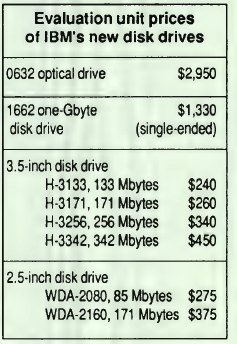
It conforms to the new ECMA standard. It uses an exclusive auto-write calibration sequence, which optimizes the read/write and seek operations based on the characteristics of the specific media. Average random seek drops from 70ms on the previous model to 40ms here. Evaluation units are available.
On its production in Fujisawa (Japan), Adstar is kind of enigmatic: “Production quantities will be available on an OEM contract basis,” according to the press release.
Five new 3.5-inch magnetic rigid disk drives
The most impressive model is a 1.05GB MR head drive, only 1-inch high, with 3 platters spinning at 5,400rpm. The areal density is a record 354Mb per square inch, with two bit recording zones. The average access time is 9.5ms with a 5.5ms latency.
“The 0662 drives deliver more data storage in a smaller package than ever before,” said Janae Lee, Adstar’s director of OEM marketing. “In addition, the units have a projected MTBF of 800,000 hours.“
General availability of the 0662 or Spitfire is scheduled for 2093.
The business unit additionally has a new line of low-profile 1-inch high 3.5-inch drives in the 3.5-inch form factor, with 4 models from 133 to 342MB and prices ranging from $240 to $450 for an evaluation unit, which foreshadows very competitive OEM quantity prices.
Other specs: 14 to 16ms average seek time, 3,600rpm, 250,000-hour MTBF, ZBR on 2 zones, 96KB segmented look ahead buffer, automatic actuator lock, SCSI-2 or AT interface.
It’s a segment market into which IBM had a hard time getting and where competition is now the strongest.
Evaluation units will be available in April for the AT-IDE models, and 3093 for the SCSI ones.
These units, just like the two new 2.5-inch ones, officially announced this month, were in technology display on IBM’s booth at last Comdex. The WDA-2080 and WDA-2160 (17mm high) have respective capacities of 85 and 171MB, compared with 63 and 126MB in the previous generation. Evaluation units are available now.
In this 2.5-inch segment, some prices give an idea on how IBM is reducing the cost per megabyte: in 90, its 32.5MMB disk was launched for $365, 65MB only cost $350 in 1992, and now you can get 171MB for $375.
Adstar finally announced, for the OEM market, its recently introduced 7051 Power Network Dataserver, a NFS server designed for workgroups being attached to up to 8 Ethernet LANs. It delivers 2,000 I/0 operations per second, said IBM, with a capacity ranging from 8 to 144GB. An average 28.8GB evaluation unit configuration costs $170,000 and will be available in April.
This article is an abstract of news published on the former paper version of Computer Data Storage Newsletter on issue ≠62, published on March 1993.







 Subscribe to our free daily newsletter