








Graphene-Based Material to Extend Life of SSDs and Flash Drives
Scientists used combination of graphene and semi-metallic Heusler alloy Co2FeGaGe.
This is a Press Release edited by StorageNewsletter.com on February 20, 2020 at 2:21 pmFrom NUST MISIS, National University of Science and Technology, Moscow, Russia
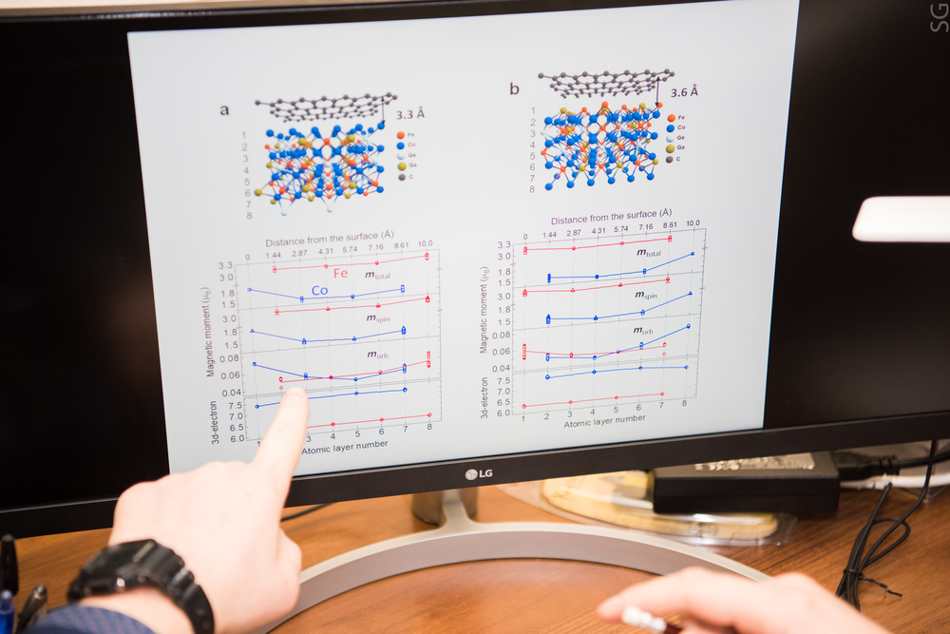
International group of Russian and Japanese scientists developed a material that will increase the recording density in storage devices, such as SSDs and flash drives.
Click to enlarge
Among the main advantages of the material is the absence of rewrite limit, which will allow implementing new devices for big data processes.
The article on the research is published in Advanced Materials.
The development of compact and reliable memory devices is an increasing need. Today, traditional devices are devices in which information is transferred through electric current. The simplest example is a flash card or SSD. At the same time, users inevitably encounter problems: the file may not be recorded correctly, the computer may stop ‘seeing’ the flash drive, and to record a large amount of information, rather massive devices are required.
A promising alternative to electronics is spintronics. Here, devices operate on the principle of magneto-resistance: there are 3 layers, the first and third of which are ferromagnetic, and the middle one is nonmagnetic. Passing through such a ‘sandwich’ structure, electrons, depending on their spin, are scattered differently in the magnetized edge layers, which affects the resulting resistance of the device. The control the information using the standard logical bits, 0 and 1, can be performed by detecting an increase or decrease in this resistance.
International group of scientists from National University of Science and Technology MISIS (Russia) and National Institute for Quantum and Radiological Science and Technology (Japan) developed a material that can increase the capacity of magnetic memory by increasing the recording density. The scientists used a combination of graphene and the semi-metallic Heusler alloy Co2FeGaGe.
“Japanese colleagues for the first time grew a single-atom layer of graphene on a layer of semi-metallic ferromagnetic material and measured its properties. The Japanese team, led by Dr. Seiji Sakai, conducts unique experiments, while our group is engaged in a theoretical description of the data obtained. Our teams have been working together for many years and have obtained a number of important results”, comments Pavel Sorokin, Sc.D. physics and mathematics, head , theoretical materials science of nanostructures infrastructure project, NUST MISIS, laboratory of inorganic nanomaterials.
Previously, graphene was not used in magnetic memory devices as carbon atoms reacted with the magnetic layer, which led to changes in its properties. By selection of the Heusler alloy composition, as well as the methods of its application, it was possible to create a thinner sample compared to previous analogues. This, in turn, will increase the capacity of magnetic memory devices without increasing their physical size.
Next, scientists plan to scale the experimental sample and modify the structure.
Article: Transition Metal Chalcogenide Single Layers as an Active Platform for Single-Atom Catalysis
ACS Energy Letters has published an article written by Péter Vancsó, Institute of Technical Physics and Materials Science, Hungarian Academy of Sciences, Centre for Energy Research, 1121 Budapest, Hungary, Zakhar I. Popov, National University of Science and Technology MISiS, 119049 Moscow, Russia, and Emanuel Institute of Biochemical Physics RAS, 199339 Moscow, Russia, János Pető, Institute of Technical Physics and Materials Science, Hungarian Academy of Sciences, Centre for Energy Research, 1121 Budapest, Hungary, Tamás Ollár, Institute for Energy Security and Environmental Safety, Surface Chemistry and Catalysis Department, Hungarian Academy of Sciences, Centre for Energy Research, 1121 Budapest, Hungary, Institute of Technical Physics and Materials Science, Hungarian Academy of Sciences, Centre for Energy Research, 1121 Budapest, Hungary, Gergely Dobrik, Institute of Technical Physics and Materials Science, Hungarian Academy of Sciences, Centre for Energy Research, 1121 Budapest, Hungary, József S. Pap, Institute for Energy Security and Environmental Safety, Surface Chemistry and Catalysis Department, Hungarian Academy of Sciences, Centre for Energy Research, 1121 Budapest, Hungary, Chanyong Hwang, Korea Research Institute for Standards and Science, Daejeon 305340, South Korea, Pavel B. Sorokin, National University of Science and Technology MISiS, 119049 Moscow, Russia, and Levente Tapasztó, Institute of Technical Physics and Materials Science, Hungarian Academy of Sciences, Centre for Energy Research, 1121 Budapest, Hungary.
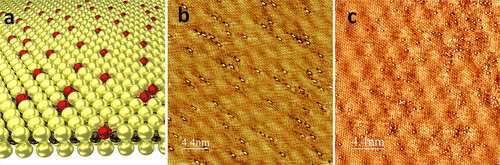
Schematic model of individually dispersed heteroatoms substituting chalcogenide atoms of 2D transition metal chalcogenide crystals (a). The practical realization of such structures evidenced by atomic resolution STM images of oxygen-atom-doped MoS2 (b) and WS2 (c) single layers with single O heteroatoms appearing as bright protrusions.
(ACS Energy Lett. 2019, 4, 8, 1947-1953)
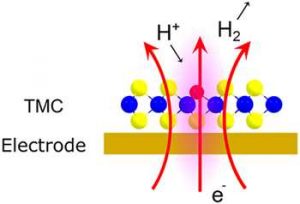
Abstract: “Among the main appeals of single-atom catalysts are the ultimate efficiency of material utilization and the well-defined nature of the active sites, holding the promise of rational catalyst design. A major challenge is the stable decoration of various substrates with a high density of individually dispersed and uniformly active monatomic sites. Transition metal chalcogenides (TMCs) are broadly investigated catalysts, limited by the relative inertness of their pristine basal plane. We propose that TMC single layers modified by substitutional heteroatoms can harvest the synergistic benefits of stably anchored single-atom catalysts and activated TMC basal planes. These solid-solution TMC catalysts offer advantages such as simple and versatile synthesis, unmatched active site density, and a stable and well-defined single-atom active site chemical environment. The unique features of heteroatom-doped two-dimensional TMC crystals at the origin of their catalytic activity are discussed through the examples of various TMC single layers doped with individual oxygen heteroatoms.“








 Subscribe to our free daily newsletter