



History (1990): What’s Quantum’s Mechanics Secret?
Producing highly-rated HDDs
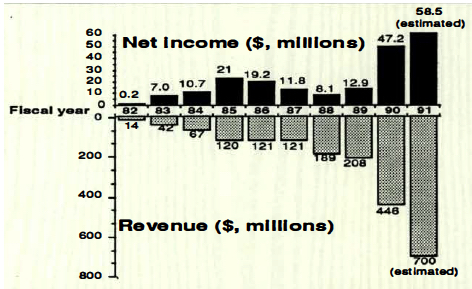
By Jean Jacques Maleval | December 9, 2019 at 1:35 pmQuantum Corporation (Milpitas, CA) recorded +115% sales in its last fiscal year, +266% net income. What’s its secret?
After a few tough years, company’s recent success came from producing Winchesters highly rated in product analyzes, at the right time, in the right form factor, in the beginning for an excellent, customer, Apple, and finally with original and performing manufacturing methods.
Today, the value of the Californian company is estimated at $550 million by financial analysts.
February 88: Quantum’s first 3.5-inch drive
Completely devoted, ever since it began, to the Winchester industry, the company was founded in February 1980 and started out with 8-inch HDDs with storage capacities ranging from 10 to 40MB.
In 1987, it switched to 5.25-inch ones with a limited success. The main decision for the company was to stop these different form factors to focus on one single one: 3.5 inches.
It costs Quantum a lot, write-offs totaling $17 million. Plus the trouble it had in producing its Q200 5.25-inch drive product family in time. Quantum upset the financial market with a net income decrease of 57% from 1986 to 1987 and a net profit loss of more than $3 million.
But “3.5-inches drives represent the liveliest market … unit sales will be (worldwide) 17.6 million this year, a whopping 55% boost over last year’s 11.3 million units,” according to Phil Devin (Dataquest, April 1990).
The first 3.5-inch drive was introduced by in February 1988 and its family totals today 19 Pro Drive series 3.5-inch products, with capacities from 40 to 425MB, embedded SCSI or AT bus controllers, an average seek time between 12 and 19ms, in standard-height and low-profile, one-inch high designs depending on the models.
Nearly $.5 billion of ProDrive series have been shipped since 1988.
The next step: 2.5 inches, in the next month.
2.5-inch drives are coming. Quantum is ahead in its 2.5-inch HDOD project since it has already shown a few models to its large OEMs to which it has given the technical specs of its future product.
Stephen M. Berkley, Quantum’s chairman and CEO, said: “It will be a second or third gen design drive, very thin, low power, high performance. With the same capacity, it will be cheaper than a 3.5-inch drive on account of the lower cost of our circuit board. It will be the highest capacity and the highest performance drive in the industry.”
Storage capacity ought to reach at least 40MB and an announcement is expected before the end of the year.
But for Berkley, the biggest problems with these new drives are that the heads, disks and motors are not produced in high volume.
Plus Development: now insignificant?
Entering the market in 1983, Plus Development is a wholly-owned subsidiary of Quantum which designs and markets storage-enhancement products like Plus HardCard, the first HDD on a circuit card; Passport, a removable HOD; and Impulse, a drive system targeted at LAN, for the end-user market.
In 1990, revenues reached $52 million, but HardCards for PCs and compatibles are no longer successful, even more since the SCSI interface was adopted by IBM in its PS/2 microcomputers.
In 4Q90, at the end of March 1990, Plus’ sales only reached $10.4 million, compared to 14.5 in 3Q89, at the end of December 1989. The subsidiary contributed approximately 8% to Quantum’s 4Q revenues compared to 13% last quarter.
And there’s no reason for its latest product, the HardCard IIs, 40 and 80MB cards, launched in January 1990 (built by MKE), to become successful.
Nevertheless, Quantum has benefited from Plus its developments in 3.5-inch drive technology enabling its head company to enter more quickly in this market.
In addition, the subsidiary developed compact, low chip-count embedded drive controllers which have helped Quantum in its ProDrive products.
Quantum bites into Apple
Apple was a precious customer that helped Quantum take off, just like Seagate, Conner Peripherals, Rodime in other times had based a good part of their success on IBM, Compaq and Apple again, respectively.
But the reliance on one single customer can become harmful after a while
“We have been working with Apple since 1986, first on 5.25-inch SCSI disks,” says Berkley. “Early 89, Apple chose our 3.5-inch drives for its Macintosh computers. Last year, Apple counted for 55% of our revenues, this year 31% in our last quarter. This ratio should not change too much, from 25 to 35% as we still are working with them on new products.”
OEM market
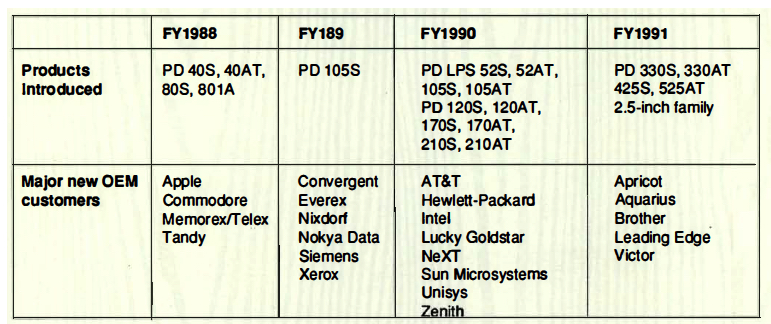
The Californian company has made big efforts to enlarge its OEM customers (see table).
According to a report in May 1990 from Bear, Stearns and Co., an investment research firm, “revenues (of Quantum) climbed 10% sequentially because of new OEM accounts, such as Hewlett-Packard and Unisys, and growth in sales through distribution.“
Another primary sales channel is through distributors who sell drives to smaller OEMs, system integrators and VARs. Sales into this channel through Quantum’s domestic distributors (Arrow Commercial Systems, Arrow Kierulff Electronics, and Marshall Industries) and through 2,500 dealers worldwide, have increased more than 350% from Y89 to FY90, growing faster over the past year than sales to OEMs.
Focusing on Europe
Quantum has marketed its products in Europe since 1981. The company’s European HQ operation, Quantum GmbH, is located in Frankfurt (West Germany) and headed by Dieter Egermann. Quantum maintains sales offices in Neuilly-sur-Seine (France) and in Crowthorne (Berkshire, UK) with a total of 54 employees on the continent.
The European growth is higher than anywhere else. It was 122% during FY90. Sales to the European market in FY90 accounted for 32% of Quantum’s total sales; in 4Q90, it was 40%.
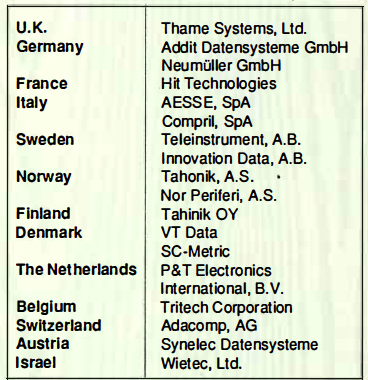
The company has now 18 European distributors in 13 products and plans to add to add about 5 more distributors during FY91. The actual target is to have 2 distributors in the large European countries and only one in small ones.
Last March, William F. Roach, VP sales of the company, announced that the firm was establishing an Amsterdam Distribution Center. It will stock the drives for the European market, initially for shipments to distributors, then, in Summer 90, to support OEMs. It was scheduled to open last April. The management was supposed to be provided by a third party service to be named. At the end of June, Berkley said that this center will open in three weeks.
Quantum provides direct local service and repair capability in a European Service Center housed with its German subsidiary in Frankfurt.
But the big to-do, is the project of opening a manufacturing plant in Europe. Under the direction of Ivan Nazario, VP of manufacturing, investigations are under way to define plans for this operation.
“In addition to establishing a location for the plant, a key part of Mr. Nazario’s effort will be to locate local sources of components. It is essential that we locate vendors who can produce components to our quality and reliability standards,” Roach said. “Our goal is to accomplish this over the next 18-24 months, assuming we succeed in identifying the correct mix of resources.“
Future plans for this facility include local research, development, and engineering capabilities.
Manufacturing: crucial agreement with MKE
“One of our biggest competitors employs close to 25,000 people in its Far East plants. We only have 500,” ironically says Berkley, without naming the company concerned, Seagate.
On the contrary, Quantum chose to automate as much as possible manufacturing with a Japanese partner rather than trying to take advantage of manual operations using low-cost mass labor in its own facilities.
Quantum balances its manufacturing between facilities in Silicon Valley and in Japan.
Its highly mechanized factory in Milpitas produces the highest capacity products. That’s where its next drives, with over 300MB capacities, are assembled. High volume, more mature technology OEM products, including all of Plus Development products, are manufactured in Ipponmatsu by Matsushita Kotobuki Eletronics Industries, Ltd. (MKE), a subsidiary of the enormous Matsushita conglomerate.
MKE’s manufacturing process was originally designed by Quantum. The Japanese firm contributed its expertise as a sophisticated manufacturer of high-volume electro-mechanical products, like VCRs, to automate the process.
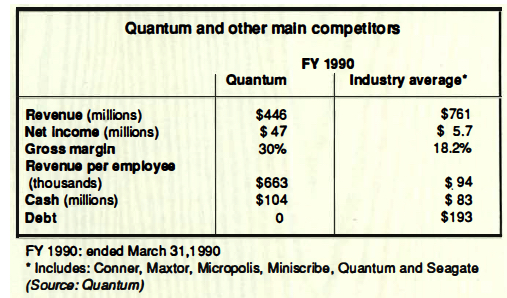
This strategy enables to achieve first-time yields of >95% which are higher than the norm in the industry; low costs lead to margins that are the best in the industry, and above the industry average, according to the company.
“During the past year, we have more than tripled our manufacturing capacity to over two million drives per year. We may potentially double our manufacturing facility by year end,” said Berkley .
The Quantum/MKE agreement only concerns manufacturing; the Japanese is not entitled to distribution rights and doesn’t own part of its U.S. partner’s capital.
“It’s a 5-year agreement and we are in the second one that ends around 1993-1994,” according to Berkley.
This kind of agreement between Americans and Japanese can have different achievements.
The partnership between Priam and Matsushita Corp. Industrial, even if it was part of the same Matsushita group, was a failure.
There also is one between PrairieTek and Alps Electronics, but in this case, Alps made an equity investment in PrairieTek, to hold about 10% of its capital.
Quantum builds its own ASIC using foundries such as Texas Instruments and NCR. Berkley estimates Quantum controllers cost about 30% less than competitors because of the in-house design.
The result of Quantum’s policy: with approximately 760 employees, revenue per employee figures are among the highest in electronics industry, over $650,000, 6X the average in the disk industry.
In spring 1990, construction began on Quantum’s new corporate and manufacturing complex in Milpitas, CA. The campus-style facility on 37 acres can house over 1,500 employees.
An easy future? Quantum should not be troubled now and even for a while. Its reputation in producing high quality drives is undeniable.
Its new 3.5-inch HDDs with over 300MB of capacity should probably be well accepted on the market and its 2.5-inch projected drive, even if it comes after its competitors, will probably satisfy its customers.
In addition, the financial situation of the company is strong enough to stand the shock. It has no bank debt and owns a small fortune amounting to $104 million in cash or equivalents.
Trouble could eventually come elsewhere. Its growth could be limited by the shortage of certain components, especially magnetic heads and certain platters, and also its big customer Apple, even if it doesn’t count as much, could bring the company worry some day.
You can also wonder about its future relations with MKE, even if they are excellent today. Quantum depends a lot on its Japanese partner that manufactures almost 90% of its products. And what will happen when MKE starts manufacturing 2.5-inch drives, in competition with JVC’s, from the same Matsushita group?
This doesn’t seem to worry Berkley who indicates that, in this enormous Japanese group, competition is routine between different departments, just like for VCRs between JVC and Panasonic.
There are nevertheless smaller risks when you handle manufacturing completely rather than when you subcontract it at such a large scale.
Finally, we noted that Quantum has no projects for optical disk, WORM or magneto-optical drives. In the Californian company, no one thinks that they will compete with Winchesters, and every one mentions NeXT Computer that started out with a magneto-optical disk as only storage peripheral for its workstation and that is today a customer of Quantum. Of course, but the 2MB disk of the NeXT station is only a buffer accelerator for the high capacity magneto-optical Canon unit.
Quantum’s OEM customers
Quantum’s distributors In Europe
Quantum’s lawsuits with its competitors
Quantum has always defended its innovations vigorously. Berkley mentioned all the present suits in a press conference In Paris. He said that CMI, a company no longer existing, had to pay $9 million to Quantum for patent violations. Similar proceedings vs. Western Digital and Tandon were developed, especially concerning hard cards. Western already paid $4 million, and “it should soon be settled with Tandon,” says Berkley. In the suit involving Quantum and Sony, Berkley thinks it will probably take another 1 or 2 years before any results.
3 million share buy-back program
Traded on the NASDAQ under the symbol of QNTM, the company’s stock split twice in calendar 1989, 3 for 2 in April and 2 for 1 in August. Quantum’s management, board members and employees maintain an equity interest in the company that amounts approximately to 19% of common shares and equivalents. On May 1, 1990, the firm announced that it plans to implement in the near future a stock repurchase program whereby up to 3 million shares of its common stock may be purchased in the market from time to time. Berkley noted that the corporation will utilize a portion of the reacquired shares for reissuance in connection with employee stock programs, but that there were no other specific plans for shares which might be purchased. He adds that it’s the third time that the company buys back a part of its shares, that about 90% of them are offered on the stock market and that no shareholder owns more than 5% of the capital.
This article is an abstract of news published on the former paper version of Computer Data Storage Newsletter on issue ≠30, published on July 1990.







 Subscribe to our free daily newsletter