








Huawei FusionServer 2298 V5 2U Up to 400TB Storage Server
Supports up to 24x3.5-inches HDDs and 4x2.5-inches HDDs (up to four NVMe SSDs), ARM-based, and with SSD accelerator component.
This is a Press Release edited by StorageNewsletter.com on April 8, 2019 at 2:23 pmAt the Huawei ISP Summit AsiaPac 2019, Huawei Technologies Co., Ltd. showcased a package of intelligent computing products, including the brand FusionServer 2298 V5 high-density storage server, TaiShan – a performance ARM-based server, and the SSD intelligent accelerator component.
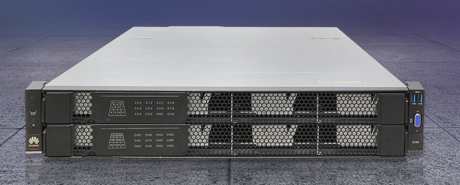
The 2298 V5 storage server aims to provide large-room and cost-effective storage for customers such as Internet service providers, enterprises, and carriers. It is applicable to SDS, big data, backup and archiving, and other storage-intensive scenarios such as warm/cold storage. It features high density, performance, easy maintenance, convenient management, and expandability. It supports up to 24×3.5-inches HDDs and 4×2.5-inches HDDs (up to four NVMe SSDs) in a 2U space, offering a storage capacity of near 400TB, 40% larger than that of the company’s 2U servers of the same generation. It leverages a hybrid storage architecture and supports tiered storage, with flexible and large-capacity local storage expansion, reducing storage costs.
It supports flexible I/O with 2xGbE and 2x10GbE LAN on motherboard (LOM) ports, simplifying network configuration and meets network requirements in most application scenarios. It also supports OCP2.0 standard I/O interfaces and is applicable to cloud data center deployment. It also support energy-saving technologies.
With the AI era impacting all industries, enterprises are turning to cloud computing and big data technologies to improve productivity and are transforming business models and service models with AI applications. The advancement of AI technologies depends on powerful computing and big data analytics capabilities and emerging trends pose increasing demands for the computing and storage capacity of servers. Against this backdrop, it has become an imperative to smarten up data centers, increase server capacity, improve O&M efficiency, and reduce storage costs.







 Subscribe to our free daily newsletter