









7% Growth for WW Personal and Entry Level HDD Systems – IDC
From 2Q12 to 2Q13, at $1.5 billion
This is a Press Release edited by StorageNewsletter.com on August 20, 2013 at 2:45 pmThe worldwide personal and entry-level storage (PELS) market grew 10.7% year over year with 16.8 million units shipped in 2Q13), according to the International Data Corporation‘s Worldwide Personal and Entry Level Storage Tracker.
Shipment value experienced growth of 7.3% year over year to $1.5 billion. This is the third consecutive quarter of year-over-year growth in worldwide shipment value.
"The second quarter of 2013 brought continued shipment and revenue growth, as well as a return to normal for the personal and entry-level storage market," said Liz Conner, senior research analyst, storage systems. "For the last four quarters, the PELS market has seen a distinct focus on recovery after the Thailand floods and resulting HDD shortage. The second quarter brought back a sense of ‘business as usual’ with vendors starting to shift their focus from recovery to the future, with added investments in personal cloud storage, mobile device connectivity, emerging markets, USB 3.0, and Thunderbolt."
HDD vendors continue to increase share in PELS units shipped, gaining 4.6 points year over year to grow to 73.6% market share. However the entry-level storage market continues to be dominated by the mainstream non-HDD vendors with 72.1% unit shipment market share, down 5.7 point year over year.
Market Highlights
- The entry-level storage market continued to grow with unit shipments growing 3.2% year over year. Specifically, the entry-level market saw strong growth in the higher bay devices (6, 8, and 12 bays), which saw units shipped grow 23.4% year over year.
- In 2Q13 the personal storage market saw good growth in dual-bay products, where unit shipments were up 17.6% year over year. Single bay personal storage devices remain the most popular choice, representing 97.0% of the personal storage units shipped in 2Q13.
- Personal storage represents 98.9% of the PELS units shipped and 87.9% of the shipment value in 2Q13.
Technology Highlights
- Form Factor – The 3.5" and 2.5" form factors each saw units shipped increase 2.7% and 13.4% year over year, respectively. However the 3.5" form factor continues to give way to the more portable 2.5" form factor, with 3.5" losing 1.8 percentage points year over year.
- Capacity Range – End users continue to migrate to higher capacity points to meet storage needs. In the 3.5" personal storage market, 2TB devices represented 51.9% of unit shipments in the quarter. For the 2.5" personal storage market, 1TB devices captured 51.7% market share. For the entry-level market, capacity ranges are more varied due to multiple bays and vendors’ ability to partially populate devices. However 4TB devices hold the most market share with 28.6% of units shipped.
- Interface – USB continues to be the interface of choice for the PELS market, growing units shipped 11.5% year over year. Ethernet also saw strong shipment growth, posting a 10.2% year over year growth rate and being the interface of choice for the entry-level market. Thunderbolt continues to ramp up, posting a year-over-year shipment growth rate of 411.7%, albeit off a very small base.
WW Personal and Entry-Level Storage Shipment Value,
Market Share, and Year-Over-Year Growth,
Second Quarter 2013 (shipment value in $ million)
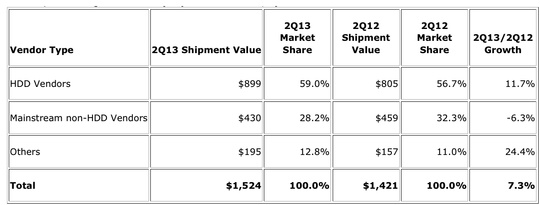
(Source: IDC Worldwide Quarterly Personal
and Entry Level Storage Tracker, August 2013)
Notes:
- The PELS market includes storage products and solutions with a single bay through twelve bay configurations that are manufactured and marketed for individuals, small offices/home offices, and small businesses.
- IDC defines Personal Storage as having 1-2 bays and Entry-Level Storage as having 3-12 bays.
- IDC defines an HDD vendor as a vendor who manufactures their own HDD drive, in addition to branded external storage.
- IDC defines a Mainstream non-HDD vendor as a major PELS vendor who does not manufacture its own HDD drives.
- Data for the PELS market is reported for calendar periods.








 Subscribe to our free daily newsletter