









Kodak Had Lot of Activities in Storage But Missed About All of Them
Company just filed for Chapter XI bankruptcy.
By Jean Jacques Maleval | February 2, 2012 at 3:11 pmEastman Kodak, founded by George Eastman in 1889, missed to transform the photography firm into a digital company from 1975, and just filed Chapter XI bankruptcy.
The company tried to diversify in storage many years ago. Here are some milestones classified by storage activity.
Micrographics
In the 1920’s, microfilm began to be used in a commercial setting and Kodak was a pioneer in this field. In 1928, it bought McCarthy’s invention and began marketing check microfilming devices under its Recordak division. Then, in the 1970’s – 1980’s, against 3M and others, it was a leader in micrographics, manufacturing microfilm, a very old storage analog media and also COM (Computer Output Microfilm to write computer data on microfim and microfiche), cameras to transfer paper documents on film, readers-printers, etc. It approached about $1 billion in 2001. This micrographics business was sold in 2011 – through Kofile – to Eastman Park Micrographics founded by former Kodak executive William ‘Sonny’ Oates.
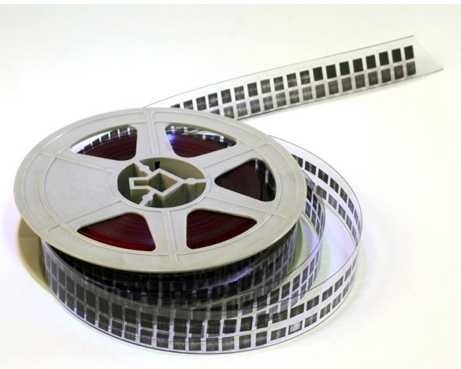
Microfilm
Tape
Kodak bought Spin Physics from Jim Lemke in 1973 to develop digital
storage, primarily tape. It was renamed Kodak Research Labs (in La
Jolla/San Diego) and was shut down around 1998. KRL made a really fast,
for the time, movie camera.
14-Inch WORMs
In 1982, Verbatim’s plant in Limerick, Ireland was taken over by Kodak and was the first in the world to produce 14-inch optical discs with a £60 million investment by the American company. Since 1986, this activity was its main storage business with proprietary media, drives and jukeboxes for archiving. A record capacity of 10.4GB was established on a disc in 1991, 14.8GB in 1994 – then next year resold by IBM – and pushed to 25GB in 1996 always on a single platter using WORM phase-change media. Kodak finally throwin the tower in 1998. It also manufactured 5.25-inch optical disc libraries based on Maxoptix drives and media. Note also a joint venture with Olivetti for optical discs in Laserdrive in 1993.
Floppy Discs
Announcing a full line of flexible floppy disks for PCs in 1984 as part of plan to expand into this market, the film and camera giant agreed to acquire Verbatim for $175 million the following year. Then in a transaction estimated at $200 million, Mitsubishi Kasei acquired Verbatim in 1990.
Magnetic Cards
Kodak invented in 1968 1MB magnetic card that never happens.
Optical Tapes
Known as Digital Optical Tape Systems (DOTS), they were developed by Kodak during the 1990’s. At a time StorageTek (now Oracle) was working on a drive. $80 million was invested by the Rochester company on this (non-magnetic) phase-change WORM media, up to 2TB, inserted in a cartridge similar to LTO. The project was finally stopped in 2002 all the 36 patents and IPs were sold to Group 47 in 2010.
CD-R/RW
Kodak launched in 1992 a writable CD that its first customer, MCI, used for producing telephone bills for corporate accounts, and then for Kodak Photo CD. The firm was also involved in CD jukeboxes.
Kodak Photo CD Player
CD-PROMs
In 1999, it invented CD-PROM, part CD-ROM, part CD-R. No future.
Tape Cartridges
Same year it linked with Applied Magnetics to develop and manufacture MR thin-film heads for QIC minicartridge drives.
Flash Cards
The firm teams up with Lexar to introduce SDHC flash cards in 2009.
Online Photo Sharing
To push its digital imaging business, it launched Kodak Gallery, to manage, share and create photo gifts online. At the beginning of 2012 the company said it has more than 75 million people using this service.
Maintenance for storage companies
One of its last storage business: maintenance service for storage companies using its team devoted to optical disc, drives and libraries, acquiring some parts of of Plasmon in Europe and working for several storage firms including Alliance Storage Technologies (Plasmon), Astute Networks, Avere, DataCore, Data-Shield, Global Information Distribution, and Nordisk Systems.








 Subscribe to our free daily newsletter