








Hitachi GST in Enterprise FC and SAS SLC SSDs
With Intel, up to 400GB, 535MB/s read and 500MB/s write
This is a Press Release edited by StorageNewsletter.com on November 16, 2010 at 3:43 pmHitachi Global Storage Technologies (Hitachi GST) announced its new Ultrastar solid state drive (SSD) family.
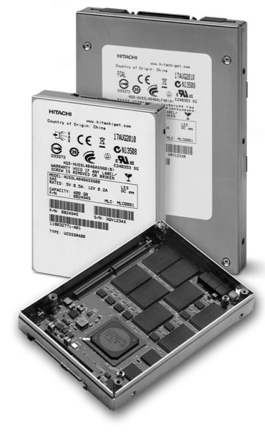
The new Ultrastar SSD400S family comes in 100GB, 200GB and 400GB capacities, featuring both 2.5-inch 6Gb/s Serial Attached SCSI (SAS) and 3.5-inch 4Gb/s Fibre Channel (FC) interfaces. As the world’s first jointly developed SAS and FC enterprise-class SSDs, the Ultrastar SSD400S family combines Hitachi’s enterprise hard disk drive (HDD) expertise with Intel Corp.‘s extensive capabilities in developing high-endurance 34-nanometer (nm), single-level cell (SLC) NAND flash memory and advanced SSD technology. This combination provides value to customers who are increasingly looking to tiered storage as a method of managing the escalating performance, capacity, endurance and reliability demands of today’s data centers.
"Hitachi’s strategic investment and commitment in the enterprise market is evident with the new Ultrastar SSD family. Our new SSD product family not only symbolizes our market opportunity to serve evolving cloud data center infrastructures, but also delivers value to our customers in terms of increasing data center performance and reducing total cost of ownership," said Mike Cordano, executive vice president of Worldwide Sales and Marketing, Hitachi GST. "We have a strong track record of working with global enterprise customers and are proud to report favorable responses to the Ultrastar SSD400S family. With qualifications now underway, we anticipate volume shipments to commence in the first half of 2011."
Hitachi GST and Intel Collaboration
Achieves Industry Milestone
to Deliver Enterprise-Class SSDs
With its legacy in hard drive innovation and years of experience in working with enterprise OEMs, Hitachi GST continues to make strides in storage and controller technology to deliver high-quality, reliable storage solutions. Intel’s focus and investment in NAND flash memory research and SSD development provides advancements in next-generation NAND lithography and offers high-endurance SSD technology. Together, Hitachi and Intel make a unique partnership, fueling next-generation ultra-performance data centers. Hitachi was the first enterprise storage company to pursue this partnership model in late 2008.
"Our vision of bringing high-performance, high-endurance NAND technology to the forefront of the enterprise market is reflected in Hitachi GST’s announcement today," said Tom Rampone, Intel vice president and general manager of the Intel NAND Solutions Group. "Hitachi, in collaboration with Intel, delivers a compelling solution that addresses the ultra-high performance needs of the enterprise, while increasing reliability and lowering the total cost of ownership for a broad range of tiered enterprise server and storage workloads."
Hitachi has the Right Formula
Proven Performance, Reliability and Endurance
The enterprise SSD market is growing at an estimated 73 percent compound annual growth rate (CAGR) from 2009-2014. Social networks, mobile applications, web TV, online video services and new tablet-like devices – all operating in the cloud – are fueling the need for faster storage solutions and improvements in high throughput and I/O performance so data can be delivered to consumers with virtually no latency. Meanwhile, data centers are pushing the boundaries to make storage more efficient, from reducing floor space, power and cooling to leveraging next-generation technologies, like virtualization, deduplication and thin provisioning. All of this is causing a shift in how today’s IT managers are building tomorrow’s data centers.
Hitachi understands enterprise storage needs – from controllers, firmware, BIOS and operating systems (OS). With a global Systems Integration Technology Lab (SIT Lab), Hitachi works to ensure compatibility and ease of integration into new or existing tier 0 enterprise storage systems and designs. This makes it easier to bring products to market more quickly and cost-effectively. With this level of commitment, the Ultrastar SSD family has been and continues to be rigorously tested in dozens of OEM system platforms across nearly a hundred configurations resulting in millions of drive hours under test.
Working in collaboration with Intel, the Ultrastar SSD400S family combines enterprise-grade NAND flash, proprietary endurance firmware and power loss management techniques to extend the reliability, endurance and sustained performance of the new SSD family. The 400GB SSD can endure up to 35 petabytes (PB) of random writes over the life of the drive, which is the equivalent of writing 19.2TB/day for five years, ensuring greater utilization and reliability in the most demanding enterprise environments. For complete end-to-end data protection and reliability, the Ultrastar SSD400S family includes advanced data integrity and power loss management technologies that are tied with industry standards to ensure compatibility in multi-tiered SSD/HDD system designs.
The new Ultrastar SSD400S family delivers the industry’s highest sequential throughput. It is the first to reach up to 535MB/s read and 500MB/s write throughput with 6Gb/s SAS, and 390MB/s read and 340MB/s write throughput with 4Gb/s FC. The new drive also delivers up to 46,000 read and 13,000 sustained write IOPS, reaching speeds 100 times faster than traditional hard drives, resulting in rapid response times for real-time transaction processing access to ‘hot’ enterprise data for improved productivity and operational efficiency. As fewer SSDs are required to achieve the same HDD ultra-high performance, the new Ultrastar SSD400S family offers significant value in terms of IOPS per Watt, while reducing TCO through low power consumption, efficient cooling and reduced space requirements.
HDDs and SSDs are ‘Better Together’
Hitachi GST leads the industry with the broadest HDD and SSD storage family for tiered storage needs in the enterprise. Hitachi’s full line of HDDs and SSDs support the entire enterprise ecosystem where HDDs and SSDs have to integrate seamlessly, side by side in tiered storage environments. Customers can now benefit from one trusted vendor supplying both enterprise-class HDDs and SSDs.
"Extending our relationship with Hitachi GST for enterprise-class SSDs in our SBB storage arrays and storage application platforms was the preferred option for us," said Ahmed Shihab, vice president of Strategic Planning at Xyratex. "Because of our experience working with Hitachi GST, we are confident that the new enterprise-class SSDs will deliver the excellent reliability, high availability, maximum endurance and sustained performance that our enterprise storage customers demand."
"Flash-based storage has the potential to impact data centers in very positive ways, but cost and reliability concerns persist for enterprise IT managers seeking to leverage SSD technology," said Jeff Janukowicz, research manager for Solid State Drives at IDC. "SSD solutions, such as Hitachi GST’s Ultrastar SSDs, can help address these concerns by delivering high reliability, efficiency and predictable performance – all which will help fuel mainstream enterprise adoption of flash storage over the next few years."
"Hitachi’s new SSDs sport an abundance of specification superlatives; yet this technical prowess is paired with a strong existing enterprise market-share, and a proven reputation derived from serving virtually every top tier global OEM," said Mark Peters, senior analyst, Enterprise Strategy Group. "This combination of ability and reach means HGST is well positioned in the enterprise storage space. It is a market where, despite ever increasing demand, the likelihood is that only vendors that can offer extensive product portfolios – such as Hitachi – are likely to prosper over the long-term."
Ultrastar SSD400S Availability
Hitachi GST has already shipped and is currently qualifying its Ultrastar SSD400S drives with select OEMs. Broader qualification samples are now available with product ramp scheduled in 2011. The Ultrastar SSD400S family is backed by a five-year limited warranty, or the maximum petabytes written (based on capacity).
Comments
HGST said to be the "first hard drive supplier to deliver enterprise-class SAS and FC solid-state drives." It's true. All the other ones only offer SATA drives: Samsung (Enterprise SSDs), Seagate (Pulsar), Toshiba (HG3), WD (SiliconEdge Blue and SiliconDrive N1x). Among the HDD makers, only Toshiba has revealed a SAS unit, the THNS064GF8BEAA.
"The new Ultrastar SSD400S family delivers the industry's highest sequential throughput." Up to 535MB/s read and 500MB/s write throughput on 6Gb SAS drive is remarkable and with exceptional endurance. On its side, Stec reached 550MB/s in read on its 6Gb SAS ZeusIOPS, Pliant is not far with 525 MB/s on its SAS model. The only others models with better transfer rates are based on PCIe card that seems the best choice for performance. The most recent ioDrive Octal from Fusio-io achieves one million IO/s and 6.2GB/s of bandwidth. HGST is here at up to 46,000 read and 13,000 sustained write IO/s. SAS and FC are too slow to support the speed of latest SSDs and OCZ was even obliged to propose a new proprietary interface called High-Speed Data Link (HSDL) at 20GB/s to accelerate the performances of solid-state storage.
These new SSD400S are the result of a joint development agreement between Intel and HGST revealed in February 2008 but they will be exclusively branded, marketed and sold by HGST. For sure, the flash chips come from Intel but what is not clear is the real designer of the controller - not the interface -, a key element for SDDs.
The Japanese company is late in this field. Initial announcement stated that its SSDs would be available in early 2010 and then in the second half of 2010. Now HGST speaks about the first half of next year for volume production.
SSD400S units integrate SLC flash chips only. In a white paper, HGST explains that it could also uses MLC in the future:" We see applications for both SLC- and MLC-based enterprise SSDs going forward. SLC will be used for write intensive applications; MLC will be used primarily for read intensive applications. We anticipate that by the second half of next year, MLC technology will be matured to meet our stringent quality standards. At this point, we cannot comment on specific product details or time lines."
Inside the HGST company, there is G-Technology, a Fabrik company manufacturer of storage solutions for the Apple Mac community. It already launched a family of external drives based on 2.5-inch SSD technology, the G-Drive mini SSD (120GB and 250B) and the RAID 0/1 G-RAID mini SSD (250GB and 500GB). But there is technically no relation with the SSD400S.
Apparently the HDD makers are in the best position to sell SSDs because they have long term relationships with all the OEMs in storage. But today the revenues of Seagate and WD are so low in flash that they are not published in their quarterly revenues. Samsung and Toshiba, in both products, are the exception, but they are manufacturing flash chips, the most expansive components of SSDs.
The real winners today in enterprise units are companies like Bitmicro Networks, Fusio-io, OCZ, Pliant, Smart Modular Technologies, Super Talent and mainly Stec, not at all involved in HDDs. It's always difficult to sell products directly in competition with those being in your core business. That's the same problems that encounter firms like Overland or Quantum to move from tape to disk subsystems even if they try to explain that the two media were complementary and not competing. That the same here where HGST considers SSDs as tier 0 and HDDs as tier 1. OK, but each time the company will sell an SSD, it will not sell an enterprise HDD...
HDD makers like HGST, but also Seagate and WD, manufacture the main components (platters, heads) of their enterprise magnetic disk drives and then got better margins in percentage selling these units rather than SSDs, even if these latter are much more expansive.







 Subscribe to our free daily newsletter