

Exclusive Interview with Sanjay Poonen, President and CEO, Cohesity
Confirming its leadership position in the fast evolving Modern Data Protection landscape
By Philippe Nicolas | November 12, 2026 at 2:01 pm Sanjay Poonen is President and CEO of Cohesity, since 2022. Before he was COO and EVP/GM of the end-user computing entity at VMware, president of SAP, VP of operations at Veritas Software then Symantec, and previously worked at Informatica and AlphaBlox. He began his career as a software engineer at Microsoft and Apple. He’s currently also board member at Philips and Snyk. He holds three patents, an MBA from Harvard Business School, a master’s degree in Management Science and Engineering from Stanford University, and a bachelor’s degree in Computer Science, Math, and Engineering from Dartmouth College.
StorageNewsletter: Sanjay, we met again recently during the 70th edition of The IT Press Tour at your HQ in Santa Clara, and it was once again a very interesting interactive session. Following this, I wished to ask you a few questions about Cohesity, the business strategy in a very active market, some solutions details and adoption and touch some perspective. But first, now that Veritas is fully integrated, could you share some key figures on where Cohesity stands today?
Sanjay Poonen: We serve more than 12,000 customers and operate in more than 140 countries. We manage more than 200 exabytes of data and have an ecosystem of over 3,000 partners globally. Cohesity Data Cloud is trusted by two-thirds of the Global 500. As we stated in December 2024, Cohesity was also the fastest data protection company to cross $1.5 billion in revenue, reaching that milestone in 11 years.
The combination has formed the global leader in AI and Data Security, with more than 15 years of consecutive leadership in the Gartner Magic Quadrant across both organisations. This gives us the reach to execute and the engineering innovation resources to support more multinational enterprise and national public sector organizations than any of our competitors, strengthening their overall cyber resilience posture and improving insight and access to their protected data. All of these make their AI implementations even more effective and resilient.
Put simply, the significance of Veritas integration lies in our global scale, which delivers market-leading business assurance, threat detection, and recovery for all our customers.
Are rising memory and flash prices affecting your business? And what changes are you seeing in customer projects as a result?
We’re seeing the same pressures on memory and flash as others in the market. Customers are looking closely at what their infrastructure costs to buy and run, and how much they can get out of their storage, power, cooling, and rack space as data volumes and AI workloads grow.
Those pressures aren’t causing customers to pull back on resilience projects. They still have more data to protect and need to recover quickly from cyber incidents. But they’re asking more questions about the architecture: how much infrastructure they need and whether they’re making full use of it.
We’ve been investing heavily in that area, improving density and performance so customers can protect more data with less space and power.
The market has moved quickly, from SaaS to cyberthreats and now AI. Has that changed Cohesity’s mission?
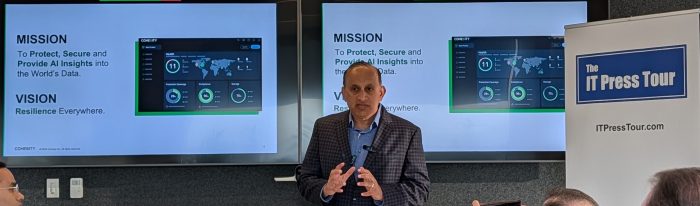
Our mission has always been to protect, secure, and provide insights into the world’s data. In today’s global environment of accelerating AI capabilities, with the offensive and defensive impact this has on cyber threats, that mission has only become even more relevant to our customers. We deliver comprehensive business resilience with complete coverage for all workloads and the broadest coverage in the industry across private cloud, public cloud, and SaaS applications.
We also continue to advance the technology that enables customers to derive insights from their secured backup data using AI. Ultimately, AI increases both the value of data and the speed at which risk propagates, and we provide Enterprises the resilience they need at machine speed.
What does that mean for NetBackup and DataProtect going forward?
We continue to invest in engineering and in expanding our global customer success organisation to keep all our DataProtect and NetBackup customers secure and fully supported. We are also committed to enabling our customers to evolve their data security posture at a pace that works for them, so we have put the NetBackup data mover on top of our platform, allowing customers to run NetBackup and write data to the Cohesity Data Cloud with equal simplicity as DataProtect users.
With Helios, our common management interface, either data mover – NetBackup or DataProtect – can be used as a migration utility to help customers choose a solution that is best matched to their business requirements, whenever they need to. This provides a practical path for customers to leverage our modern platform while managing their existing data and operational requirements.
How are you using AI inside Cohesity, especially in product development?
We’re using AI coding tools to accelerate engineering, so our engineers can focus on higher-level design and refinement. That matters because the opportunity is to put more useful innovation into customers’ hands and respond faster to their needs. One example is building protection for new AI infrastructure, such as vector databases. We were able to build the Pinecone backup and recovery solution really fast using AI coding techniques. It also enables us to ensure the delivery of more releases per year for both our on-premises portfolio, as well as our cloud and SaaS roadmap. We are increasing the innovation and relevance of these updates, with even greater alignment with our customers’ exact feature requests so that we can respond more quickly. We’re also using advanced AI to strengthen our own platform.
Cohesity supports both closed and open frontier models in our cyber defense work. We’re the only vendor in our space that’s part of five initiatives that address the risks of AI adoption: Anthropic’s Project Glasswing, OpenAI’s Daybreak, Google Gemini for Cyber, the Open Secure AI Alliance, and the Open Weights and American AI Leadership initiative. None of our competitors can say the same. These efforts help our customers ensure that AI resilience spans agents, identity, and data. Through our membership in all of these initiatives, our engineers develop capabilities faster and helping us continuously and proactively examine the security of the platform our customers trust to keep their core business systems fully operational.
AI clearly brings real value, but it also exposes corporate data. How does Cohesity help customers protect their data and keep control as AI agents multiply?
There are two resilience gaps to close: protecting the agent infrastructure itself and protecting the data and systems agents access. Agent Resilience protects agent memory and configuration using proven Cohesity capabilities, including snapshots, immutable backup, and clean-room recovery. It also protects databases, file systems, and other services agents interact with. The customer outcome is the ability to restore quickly to a known-good state after data corruption, misconfiguration, or data poisoning.
Control also depends on data that is discoverable, correctly indexed, enriched with business context, governed, and protected. Cohesity Maestro (launched earlier this year) makes Cohesity Data Cloud operable from the AI tools customers already use, bringing security and recovery capabilities directly into their AI-driven workflows. Every Maestro request follows the same authentication, authorization and audit controls as direct platform access, so those interactions remain governed and traceable.
With SaaS, security and AI in mind, what are Cohesity’s new differentiators? Why do customers choose Cohesity today?
We describe our differentiation through five S’s: speed, scale, security, smarts, and simplicity. Speed and scale remain fundamental. Added to that are the depth of our security capabilities, the intelligence we bring through AI, and a simple, modern user experience. Together, those capabilities help customers protect increasingly complex environments and recover the operations their businesses depend on.
We support hybrid and multi-cloud environments, including sovereign environments. We bring together governance, observability, orchestration, and recovery, with granular point-in-time recovery across agents, data, and infrastructure. We also help customers activate governed enterprise data for AI innovation, extending the value of the data they already protect.
We’re making our protection and intelligence accessible from the AI tools customers already use. You shouldn’t have to come to us. We should come to you. That reflects how we think about our role: meeting customers where they work and making resilience part of their operating model.
Data sovereignty is a major topic, especially in Europe. How does your offering address it?
Data sovereignty is a critical issue, and we are dedicated to working with our local and global partners to help customers maintain control of their data and address their compliance requirements. This approach enables us to support on-premises, public cloud, and local service provider sovereignty requirements, giving our customers and partners flexibility in where and how they protect their data and operate their infrastructure.
This approach also extends to AI. Cohesity Gaia Self-Managed supports on-premises deployments, helping European enterprises maintain full control and sovereignty over sensitive data and the associated AI infrastructure. Customers can put their enterprise knowledge to work while retaining control of the environment in which they do so.
In France specifically, our agreement with AntemetA delivers a sovereign data security offering using private-cloud resources located entirely on French territory, both geographically and legally, without dependencies on SaaS or public-cloud services. The design keeps customer data in France, with infrastructure, administration, and support provided by teams based in France. It illustrates how we combine our data security and resilience capabilities with local operational expertise to address customers’ sovereignty needs. We have similar agreements with other partners in Europe and across the world and are dedicating significant resources to expanding these.
What are the main directions for the company and its products over the next 12 to 18 months?
Our direction addresses three connected challenges at the intersection of AI and cyber resilience, all grounded in our mission to protect, secure, and provide insights into the world’s data.
First, Agent Resilience protects the AI systems customers are deploying and the resources those agents affect. As AI becomes part of core business operations, those systems need the protection and recovery capabilities that enterprises expect for other critical infrastructure.
Second, Autonomous Cyber Resilience uses AI to help customers stay continuously prepared to recover. Customers define their minimum viable company – the critical systems and operations that must keep running – and hence their resilience objectives. The platform assesses the current posture, recommends improvements, and can implement approved changes. The goal is to help customers maintain a current, practiced recovery capability as their environments change.
Third, our Gaia Catalog helps make valuable enterprise data available to all the AI projects that our customers need. We already secure that data, so there is a clear opportunity to make it easier to curate, approve, and provide secure access to maximize business value. Across these areas, we’re extending automation and connecting our protection, response, and recovery capabilities to customers’ preferred AI tools.
The customer outcome we are working toward is stronger resilience alongside faster, governed use of enterprise data for AI.
And to conclude, I have to ask: when do you plan to go public?
An IPO is a milestone; it’s not the final destination. First and foremost, we’re focused on building an incredible company and an iconic brand. We are the leader in AI and Data Security. We’re on a mission to protect, secure, and provide insights into the world’s data. Our innovation engine is second-to-none.
That mission and the value we deliver to customers continue to guide our priorities. We’ve been clear that an IPO is one option that we’re evaluating. But again, the more important point is that we’re focused on building an incredible company for the era of AI data security.
Comments
Cohesity has evolved rapidly in recent quarters through major strategic initiatives, strengthening and consolidating its market leadership, particularly following the Veritas transaction. With a comprehensive portfolio supporting on-premises, cloud, hybrid, and SaaS workloads, the company has also established strong foundations in cybersecurity and AI, two critical areas that present both significant threats and substantial business opportunities. Click the image below to access the full presentation.




 Subscribe to our free daily newsletter