



WD: Fiscal 1Q27 Financial Results
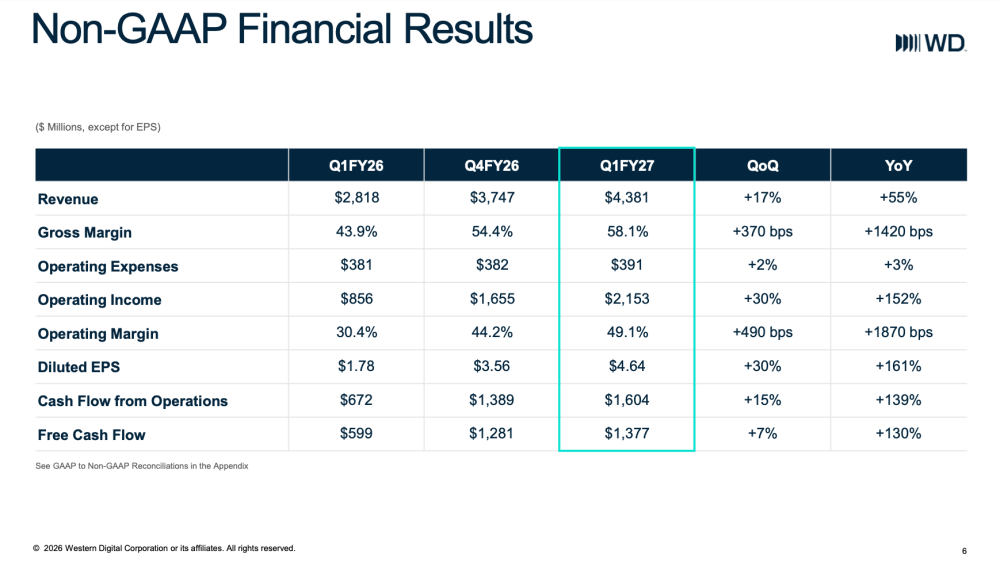
Generating $4.38 billion, up 17% QoQ and up 55% YoY
This is a Press Release edited by StorageNewsletter.com on October 27, 2026 at 2:01 pmSummary:
- Revenue of $4.38 billion, up 55% YoY
- GAAP gross margin of 57.8%; non-GAAP gross margin of 58.1%
- GAAP diluted EPS of $4.63; non-GAAP diluted EPS of $4.64
- Cash flow from operations of $1.60 billion; free cash flow of $1.38 billion
- Q2FY27 revenue expected to be up 66% to 72% YoY
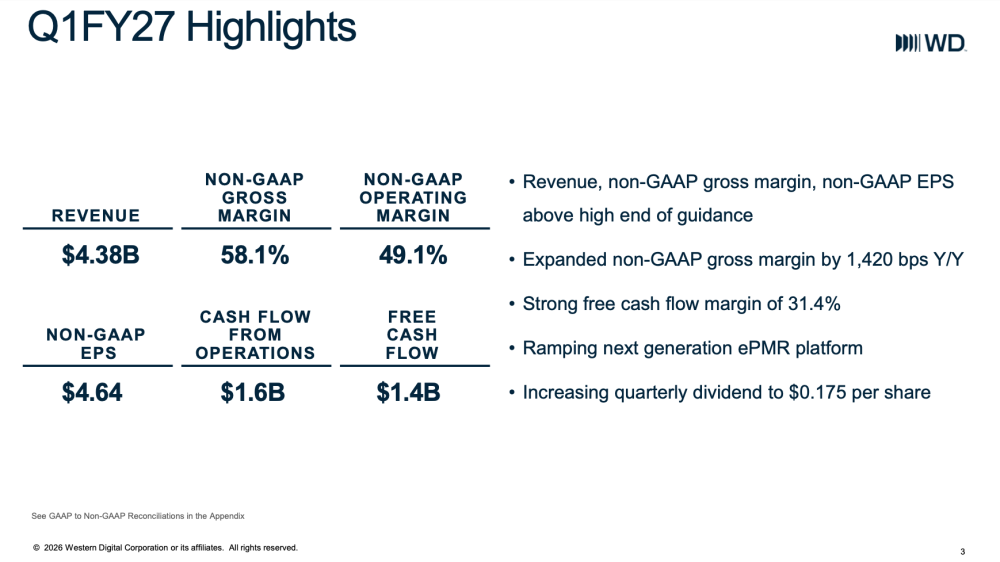
Western Digital Corp. reported fiscal first quarter 2027 financial results for the period ended October 2, 2026. “Fiscal 2027 is off to a strong start, with results exceeding expectations, driven by robust customer demand and disciplined execution. In our fiscal first quarter, revenue grew 55% year over year, non-GAAP gross and operating margins expanded to 58.1% and 49.1%, respectively, resulting in a 161% year-over-year increase in non-GAAP EPS. Reflecting our confidence in the business and our commitment to return capital to shareholders, we are raising our quarterly cash dividend by 17% to $0.175 per share,” said Irving Tan, CEO, WD. “We are executing well through our technology transitions to meet the growing demand for storage. As we deepen our customer relationships, broaden the customer base to new areas of the market, and extend our visibility into future demand, we are building an increasingly durable foundation for long-term value creation.”
Q1FY27 Financial Highlights
Click to enlarge
Click to enlarge
Business Outlook for Fiscal Second Quarter of 2027
“Our first quarter results demonstrate the continued momentum in our business, with robust exabyte growth and improved pricing driving another quarter of strong financial performance,” said Kris Sennesael, CFO, WD. “Looking ahead, for our fiscal second quarter of 2027, at the midpoint of the ranges, we expect revenue of $5.1 billion, non-GAAP gross margin of 60.5%, and non-GAAP EPS of $5.80.”
Dividend
WD’s Board of Directors declared a cash dividend of $0.175 per share of the company’s common stock, which will be paid on December 17, 2026 to stockholders of record as of the close of business on December 4, 2026.
Comments
WD has delivered another strong quarter, confirming that the HDD industry is experiencing a powerful resurgence driven by AI infrastructure, hyperscale cloud expansion, and unprecedented demand for high-capacity storage. The company's latest financial results demonstrate not only accelerating revenue growth but also remarkable improvements in profitability, cash generation, and operational efficiency.
WD reported revenue of $4.38B for 1Q27, representing 55% YoY growth, following an already impressive 4Q26, when revenue reached $3.75B, up 44%. The acceleration illustrates the strength of demand for nearline HDDs and the company's ability to translate this momentum into higher revenues and margins
Click to enlarge
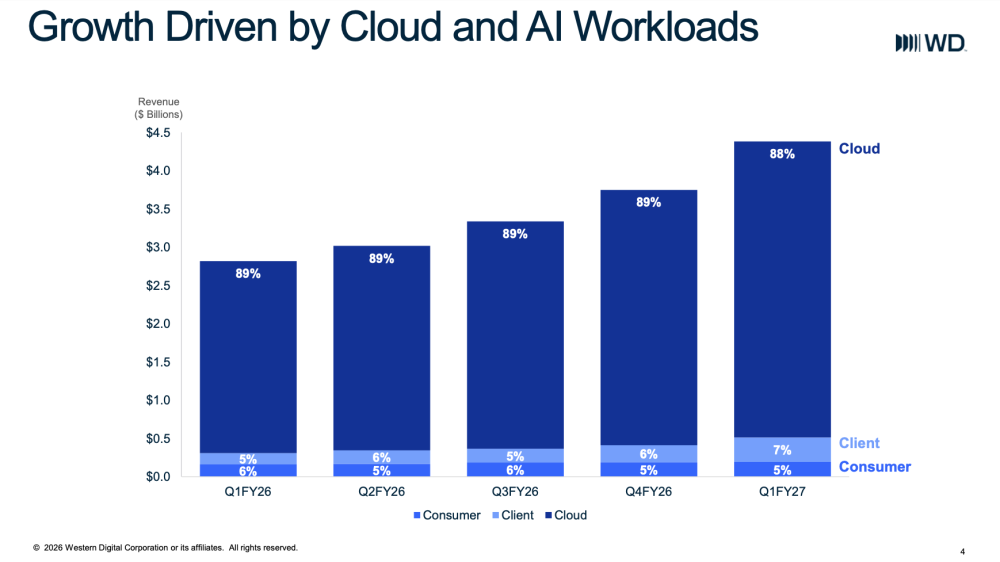
These figures highlight a fundamental transformation in WD's business model: the company is increasingly monetizing capacity, density, technology differentiation, and supply discipline rather than simply shipping more drives.
The transformation is largely driven by hyperscalers, which require enormous storage capacity for AI training datasets, inference-generated content, data lakes, backups, and long-term retention. WD's cloud business accounted for approximately 89% of FY2026 revenue, illustrating its increasing dependence on large infrastructure customers.
This also demonstrates why predictions of HDD obsolescence were premature but nobody really anticipated the crazy pricing trajectory and AI stellar demand. SSDs dominate performance-sensitive workloads, but HDDs remain economically attractive for massive-scale capacity storage. Higher-capacity drives, including UltraSMR products and future HAMR generations, reinforce this position.
WD's performance reflects a structural change in the HDD industry. Following the separation of Sandisk, WD has become a focused HDD supplier, competing primarily with Seagate and Toshiba in an increasingly concentrated market.
Three forces support this momentum: accelerating exabyte demand, disciplined manufacturing capacity, and technological advances that improve density and cost per terabyte. The combination creates an unusually favorable environment for HDD manufacturers.
Nevertheless, risks remain. Hyperscaler concentration exposes WD to changes in capital expenditure plans, while technology transitions, particularly HAMR, require flawless execution. Higher selling prices may also eventually encourage customers to optimize storage consumption.
The central question is whether today's exceptional profitability represents a sustainable industry reset or the peak of another storage cycle. For now, WD's revenue acceleration, expanding margins, and forward guidance strongly support the first scenario, although the durability of these conditions will ultimately depend on AI infrastructure investment and supply discipline.
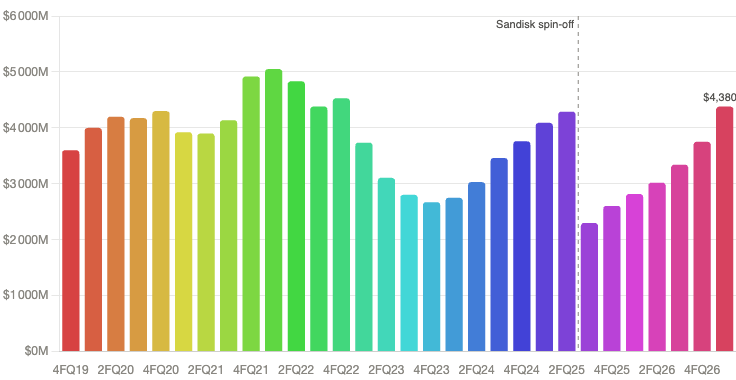
Below you can find the quarterly revenue trajectory since 4Q19 illustrating cycle, trends, pressure and AI boom.




 Subscribe to our free daily newsletter