




Nvidia GTC Berlin 2026: Google Cloud and Nvidia Announce General Availability of Nvidia Vera Rubin Infrastructure
Google Cloud A5X instances, accelerated by Nvidia Vera Rubin NVL72 systems, support European innovators with next-generation agentic and reinforcement learning infrastructure
By Philippe Nicolas | October 23, 2026 at 2:01 pmBlog written by Uttara Kumar, senior product marketing manager, Nvidia, published October 21, 2026
General availability of the Nvidia instances is coming next month, with planned expansion of availability to Europe — bringing an integrated platform for training, inference and large-scale reinforcement learning to cloud customers. A5X instances bring together Nvidia Vera Rubin NVL72, Nvidia ConnectX-9 SuperNICs, Google Cloud Virgo Network and Google Cloud’s fourth-generation advanced liquid-cooling technology for demanding agentic inference and reinforcement learning workloads at scale. Google Cloud plans to scale its Vera Rubin-based infrastructure to as many as 960,000 Rubin GPUs across multiple sites.
Ineffable Intelligence, a London-based technology company founded by AlphaGo creator David Silver, was the first customer to access A5X. Ineffable is using the platform to advance large-scale reinforcement learning and shape “superlearner” systems that learn continuously from experience.
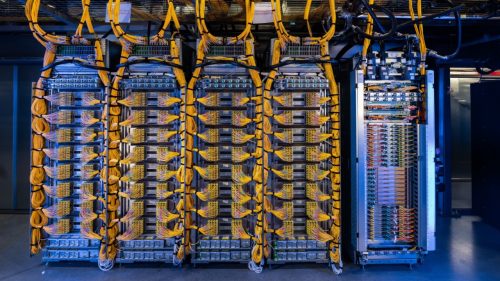
Learning through interaction requires a continuous cycle of generating experience, evaluating outcomes and updating models, requiring infrastructure that can support the entire process at scale. A5X brings Vera Rubin into Google Cloud’s AI Hypercomputer as an integrated system, combining compute, networking and storage to support experience-driven learning at scale.
“We’re building superlearners that continually improve through their own experience,” said David Silver, founder and CEO, Ineffable Intelligence. “That demands both substantial compute and a tight connection between generating experience and training on it, so each improvement in the agent can quickly shape its next experience. Vera Rubin’s combination of compute performance and high-bandwidth connectivity, between the Vera CPU and Rubin GPUs and between the Rubin GPUs within the rack, allow us to push the scale and ambition of our reinforcement learning research further.”
WPP, a London-based marketing and communications company, has also demonstrated its creative agent reference architecture on Nvidia Vera Rubin-based A5X instances using Nvidia Nemotron models and Nvidia OpenShell, part of the Nvidia OpenShell Reference Architecture for safe AI agents.
The agents turn conversational requests into multistep creative workflows, such as video generation, upscaling and restyling, with human approval before execution. OpenShell provides governed sandboxes for agent execution, helping control access to sensitive brand assets and creative tools. In WPP’s initial tests, workloads that typically required a multi-node cluster ran on a single A5X instance.
As organizations deploy agentic systems, they need to protect the proprietary models and sensitive data that power these systems — even when running on infrastructure they don’t own.
Google Cloud will be among the first cloud providers to offer Nvidia Confidential Computing at rack scale on bare metal instances such as A4X Max instances powered by Nvidia GB300 NVL72. Additionally, Google Cloud is making Confidential Computing generally available on G4 VMs powered by Nvidia RTX PRO 6000 Blackwell Server Edition GPUs, offering a flexible platform for confidential inference and fine-tuning. Customers including Vertebrae, Polaris Cloud and Confidential Core AI are using Confidential G4 for conversational privacy, verifiable agent execution and policy-governed enterprise intelligence.
To support energy-efficient deployment at scale, Google Cloud and Nvidia are exploring Nvidia DSX MaxLPS capabilities for Vera Rubin-based infrastructure to help optimize performance per watt and expand capacity within available data-center power budgets.
Comments
Google and Nvidia deepen AI infrastructure partnership with Vera Rubin.
The two technology giants expand their decade-long collaboration, combining next-generation GPUs, networking, storage and cloud services to accelerate AI factories.
Google and Nvidia have maintained a strategic partnership for more than a decade, evolving from GPU acceleration for cloud workloads into extensive co-engineering across AI infrastructure, networking, software and enterprise services. Their relationship illustrates how hyperscalers increasingly combine proprietary technologies with Nvidia's accelerated computing ecosystem to address the explosive demand for AI training and inference.
Google Cloud has progressively integrated Nvidia's GPU generations, including Hopper, Blackwell and now Vera Rubin, into its AI Hypercomputer architecture. Beyond hardware, the collaboration encompasses Nvidia CUDA, NeMo, Dynamo, confidential computing and Kubernetes-based orchestration. Google also integrates Nvidia technologies into its broader AI ecosystem, including Gemini and Google Distributed Cloud.
The latest announcement, made this week at the Nvidia GTC Berlin 2026, represents another significant milestone. Google Cloud introduced its A5X bare-metal instances powered by Nvidia Vera Rubin NVL72 rack-scale systems, targeting large-scale agentic inference and reinforcement learning. General availability is scheduled for November 2026, including expanded European deployment options.
The infrastructure combines Nvidia Rubin GPUs, Vera CPUs and ConnectX-9 SuperNICs with Google's Virgo networking architecture and fourth-generation liquid cooling. Google plans to scale deployments to 80,000 Rubin GPUs within one site and up to 960,000 GPUs across multiple locations. These figures represent architectural scaling targets rather than installed capacity.
Storage becomes another critical dimension. Google Cloud Managed Lustre will support Nvidia GPUDirect Storage, enabling direct data transfers between parallel storage and GPU memory while bypassing traditional CPU bottlenecks. Advanced KV-cache capabilities will extend context memory beyond GPU HBM, addressing increasingly demanding inference workloads and improving token-generation economics.
The partnership also extends into sovereign AI, confidential computing and open-model deployment, addressing growing enterprise requirements for data residency, security and infrastructure control.
From a market perspective, this collaboration highlights an interesting paradox. Google develops its own TPU accelerators and Gemini models, competing with Nvidia across several technology layers, while remaining a major Nvidia infrastructure customer and partner.
This dual strategy allows Google to optimize internal workloads with proprietary silicon while offering customers broader GPU choices. For Nvidia, Google represents both a substantial commercial opportunity and a strategic distribution channel.
Ultimately, the competition is shifting beyond accelerator performance toward complete AI factory economics, encompassing networking, storage, memory hierarchy, power efficiency and cost per generated token. The Google–Nvidia relationship demonstrates that cooperation and competition can coexist as AI infrastructure becomes increasingly heterogeneous.





 Subscribe to our free daily newsletter