









Xinnor Releases xiNAS v3 and Opens Technology Previews for AI-Assisted Management and pNFS
Expanding the operational side of our high-performance NFS over RDMA platform
This is a Press Release edited by StorageNewsletter.com on September 28, 2026 at 2:00 pmXinnor released xiNAS 3.13, the new production version of its high-performance NFS over RDMA storage platform, with unified management, automation and diagnostics for day-to-day operations. Separately, Xinnor opened two technology previews showing directions under development for future xiNAS releases: AI-assisted storage management through MCP in xiNAS 3.14, and a mechanism for exposing live xiNAS storage condition to pNFS coordination software in xiNAS 3.15.
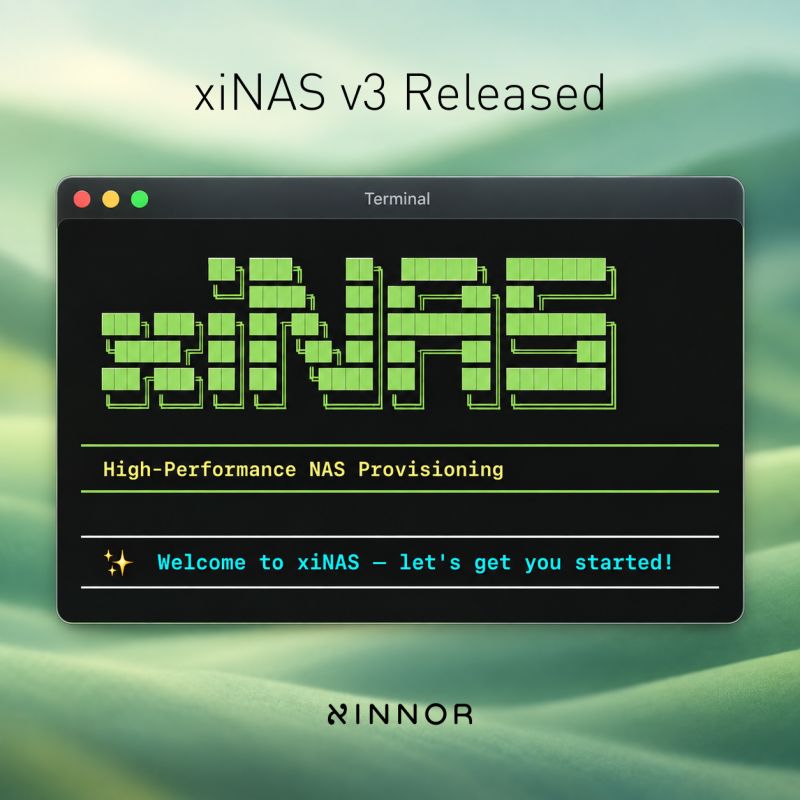
xiNAS 3.13 introduces a single control plane for storage provisioning, NFS configuration, health inspection and configuration history. Whether an operation comes from the terminal interface, CLI,REST API or MCP-client, xiNAS follows the same workflow: it builds a end-to-end plan for a particular task showing what will change, checks permissions, applies the approved operation and records it in the audit log.
Operations that can alter or destroy data require the appropriate role and explicit confirmation. This gives administrators a consistent way to manage RAID, filesystems, NFS and networking instead of working through separate management paths.
The xiNAS 3.14 technology preview extends this control plane to MCP-compatible AI assistants and automation tools. Administrators can use an AI client to inspect system health, investigate unavailable shares, review changes or prepare configuration operations.
The AI client does not receive shell access. Requests are mapped to defined xiNAS operations and remain subject to the same permissions, planning, confirmation and auditing rules used by other management interfaces. Diagnostic results also record which checks succeeded, failed, timed out or could not be performed, so missing information is not treated as evidence of a healthy system.
“AI can make storage administration much easier, but it should not bypass the controls that make infrastructure predictable and safe,” said Sergei Platonov, VP, strategy, Xinnor. “In the 3.14 preview, an assistant can inspect the system, explain what it finds and prepare an operation, while permissions, the execution plan and final confirmation remain under xiNAS control.”
The xiNAS 3.15 technology preview explores a separate problem in scale-out pNFS environments: how a coordination layer could take the actual condition of storage servers into account when placing new data.
In the preview, xiNAS publishes the condition of the RAID, filesystem and NFS layers behind each share. A connector can make this information available to pNFS Lattice, an open-source metadata and coordination layer for pNFS. This creates a basis for evaluating placement policies that could avoid servers that are rebuilding, degraded or unavailable.
The 3.15 work is an early technology preview intended for technical evaluation and development; it is not part of the current production xiNAS feature set.
xiNAS was introduced earlier this year on Supermicro storage servers with AMD EPYC processors and PCIe Gen5 NVMe drives. A single 12-drive system demonstrated up to 74.5GB/s read and 39.5GB/s write, while two servers reached 117GB/s read and 79.6GB/s write.
xiNAS 3.13 is available as the current stable release. Source branches for xiNAS 3.14 and 3.15 are available separately for technical evaluation. Sergei Platonov will discuss the architecture and safety model behind the MCP preview at SNIA Developer Conference 2026 on September 30.








 Subscribe to our free daily newsletter