







Data Centers Set to Drive a $1.5 Trillion Semiconductor Market by 2031
From chip to rack: how AI is rewriting data centers
This is a Press Release edited by StorageNewsletter.com on September 18, 2026 at 2:01 pmSummary:
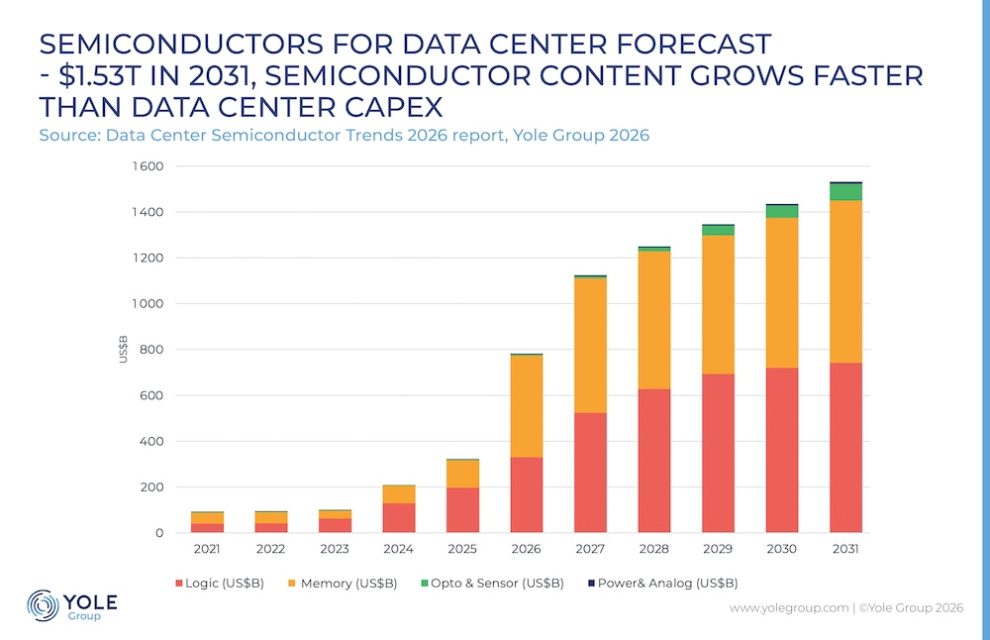
- The data center semiconductor market more than doubled in 2026 and is set to reach more than $1.5 trillion by 2031
- From chip to full rack, value is shifting: hyperscalers and AI labs both buy merchant GPUs and co-design their own AI ASICs
- Leadership: Nvidia now captures about 16% of all semiconductor revenue
- Technology status: advanced packaging, HBM4, co-packaged optics, and power (1MW racks, 800 V, liquid cooling) set the direction
Every leap in AI now rests on a physical bill: the chips, memory, interconnects, and power packed inside the data center. Against this backdrop, Yole Group releases its latest report, data center semiconductor trends 2026, offering a comprehensive analysis of the semiconductor market, ecosystem, supply chain, and technologies shaping the data center semiconductor landscape.
An acceleration that keeps outpacing the industry
AI has become the semiconductor industry’s single growth engine, and it is compounding faster than any prior cycle. Each Yole Group edition since 2024 has captured a further step change in demand, with the market set to roughly double in 2026 alone. Yole Group’s analysts now size it at $1.5 trillion by 2031, the point at which semiconductor value starts growing faster than the data center capex that drives it, itself heading toward roughly $1.8 trillion by the end of the decade.
“AI has turned the data center into a full-system problem. Performance is now sold by the rack, not the chip, and the winners will be decided by how memory, advanced packaging, optics, and power come together,” said Eric Mounier, chief analyst, Yole Group.
Four segments redrawing the map
Yole Group’s new edition tracks how the semiconductor content of an AI data center is shifting, segment by segment:
- Logic is still the largest slice of the market. GPUs dominate today, but the custom AI ASICs that hyperscalers co-design are the fastest-growing challenge to that lead
- Memory is the swing factor of 2026: surging HBM demand and a steep rise in server DRAM prices have made it the fastest-growing segment of all
- Optical is moving to the center of the design. As co-packaged optics reach the market in 2026, interconnect is becoming as critical to AI performance as compute itself
- Power is where a new layer of value is forming, as racks move to higher-voltage architectures to feed ever-denser AI systems
Click to enlarge
From chip to rack
Underpinning this is a shift from the chip to the rack. AI performance is now sold at the full-rack level, in systems such as Nvidia’s NVL576, AMD Helios, AWS NL72, and Google Ironwood, and the real bottleneck at scale has become advanced-packaging capacity, alongside a fast-moving HBM roadmap.
Concentration, regionalization, and a widening power gap
Concentration and regionalization are reshaping the supply chain. No single company covers the whole chain, though Nvidia has grown into a supply-chain powerhouse, capturing ~16% of all semiconductor revenue and locking in priority capacity at TSMC, SK hynix, and packaging partners. Regional paths diverge: Europe backs sovereignty with a €200 billion InvestAI plan, the United States is defined by Nvidia’s dominance, and China’s build-out stays gated by SMIC under US export controls.
But power is fast becoming the industry’s real ceiling. With AI racks approaching 1MW by decade’s end, higher-voltage delivery (800 V, SiC and GaN) and direct liquid cooling are becoming standard, and grid access is now as much a constraint as the chips themselves.
With AI a durable, long-term growth driver, the technology, supply chain, and competitive dynamics behind this market have never mattered more to chipmakers, memory and packaging suppliers, hyperscalers, ODMs, and investors. Data center semiconductor trends 2026 provides the market intelligence and technology insight to navigate it and spot the next opportunities.
Comments
AI is everywhere, reshaping virtually every segment of the IT industry and driving massive data center investments, particularly across the semiconductor market. AI has clearly emerged as the industry's dominant growth engine. Here are the key points:
- The market is compounding faster than any prior cycle, roughly doubling in 2026 alone, with Yole sizing it at $1.5T by 2031, the point where semiconductor value growth overtakes data center capex, itself heading toward roughly $1.8T by decade's end
- Four segments are redrawing the map:
- Logic remains largest (GPUs dominant, custom AI ASICs the fastest-growing challenger)
- Memory is 2026's swing factor thanks to surging HBM demand and rising server DRAM prices
- Optical is moving to the center as co-packaged optics reach market
- and Power is forming a new value layer as racks shift to higher-voltage architectures
- Value is shifting from chip to rack, with systems like Nvidia NVL576, AMD Helios, AWS NL72, and Google Ironwood, the real bottleneck now being advanced-packaging capacity and the HBM roadmap
- Nvidia has become a supply-chain powerhouse capturing roughly 16% of all semiconductor revenue, while Europe pursues sovereignty via a €200B InvestAI plan and China's build-out stays gated by SMIC under US export controls
- Power is emerging as the real ceiling, with AI racks approaching 1MW by decade's end and grid access becoming as constraining as chip supply
This $1.5T figure sits within a fast-escalating series of forecasts. Just a year earlier, Yole's 2025 edition put the data center semiconductor TAM at $209B in 2024 growing to $492B by 2030, the 2026 edition roughly triples that trajectory, reflecting how quickly hyperscaler capex and AI ASIC/HBM demand are being repriced. It also converges with other Trillion $ narratives: PwC projects $1.5T in fab investment between 2024 and 2030, and a SIA-Deloitte study estimates chip revenue from AI data centers could reach $1.2T by 2028. The common thread across all three: memory (HBM), advanced packaging, and now power delivery are displacing raw compute as the binding constraints.







 Subscribe to our free daily newsletter