








Recap FMS 2026
A new era with more than 4,000 attendees under Terrapinn umbrella
By Philippe Nicolas | August 25, 2026 at 2:01 pmA few months ago, Terrapinn acquired FMS, raising plenty of expectations for this year’s edition, and we were not disappointed. In just a few months, the event team managed to introduce several meaningful improvements and changes. The logo and overall visual identity were completely redesigned, giving FMS a welcome refresh, while the organizers wisely preserved what already worked well: the expo floor, of course, but above all the conference program, a particularly rich component that gives the event its unique flavor.
Organizers shared the latest attendance figures, with more than 4,000 participants across all profiles, exceeding the numbers recorded during recent editions. This is clearly a positive sign. The exhibitor list was also solid with classic or let’s say “usual suspects” even if some vendors preferred not to exhibit and instead secured private meeting rooms nearby. We noticed several absences from the show floor, although some of these companies still appeared on the conference agenda despite having no physical booth. Nvidia, for instance, was invited twice on the main stage without exhibiting. Other notable absences included Phison, Swissbit and Panmnesia, while newcomers such as Primemas appeared alongside returning names including ScaleFlux, Winbond and YMTC. We still wonder, however, why some vendors participate in the event when their businesses are relatively far removed from the component, memory or device level.
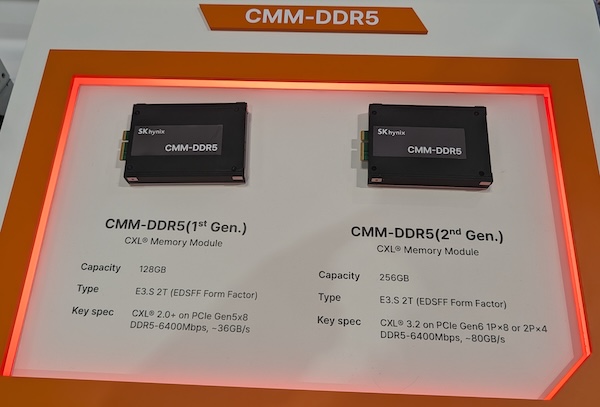
In terms of topics, there is no doubt that AI now drives almost everything in IT and, obviously, memory and storage are no exception. The now-famous “Memory Wall” was on everyone’s lips and featured prominently across virtually all keynotes. It is a very real challenge, pushing vendors to innovate and explore different approaches. It has triggered initiatives around KV cache, HBF through the Sandisk and SK hynix collaboration, new iterations of CXL that received significant attention, as well as more traditional subjects such as high-capacity SSDs, TLC and QLC NAND, and PCIe Gen 5 and Gen 6.
The Memory Wall also prompted several speakers, both during keynotes and breakout sessions, to revisit the concept of a new memory and storage hierarchy. As AI increasingly moves into the inference phase, the ability to preserve context, reduce token usage, improve QoS and ultimately lower TCO becomes essential.
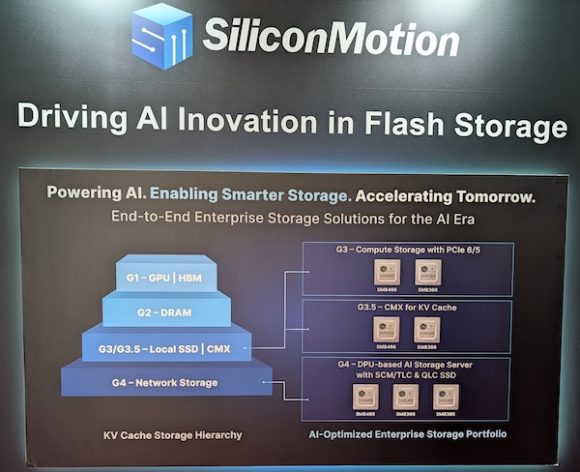
As we all know, AI training is primarily about compute, while AI inference is increasingly about memory. More concretely, we can group the five major themes of the conference as follows:
- AI inference and the emerging memory/storage hierarchy
- New NAND technologies, including BiCS10, V-NAND, XL-Flash and HBF
- Connectivity, particularly PCIe Gen 5 and Gen 6
- Memory pooling and sharing with CXL 3.2
- Energy consumption and cooling
Among the dense vendor presence, we selected several announcements that readers can explore in full on our dedicated FMS page:
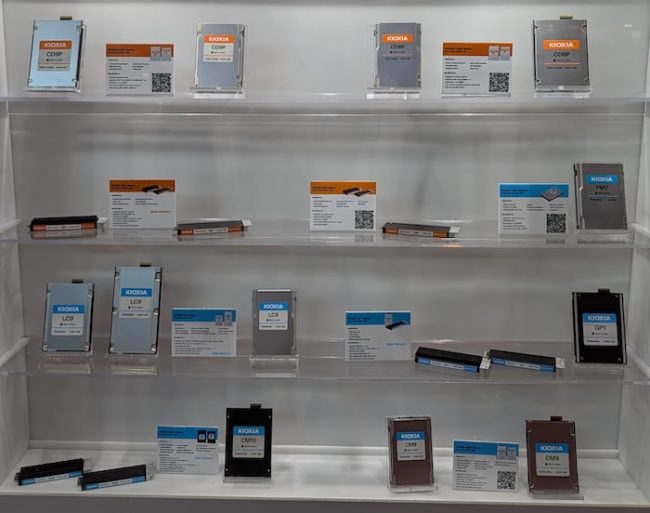
- Kioxia unveiled the CM10 Series, presented as the first PCIe Gen 6 enterprise SSD built on 332-layer BiCS FLASH Generation 10 TLC memory. The company also showcased its GP1 Series ultra-high-IOPS SSDs, XL1 Series with second-generation XL-FLASH, and next-generation E1.S SSDs
- Samsung unveiled its next-generation 3D Memory vision, outlining the future of AI infrastructure. It also displayed several new SSDs, including the 256TB BM1773 in E3.S and U.2 form factors, alongside the PM1763, its V-NAND V10 approach, HBM4 and CXL memory modules
- Micron also had a significant presence, with demonstrations involving partners including Astera Labs and Microchip
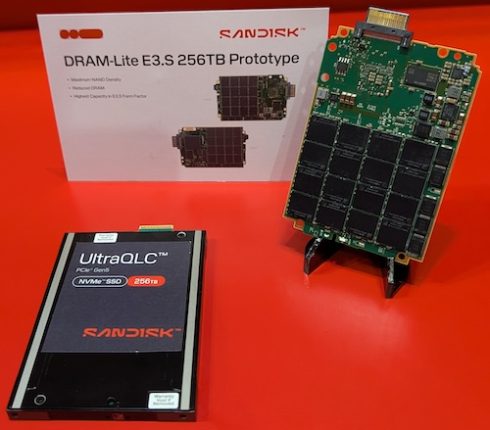
- Sandisk showcased HBF alongside BiCS10 NAND and an UltraQLC E3.S 256TB prototype
- Sandisk and SK hynix also released the first OCP Technical Specification for High Bandwidth Flash standardization
- SK hynix showcased several new and recently introduced products across HBM, NAND, SSDs and CXL memory
- Silicon Motion unveiled its MonTitan SSD Reference Design Kit for AI infrastructure and showcased next-generation storage solutions for agentic AI, alongside a joint automotive platform demonstration with MediaTek
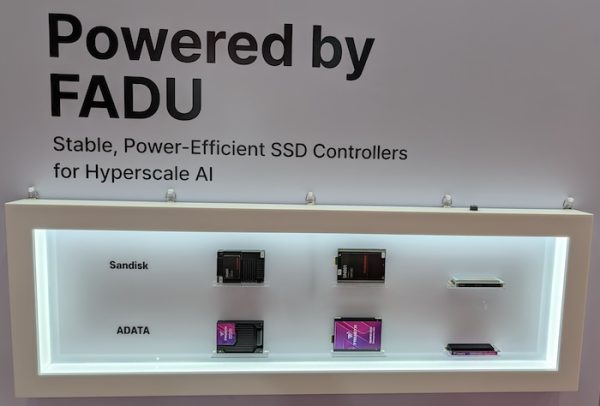
- FADU maintained a strong booth presence and demonstrated SSD controllers with several partners
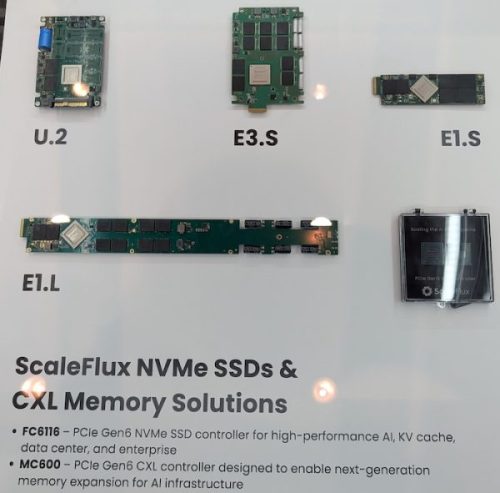
- ScaleFlux showcased PCIe Gen 6 SSDs and CXL memory controllers
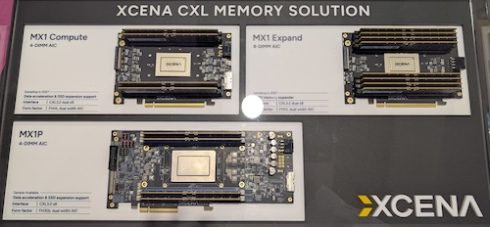
- Xcena displayed its MX1 product line
- TenaFe demonstrated PCIe Gen 5 SSD solutions targeting AI, Edge AI and DRAMless data center boot applications
- Intel hosted four companies on its booth, Montage, Micron, Xcena and Marvell, to demonstrate memory expansion technologies
- Innodisk introduced DDR5 12,800 MT/s MRDIMM modules
- Longsys discussed its Edge AI storage fusion strategy
- DapuStor presented its 512TB SSD
- NEO Semiconductor launched the NEO.AI Memory Platform
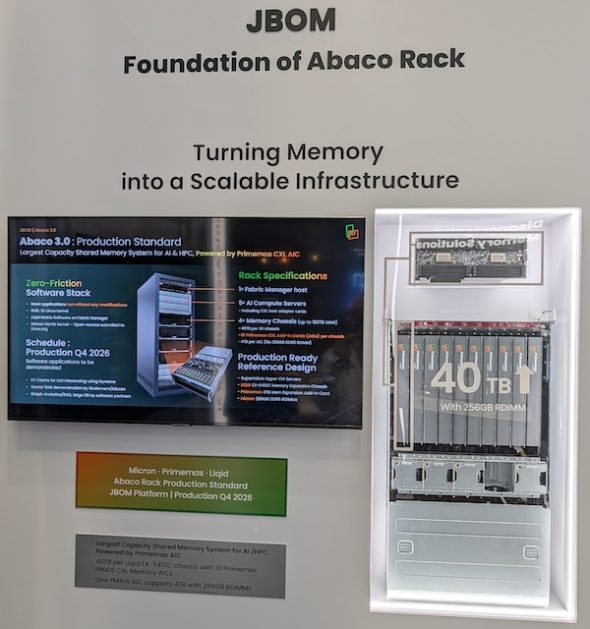
- Liqid, together with Micron and Primemas, displayed the Abaco 3.0 Rack on the Primemas booth
- Teledyne LeCroy announced that its Summit M616 protocol analyzer is now PCIe 7.0-ready
- OmniCore quietly launched its all-SSD NAS
- Xsight Labs announced a new funding round of more than $300 million at a $2.8 billion valuation
Beyond hyperscalers, neoclouds, universities and research centers, we hope the event will attract a broader range of enterprise end users in the future, creating a more balanced attendee profile. This is one area where we would like to see further progress in upcoming editions.
We invite all our readers to visit our dedicated FMS page, where they can find this recap together with all the news and announcements made by sponsors, exhibitors, industry associations and partners during the event.
The 2027 edition of FMS will return to the same location, but earlier in the year, from July 27 to 29, 2027. And there is something new: the team has launched the European edition of FMS, scheduled for October 19–20, 2027 at RAI Amsterdam in the Netherlands.








 Subscribe to our free daily newsletter