



EU Launches AI Gigafactories Call to Boost Europe’s Computing Capacity and Unlock More than €30 Billion in Investment
Europe wants to become the first AI continent - European AI gigafactories will provide the necessary computing power to make this possible
This is a Press Release edited by StorageNewsletter.com on August 18, 2026 at 2:01 pmThe EU launched a call for tenders to establish up to seven AI Gigafactories across Europe, as part of its latest major push to accelerate Europe’s technological sovereignty and ambition of becoming the AI Continent. Led by industry and supported by up to €10 billion in EU and national funding, the initiative is expected to unlock at least €20 billion in private investment across the Union. It will expand Europe’s AI computing capacity and give start-ups, scale-ups, small and medium-sized enterprises, industry, academia and public authorities access to infrastructure for training, inference and fine-tuning advanced frontier AI models.
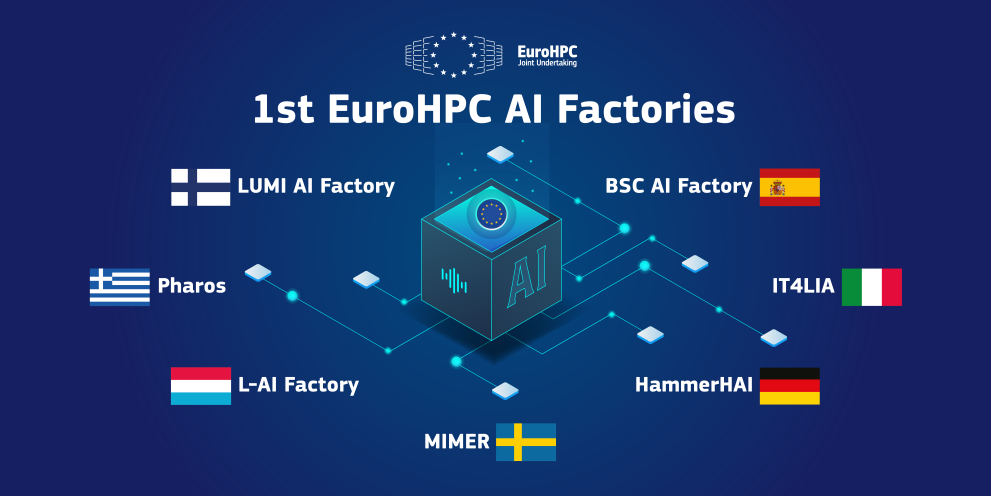
The AI Gigafactories will combine advanced AI processors, software and cloud technology stacks, high-speed connectivity and energy-efficient data centres. Together with Europe’s network of 19 AI Factories, they will strengthen Europe’s technological leadership, resilience and strategic autonomy.
The initiative will ensure that Europe can develop advanced AI on its own infrastructure, in line with EU rules and values. AI technologies developed in the AI Gigafactories will follow EU standards on data protection, safety, security and ethics.
Who can apply
Consortia or Special Purpose Vehicles bringing together companies, public entities, investors and other partners can apply.
The AI Gigafactories may be established in a single Member State, either on one site or across several locations. They may also include cross-border developments in several Member States through distributed AI computing facilities.
Proposals will undergo a competitive evaluation to select the successful projects.
Funding and scale
The European High Performance Computing Joint Undertaking (EuroHPC JU) and Member States will jointly procure compute access time from the selected AI Gigafactories. Eighteen Member States have signed a joint procurement agreement with the EuroHPC JU: Croatia, Czechia, Denmark, Estonia, Finland, France, Germany, Greece, Hungary, Ireland, Italy, Latvia, Lithuania, Poland, Portugal, Slovakia, Spain and Sweden. The procurement process will support up to seven AI Gigafactories across two consecutive development phases and two lots, with participating Member States matching EU funding. Public funding acts as a powerful catalyst for the initiative, driving the deep private investment required to construct and operate these facilities.
The first lot will support up to four projects, each eligible for up to €100 million in EU funding in phase one and up to an additional €400 million per project in phase two. Each Gigafactory selected in this lot must deploy at least as many of the most advanced AI processors as are currently installed in Europe’s most powerful AI factory. In phase two, capacity must increase to at least three times that level. The second lot will support up to three projects, each eligible for up to €200 million of EU funding in phase one and up to an additional €800 million per project in phase two. Each Gigafactory selected in this lot must deploy up to twice as many of the most advanced AI processors as are currently installed in Europe’s most powerful AI factory. In phase two, capacity must increase to at least four times that level.
Hardware for the AI Continent
Advanced AI depends on highly specialized computing hardware. As global AI adoption accelerates, access to large-scale sovereign AI infrastructure is becoming increasingly important for Europe’s industrial competitiveness and technological sovereignty
AI Gigafactories consortia may procure hardware during any of the two development phases of the AI Gigafactory from any hardware providers in Europe or likeminded countries. Part of this procurement may be dedicated to European start-ups and scale ups, with the AI Gigafactories providing concrete opportunities to strengthen the European digital supply chain. At the same time, and as a follow up of the EU-US trade deal, the Commission has signed three letters of intent with major US hardware providers, AMD, Nvidia and Qualcomm to ensure consortia have seamless access to necessary hardware.
Next steps
- The call closes on 12 November 2026
- Following an evaluation process managed by the EuroHPC JU, award decisions are expected by early 2027. The necessary framework and specific contracts will then be signed to allow construction to begin in 2027
- Selected AI Gigafactories are expected to begin operations within a maximum of 18 months from the signature
Comments
It's big and Europe wants a piece of the AI cake as it will also define the future of some regions, continents and countries.
On 30 July 2026, the EuroHPC Joint Undertaking launched a call for tenders to select the consortia that will build and operate up to seven AI Gigafactories (AIGF) across the EU. Proposals are due by 12 November 2026, with selection expected in early 2027. Selected facilities must begin operations within 18 months, putting real-world launch around mid-2028. At least seven Member States will host a site, with cross-border deployments also possible.
AIGFs are the next step beyond the 19 AI Factories already operational (plus 13 "AI Factory Antennas"), themselves one of five pillars of the AI Continent Action Plan (April 2025): computing infrastructure, high-quality data access, sectoral AI adoption, skills, and simplified AI Act implementation. The stated goal is a complete AI computing environment, AI-optimised supercomputers, advanced data centres, high-capacity storage, ultra-fast networks, secure cloud access, serving researchers, the public sector, and businesses, with particular focus on start-ups, scale-ups and SMEs.
Public funding from the EU and Member States, capped around €10 billion, is meant to act as an "anchor customer" to de-risk the project and unlock at least €20 billion in private investment, over €30 billion combined. Part of the funding comes from the current Multiannual Financial Framework (MFF), but the bulk depends on the next MFF (2028–2035), which exposes the timeline to multi-year budget uncertainty. Letters of intent have been signed with AMD, Nvidia and Qualcomm to secure access to AI accelerators.
The earlier informal expression-of-interest call drew 77 proposals across 16 Member States and 60 sitesm genuine industry engagement. But the project has visibly scaled back and slowed: originally ~€20bn for 4–5 sites under InvestAI (Feb 2025), now €10bn public funding for 7 sites as of mid-2026, with operations pushed to 2028. Outlets like Euronews have flagged the growing gap between the EU's "urgent sovereignty" rhetoric and its actual pace versus the US and China.
The emphasis on a resilient supply chain (European + like-minded-country suppliers) and on catalysing domestic AI chip design, and eventually manufacturing, connects directly to storage-industry concerns: the AIGFs explicitly treat high-capacity storage as a core infrastructure layer, not an afterthought.
The model relies on complex public-private multinational consortia (SPVs), pretty common with Europe bureaucraty, governance split across two EU budget cycles, and continued dependence on non-European chip vendors (AMD, Nvidia, Qualcomm) for the initial phase, which tempers how much genuine "strategic autonomy" this buys in the near term, even if the long-term ambition (a full European value chain) is coherent.
It appears that the initiative is structurally sound and well integrated with the existing AI Factories ecosystem, but its success hinges on securing post-2028 funding and closing the gap between the EU's sovereignty rhetoric and its actual delivery pace.








 Subscribe to our free daily newsletter