








Intel: Fiscal 2Q26 Financial Results
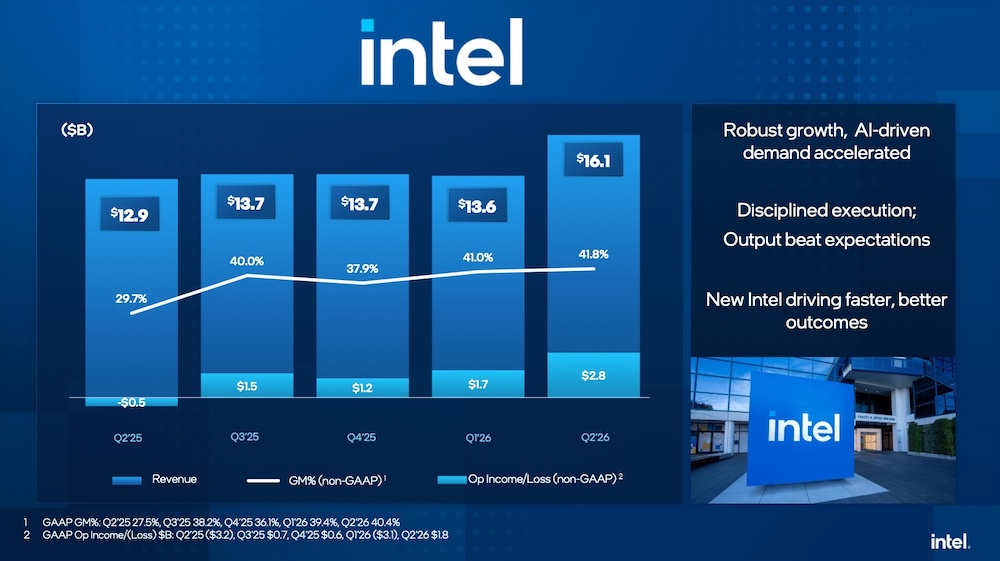
Generating $16.1 billion, up 18% QoQ and up 25% YoY
This is a Press Release edited by StorageNewsletter.com on August 13, 2026 at 2:01 pmSummary:
- Second-quarter revenue was $16.1 billion, up 25% YoY
- Second-quarter earnings (loss) per share (EPS) attributable to Intel was $(2.16); non-GAAP EPS attributable to Intel was $0.42
- Forecasting third-quarter 2026 revenue of $15.8 billion to $16.8 billion; expecting third-quarter EPS attributable to Intel of $0.31 and non-GAAP EPS attributable to Intel of $0.38
Intel Corp. reported second-quarter 2026 financial results.

“AI is driving unprecedented demand for compute, and as we continue to execute, Intel is well-positioned to capture sustainable growth across our CPU franchise, ASICs, advanced packaging and vast wafer foundry network,” said Lip-Bu Tan, Intel CEO. “Our Q2 results represent our strongest revenue growth in more than fifteen years, enabled by greater speed, accountability, and customer focus.”
“We delivered a strong second quarter, exceeding our financial guidance on robust demand and improved execution, including volume upside driven by higher factory yields and improved cycle times,” said Dave Zinsner, Intel CFO. “AI-driven compute continues to strengthen, and to support expected growth this year and next across products and foundry, we are meaningfully increasing our investments in equipment, clean room space, and substrates.”
Q2 2026 Financial Results
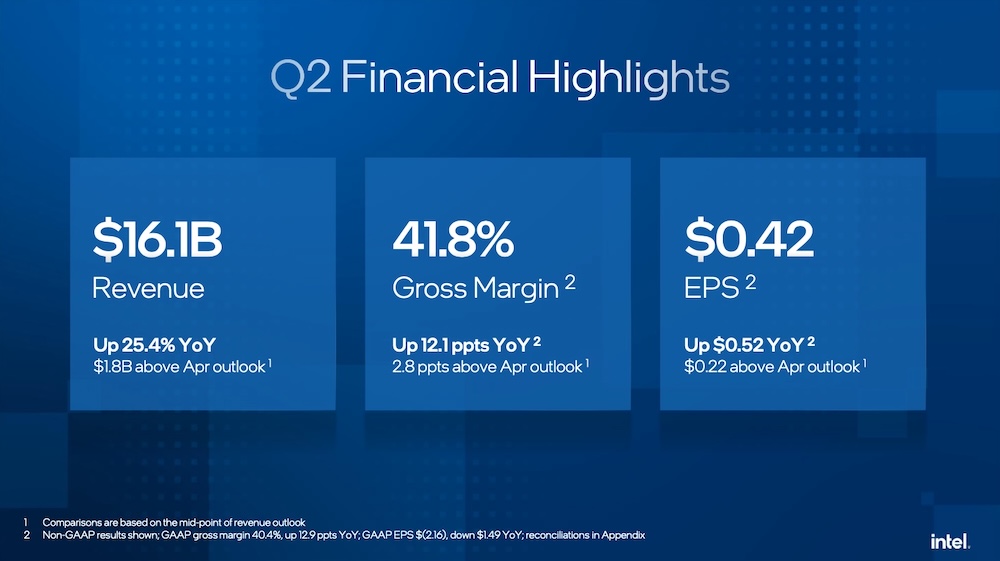
In the second quarter, the company generated $7.0 billion in cash from operations.
Business Unit Summary
The comparability of our Consolidated Condensed Financial Statements YoY was impacted by the deconsolidation of Altera. Altera, a business offering programmable semiconductors, primarily FPGAs, and related products for a broad range of applications that was previously a wholly owned subsidiary, was deconsolidated from our Consolidated Condensed Financial Statements effective September 12, 2025, following the closing of the sale of 51% of Altera’s issued and outstanding common stock. Altera’s financial results of operations were included in our Consolidated Condensed Financial Statements through September 11, 2025.
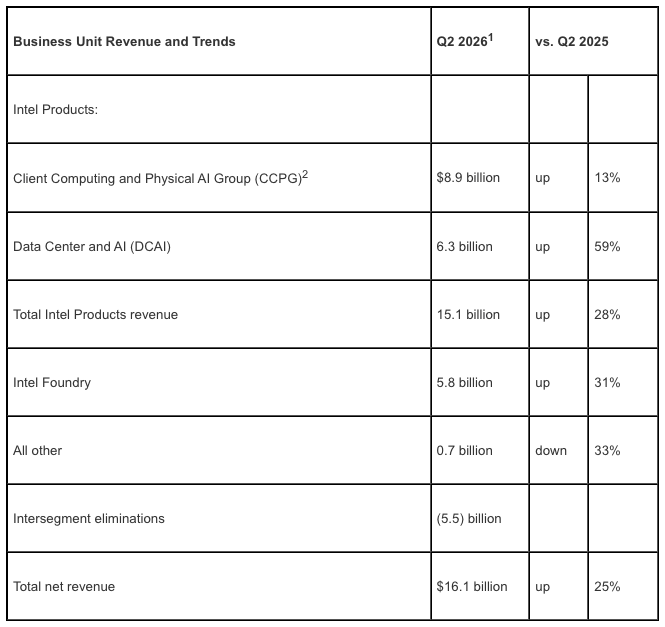
1 Operating segment revenues include inter segment transactions and are presented as actual and rounded; as a result, totals may not sum
2 Client Computing and Physical AI Group operating segment, formerly the Client Computing Group (CCG) operating segment
Business Highlights
- Product Momentum
- Intel advanced its agentic AI infrastructure strategy with new rack-scale AI infrastructure and disaggregated inference solutions built on Intel Xeon processors. Intel, SambaNova and Foxconn demonstrated production-ready rack-scale infrastructure for inference and agentic workloads, while Vector Core Compute (VC2) unveiled a disaggregated agentic cloud combining Intel® Xeon® processors, SambaNova RDUs and Nvidia Blackwell GPUs
- Intel launched next-generation data center CPU, Xeon 6+, Intel’s first server class product on Intel 18A for sustained performance under real-world power constraints
- Intel expanded its physical AI and robotics momentum, with more than 130 customers adopting or testing Intel Core Ultra Series 3 and Intel® Core Series 3 processors for edge AI and robotics applications. Intel also introduced OpenVINO Physical AI, an open-source framework designed to help developers deploy robotics models across vision, language, reasoning and motion-control workloads
- Intel introduced Intel® Arc G-Series processors, a new family of products designed for next-generation handheld gaming systems
- Intel announced strategic collaborations with Foxconn, Siemens, Hitachi, Echo Neurotechnologies and Greenstone Biosciences to co-develop industry-specific AI and compute solutions powered by Intel processors and purpose-built silicon
- Intel introduced Ethernet® E835 portfolio, scaling from 10GbE to 200GbE across cloud, AI, enterprise, edge and telco infrastructure, demonstrating its networking leadership
- Foundry Momentum
- Intel Foundry advanced the Intel 18A family as Intel 18A-P entered risk production, meeting the timeline shared with customers and partners last year while extending the platform with enhanced performance, power, and thermal resistance
- Intel Foundry has entered high-volume manufacturing for a subset of Intel Core Ultra Series 3 processors, code-named Panther Lake, using ASML’s EXE High NA EUV technology
- Intel expanded its purpose-built silicon business beyond networking and IPUs through a strategic collaboration with Fortinet to develop Fortinet Security Processor 6 using Intel’s advanced design, packaging and manufacturing capabilities
- Intel announced a €5 billion investment to expand manufacturing capacity and increase production of Intel® Xeon® 6 and next-generation Intel® Xeon® processors built on Intel 3
- Intel expanded Bowers campus capacity, increasing Intel mask operations capability to support current and future leading-edge process technology development and manufacturing
- Culture & Leadership
- Intel strengthened its leadership team with the appointments of Alex Katouzian to lead the client computing and physical AI group, Pushkar Ranade as chief technology officer, Seok-Hee Lee to lead advanced packaging, and Aparna Bawa to lead Intel’s global legal, ethics, compliance, people, and culture organization. These appointments further align Intel’s product, technology, manufacturing, and culture organizations with the company’s innovation and execution priorities
- Intel and Google Cloud expanded their multi-year strategic collaboration to scale AI capabilities across Intel’s workforce and strengthen existing workflows as part of Intel’s AI-powered transformation
Comments
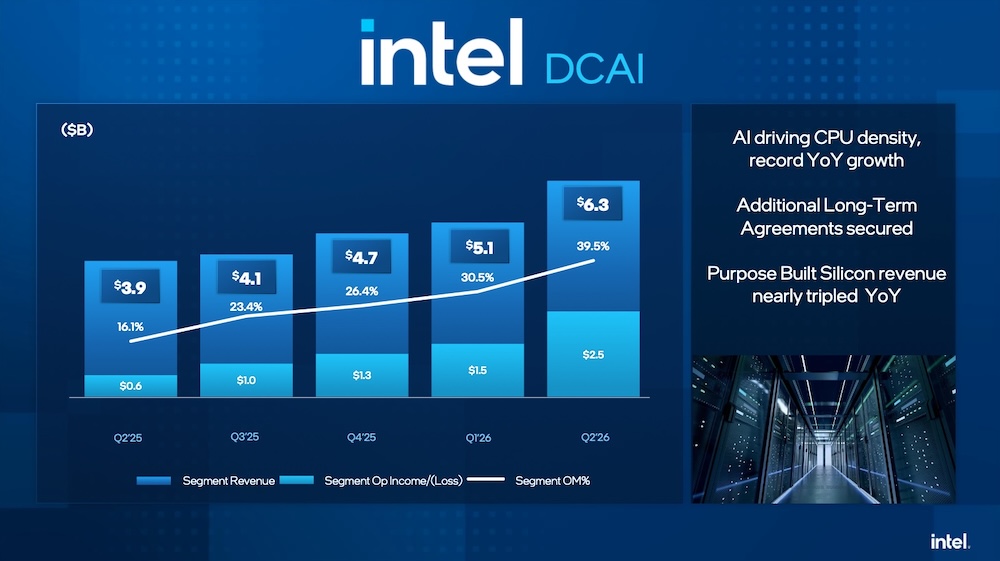
Intel posted $16.1B revenue in Q2 2026, up 25% YoY, its strongest growth in over 15 years and Data Center and AI (DCAI) revenue surged 59% to $6.3B, and Client Computing/Physical AI grew 13% to $8.9B. Foundry revenue rose 31% to $5.8B but still posted a $2.1B operating loss. GAAP net loss was a stunning $11B, driven almost entirely by a non-cash $12.5B mark-to-market charge on the escrowed shares tied to the US government's Chips Act equity stake.
Two days after the quarter closed, Intel priced an upsized $20B common stock offering (from $15B) at $95/share, ~210.5 million shares, ~$19.7B net proceeds, for "general corporate purposes," explicitly capex and working capital.
Intel's operational turnaround with Foundry ramping 18A/18A-P, Panther Lake in high-volume manufacturing on ASML High-NA EUV, Xeon 6+ launches, DCAI's inference/agentic-AI push with SambaNova, Foxconn and even NVIDIA Blackwell GPUs in hybrid racks is real and reflected in margins and topline growth. But the capital intensity behind it is enormous: a €5B European fab expansion, "meaningfully increasing" spend on equipment, cleanrooms and substrates, and a balance sheet still absorbing dilution from the government's warrant/equity structure (5.1B diluted shares now vs 4.4B a year ago, before this new raise adds another ~210M+). The $20B raise, layered on the government's Chips equity, SoftBank/Nvidia-adjacent investments, and partner contributions from the Q2 cash flow statement, confirms Intel is financing an AI-era foundry buildout that cannot be self-funded from operations alone, adjusted free cash flow was still negative $8.4B in the quarter. The company had some difficulties to anticipate the arpid grawth and demand around AI.
For the storage and data-center ecosystem this matters on two fronts. First, DCAI's 59% growth and the rack-scale, disaggregated-inference architecture Intel is co-developing (Xeon + RDU/GPU combinations, including Nvidia silicon) shows the CPU is being repositioned as inference/agentic-AI infrastructure rather than pure compute, a direct response to Nvidia's platform dominance and to AMD's own EPYC/MI-series gains in the same space. Second, Intel explicitly cites "industry-wide substrate and memory shortages" as a risk factor being a signal worth tracking for storage vendors, since HBM/DRAM tightness driven by AI accelerator demand (Nvidia, AMD, and now Intel's own ASIC ambitions) is squeezing the same substrate and packaging supply chain Intel depends on for 18A and advanced packaging.
It appears that Intel isn't trying to out-GPU Nvidia or out-accelerate AMD, it's betting that CPU + foundry + advanced packaging + government-backed capital gives it a structurally different moat (sovereign/domestic manufacturing, rack-scale system integration) rather than a head-on AI-silicon fight. Whether $20B of fresh equity dilution buys enough runway before 14A and Foundry profitability arrive remains the open question for investors and, by extension, for the storage/infrastructure supply chain watching Intel's capex signals. We'll see but just a few hours after Nvidia unveiled its $500B initiative, this appears to be... how to say...







 Subscribe to our free daily newsletter