








Exclusive Interview with Bill Andrews, CEO, ExaGrid
Confirming its leadership position in secondary storage dedicated to backup
By Philippe Nicolas | July 15, 2026 at 2:01 pm Bill Andrews is president and CEO of ExaGrid, based in Marlborough, MA, a company he led since 2005 being one of the longest CEO tenure in our storage industry. Before he had several executives positions at Pedestal Software, Edial, Adero, StarBurst, LiveVault, Microcom, Bitstream or Data General. He received a BS in industrial technology from Fitchburg State University.
StorageNewsletter: Bill, it’s a pleasure to speak with you just a few weeks after another dense meeting during The IT Press Tour. You spent time to refresh us on the company revenue trajectory, could you illustrate this with a few key metrics you follow carefully? What are your KPIs as the CEO of ExaGrid?
Bill Andrews: The metrics I track closely are:
- Top-line revenue growth as we continue to grow double digits year over year
- Free cash flow, which we have generated every quarter for the last 22 quarters. We have no debt of any kind, we don’t even have an account receivable line. We don’t say how much cash we have but it is high for a company our size
- The rule of 40’s which is percent revenue growth plus EBITDA as a percent of revenue. If all goes well this year, we have an honest chance of hitting 40
- ASP (average selling price) per each new customer. Our ASP continues to go up and is now over $150,000 USD per new customer, on average. Over 75% of our new customer bookings each quarter come from six-figure (over $100K USD) and seven-figure (over $1M USD) deals. In Q2 of 2026, over 80% of new customer bookings came from six- and seven-figure deals
- The percentage of bookings/revenue that comes from sitting behind each backup app. The majority comes from Veeam, Cohesity NetBackup, Commvault, and Oracle RMAN direct. Our Rubrik and Cohesity DataProtect business are fairly new and are also now contributing
- Other statistics I track:
- Competitive win rate, which is consistently over 70%
- Customer rate on Maintenance and Support contracts, which is 99.2% of customers
- Customer retention rate, which is 95.6%
- We have over 5,200 active-installed customers installed in 108 countries
ExaGrid belongs to the top players in secondary storage, how do you differentiate from the competition? In other words, why do end-users select and prefer your solutions?
Customers have only 3 choices:
- Primary storage as a backup storage target from Dell, HPE, NetApp, Everpure, etc. The challenge is that it is expensive with any retention as primary storage disk does not have deduplication that works with backup. Also, it is hard to manage as there are no integrations with the backup applications. All of these solutions are network-facing so they are vulnerable to cyber attacks. We replace primary storage disk 2/3rd of the time
- Inline scale-up deduplication appliances such as Dell Data Domain and HPE StoreOnce. They use deduplication to lower the storage footprint and resulting cost but are very slow for backups and restores as they perform the deduplication inline on the way to the disk, are not scalable as they have front-end controllers with disk shelves, so the backup window grows as the data grows. And are network-facing so again vulnerable to cyber attacks
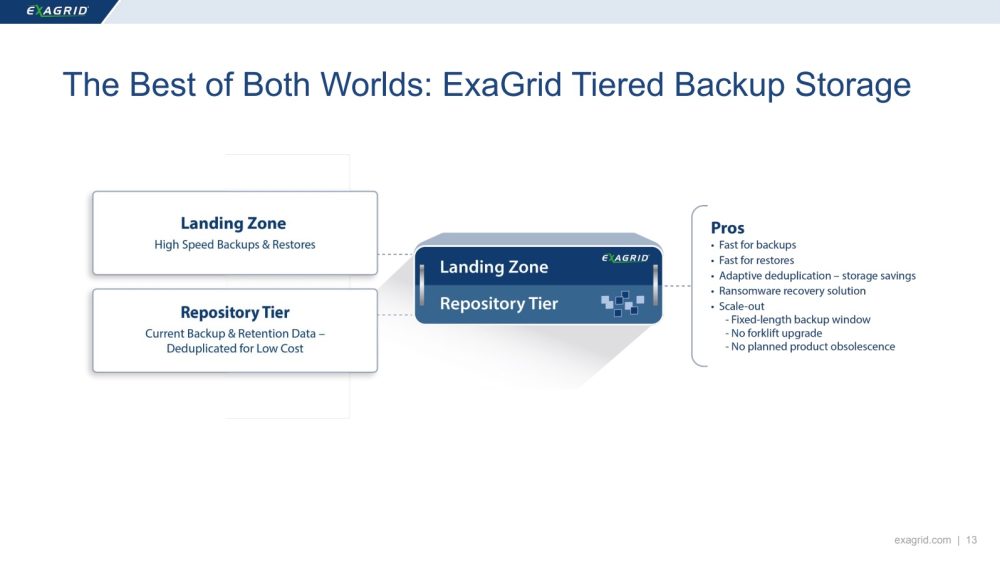
- ExaGrid has a different architecture: Tiered Backup Storage which has a front-end Landing Zone for fast backups and restores but also a second Repository Tier where all data is kept in a deduplicated format for storage savings. The system is scale-out as each appliance has processor, memory, networking and disk and as data grows all resources are added, keeping the backup window at a fixed length as data grows. Lastly, ExaGrid has a strong integrated ransomware recovery solution. AI-Powered Retention Time-Lock with delayed deletes, immutable data objects, a non-network facing tiered air gap, and Auto Detect & Guard to identify delete pattern anomalies, alert IT, and automatically extend the delayed delete policy. ExaGrid does six things that no other storage does to improve backup performance so ExaGrid is the only solution that provides the fastest backups, fast restores, a scale-out architecture with a fixed-length backup window, strong security including ransomware recovery, all disaster recovery options, and low cost for upper mid-market up to large enterprise accounts
You introduced full flash appliances, how have they been received from your partners and end-users?
At first they were well received but then SSD components prices in the industry have skyrocketed, putting Flash/SSD out of reach for backup workloads.
Where is the gain for end-users and partners as well, for the backup and restore phases and how did your pricing change for these new targets?
For SSD, we are the lowest price due to our advanced deduplication in the repository but as mentioned above SSD prices are on the rise, muting SSD use for backup storage. We believe this will clear as SSD prices start to drop in 2027.
With the variety and huge volume of cyber attacks, how does ExaGrid protect users’ data and guarantee 100% clean and safe data?
As discussed our unique AI-Powered Retention Time-Lock with delayed deletes, immutable data objects, a non-network-facing tiered air gap, and Auto Detect & Guard. This layered approach proactively identifies anomalous deletion activity, notifies IT, automatically reinforces retention policies, and helps defend against ransomware and other security threats.
In terms of backup software, you support the main players and solutions and you told us that Cohesity should arrive soon, what is the status on that? And what about NetBackup installed base, what do you see from end-users, did they start some migration towards the original Cohesity product?
We have released Cohesity DataProtect and it is now shipping, if fact we have already won an over $1M dollar Cohesity DataProtect deal.
With NetBackup, customers have 3 choices:
- Stay with Cohesity NetBackup – we are seeing many customers do this
- Move from Cohesity NetBackup to Cohesity DataProtect, we are seeing customers do this as well
- We are also seeing Cohesity NetBackup customers moving to Veeam, Commvault, or Rubrik. All three of these backup applications are picking up business due to the door being opened when Cohesity acquired NetBackup
On the product side, what do you prepare, any new features soon? Not so easy as your product is already very comprehensive
We are announcing:
- Cohesity DataProtect support
- Share quotas for MSPs where they can set a quota by TB and if it exceeded they get an alert letting them know the customer is over the contract value for TBs per month
- We are also announcing NFS encryption over the wire. We already supported encryption over the wire with the Veeam Data Mover, CIFS, and S3. NFS adds to this
Your business model is fully indirect, any new iterations or ideas to boost your partners and thus your revenue, what can they expect?
We are recruiting reseller account executives and solutions architects in over 50 countries worldwide. We have the best product, best support, etc. but the resellers have the customer relationship. We are also working more and more with the world’s 14 largest Global Systems Integrators (GSIs). We are working with HCL and Kyndryl and are in testing at a 3rd GSI.
How do you see the secondary storage market evolve in the next 2-3 years’ timeframe?
We don’t see our competitors advancing their products as their focus is elsewhere. Primary storage has never had specific features for backup, and we are not seeing much if anything being announced from Dell Data Domain or HPE StoreOnce. ExaGrid is the largest independent backup storage vendor in the world, and we are 100% focused on advancing backup storage. This is an exciting time as we can further the technology and feature gap versus our competitors moving forward.
What could be the next steps for the company? Any perspective on that?
Our goal is to keep advancing the product, growing the customer base, and growing our top revenue line while maximizing our P&L, EBITDA, and Free Cash Flow. If we see any products or companies that makes sense for our installed base, we are open to acquiring products or companies but they have fully synergistic. We are not pushing or rushing in this area, but our eyes and ears are open. It is a big market and ExaGrid has a lot of running room ahead of us. The big players Dell, HPE, NetApp, and Everpure dominate primary storage and by default have the majority of backup storage market share however, they are not developing like ExaGrid is, thus our over 70% competitive win rate and continued growth.
Comments
Within the secondary storage market dedicated to backup, ExaGrid stands out as a unique pure-play vendor. Its differentiation stems from the CEO's long-standing leadership, an advanced product architecture with innovative features, a strong business trajectory marked by profitability, and a well-established partner ecosystem.
Click to enlarge
We expect business momentum to accelerate as new platform support and upcoming product enhancements drive additional partner adoption.
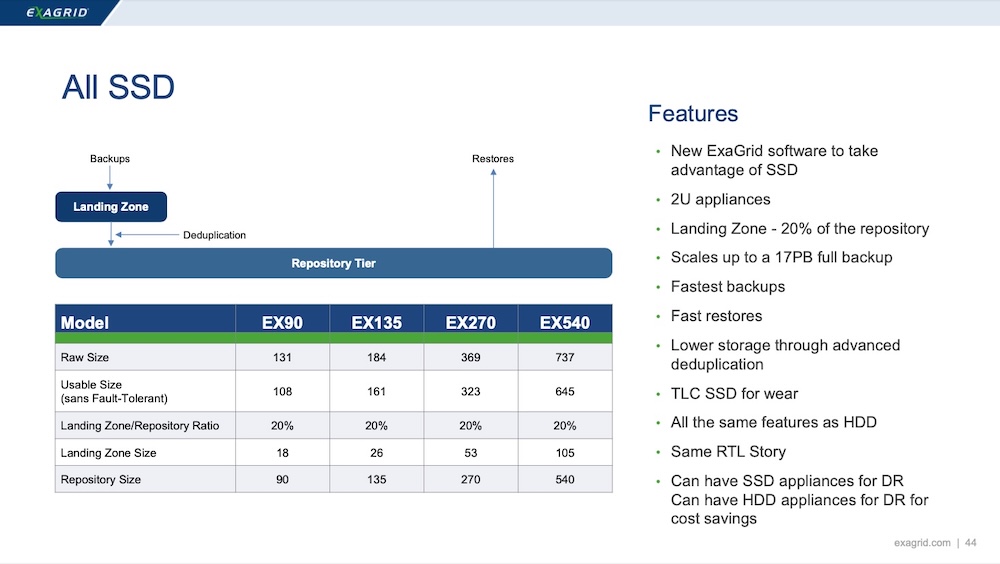
We provide more details below with the ExaGrid SSD appliances models.
Click to enlarge
At the same time, the company's long-term exit strategy remains an open question, and it will be interesting to see whether the next few quarters provide greater clarity.







 Subscribe to our free daily newsletter