








Microsoft Breaks Past FAT32’s 32GB Barrier, Extending Support up to 2TB
Still widely used in embedded, mobile, and IoT devices
By Philippe Nicolas | June 19, 2026 at 2:02 pmThe big FAT32 news right now is all about one thing: Microsoft is finally lifting a 30-year-old artificial limitation that was artificial.
Microsoft removes the 32GB FAT32 formatting cap in Windows 11
With that release of Windows 11 Insider Preview builds on April 10, 2026, Microsoft increased the maximum size for formatting FAT32 volumes via the command line from 32GB to 2TB. The change shipped in both the Dev Channel (Build 26300.8170) and Beta Channel (Build 26220.8165).
The backstory is almost comical: former Windows developer Dave Plummer explained that the original 32GB limit was introduced for the Windows 9x format utility as an arbitrary choice, even though the FAT32 specification itself never imposed such a restriction. With a 32-bit sector count field, FAT32 supports volumes up to 2TB with 512-byte sectors and up to 16TB with 4,096-byte sectors.
A few important caveats:
- The Windows graphical interface still enforces the 32GB cap, to format larger volumes, users must use the command line, that will limit adoption
- The 4GB maximum individual file size limit of FAT32 remains unchanged, which still makes it impractical for large video files or backups
- The update currently applies only to Insider preview builds and is not yet available to all users and we all expect more global availability
Why FAT32 still matters
FAT32 remains relevant for compatibility with older devices, BIOS/UEFI tools, removable media, embedded systems, and situations where broad cross-platform support outweighs filesystem sophistication. It’s also simple enough that it can be used on nearly any microcontroller, allowing devices to write data to SD cards that can be read by virtually anything.
Users who need more functionality have also been able to use exFAT since 2006, which removes the 4GB individual file size limit.
Alongside the FAT32 change, Microsoft also significantly improved performance when navigating storage settings on large drives, independent testing confirmed loading is now nearly instant, even on low-spec machines.
Microsoft also developed exFAT and introduced in 2006 to address FAT32 limitations such as volume max size of 128PB and file max size of 16EB (“theoretically”).
We need to mention other FAT implementations: Tuxera, Paragon, Embedded Access, Sciopta, eSol… Some players also offer NTFS for Mac and thus extend the Microsoft file system coverage beyond Windows and MS-DOS.
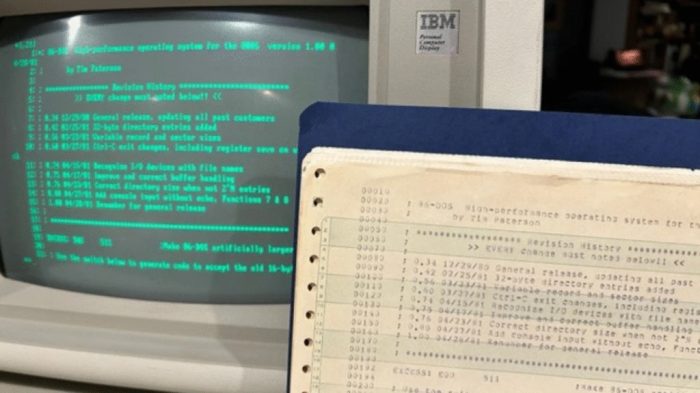
And to conclude we wish to extend this topic with the continuing action from Microsoft to make MS-DOS open source, please refer to this Microsoft blogpost on the project.
References:
- Overview of FAT, HPFS, and NTFS File Systems
- FAT File Systems. FAT32, FAT16, FAT12
- FatFs – Generic FAT Filesystem Module








 Subscribe to our free daily newsletter