








IT Press Tour 68: JuiceFS
An interesting pure software generic file storage alternative
By Philippe Nicolas | June 16, 2026 at 2:01 pmWe had the opportunity to meet JuiceFS for the 2nd time during the recent 68th edition of The IT Press Tour held last week in Boston, MA. Joe Zhou, DevRel, JuiceFS (Juicedata), refreshed the group on file storage approach, very intersting as Amazon has added recently S#Files.
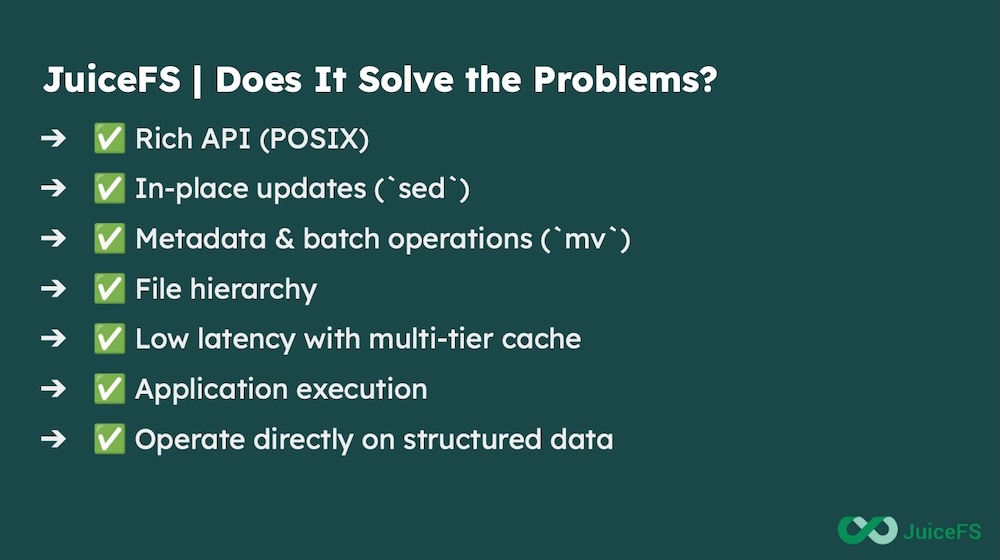
Zhou positioned object storage as the de facto backend of modern data infrastructure, citing a growing roster of diskless architectures built on S3 and equivalents, LanceDB, Snowflake, Chroma, Milvus, TiDB, Neon (acquired by Databricks), WarpStream, turbopuffer (used by Anthropic and Notion), RisingWave, and JuiceFS itself. The appeal is structural: simple but powerful primitives such as PUT, GET, and Compare-And-Swap, a flat namespace, virtually unlimited scalability, 11 nines of durability, multi-region availability, immutability, and roughly $0.02/GB/month at scale in popular regions. Yet object stores remain fundamentally limited for many workloads: no in-place updates, no real file hierarchy (only indexed prefixes), costly batch metadata operations, higher latency, no direct execution, and poor fit for structured data. These constraints explain why an entire generation of databases and file systems is now being rebuilt to expose richer APIs, POSIX in JuiceFS’ case, Postgres in Neon’s, on top of immutable object buckets.
Click to enlarge
Zhou devoted significant time to AWS S3 Files, released in April 2026, presenting it as “a decent approach” but a limited one. S3 Files mounts an S3 bucket as a POSIX-compatible NFS volume, using EFS as a high-performance cache and metadata tier in front of S3 as the source of truth, with a strict 1-to-1 mapping between files and objects. Default behavior is optimized for small files (sizeLessThan defaulting to 128 KiB), with writes landing first in EFS and offloaded to S3 after roughly 60 seconds. The trade-offs are significant: write amplification, appending a few bytes to a 2 GB video requires retrieving, merging and rewriting the entire object via S3 Append’s multi-stage GET-merge-PUT workflow, costly metadata operations (an mv /foo /bar over one million keys triggers a background rewrite of every object), batching delays, conflict resolution where S3 always wins, no multi-cloud support, and complex layered pricing across EFS storage, writes, reads, sync operations and eventual S3 costs. On Zhou’s scorecard, S3 Files delivers POSIX and file hierarchy but fails on in-place updates, batch metadata, application execution, and structured-data workloads.
Click to enlarge
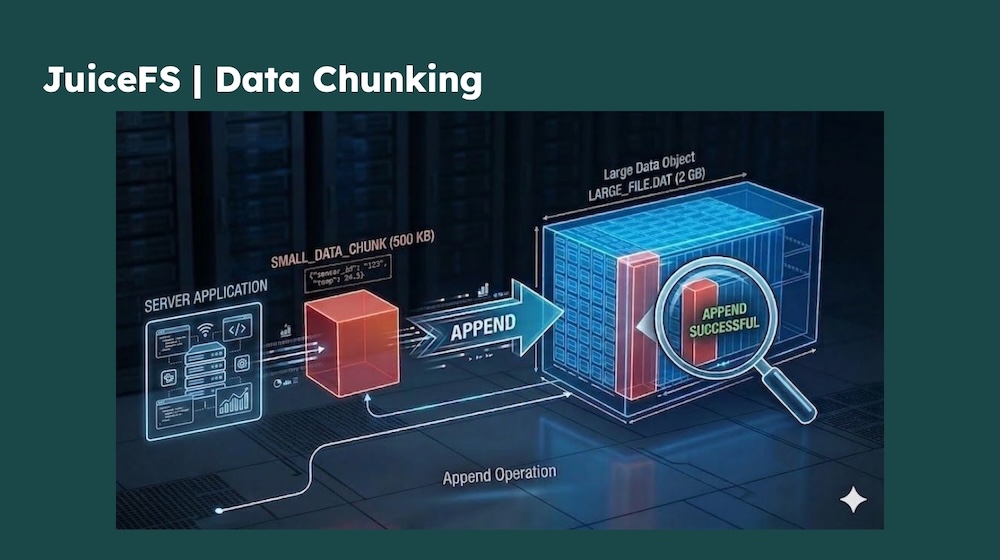
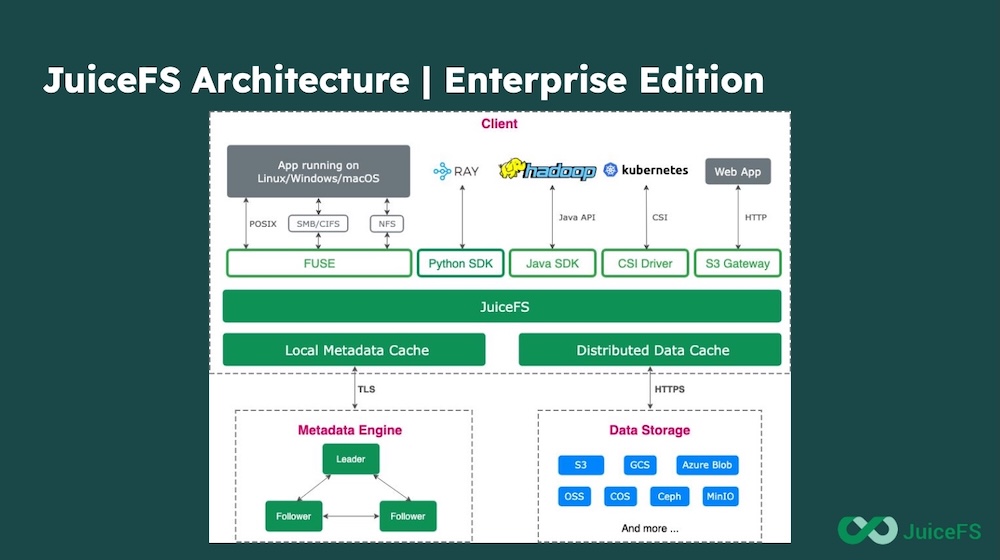
JuiceFS’ answer is strict data/metadata separation combined with file chunking. The Community Edition (Apache 2.0) pairs an external metadata engine, Redis, TiKV, MySQL, PostgreSQL, FoundationDB, with any mainstream object store (S3, GCS, Azure Blob, OSS, COS, Ceph, MinIO), exposed via FUSE, Java SDK, Python SDK, CSI Driver and an S3 Gateway. Files are chunked into immutable 4 MB blocks, so appends rewrite only the last block and renames are a single metadata operation. CE now supports configurable storage-class tiering (Standard-IA, Intelligent-Tiering, Glacier IR) per directory or file. The Enterprise Edition adds a proprietary Raft-based horizontally scalable metadata engine with 3-copy redundancy, a distributed data cache shared across thousands of clients, native cross-region replication, multi-cloud mirroring (cache-only or full mirror), and a soft limit recently pushed from 100 billion to 500 billion files per volume, with one EE deployment already running at 1.47 PiB and 404 billion inodes. MiniMax, a leading Chinese AI lab whose models compete alongside Anthropic and OpenAI, runs JuiceFS in hybrid-cloud mode with GPUs in its own IDC and cache-only mirrors closer to compute, and is now evaluating full mirrors. Other named adopters include HeyGen, GMI, PixVerse, Momenta, Horizon Robotics, Xiaomi, Lovart, NAVER, Trip.com, fal, D-Robotics, Cerebrium, Fly.io and Jerry. JuiceFS EE pricing is by source-region capacity only, no per-client fees, no JuiceFS-imposed data transfer charges since traffic flows directly between client and object store.
Click to enlarge








 Subscribe to our free daily newsletter