









The Pennsylvania State University: Borrowing from Biology to Power Next-Gen Data Storage
Synthetic DNA enables advanced, large-capacity and low-power memory storage devices
This is a Press Release edited by StorageNewsletter.com on April 14, 2026 at 2:00 pmFrom The Pennsylvania State University
DNA, the genetic blueprints in every living organism, is nature’s most efficient storage mechanism, capable of storing about 215 million GB of data/gram. That storage capacity, if applied to electronics, could enable significantly more efficient data centers, speedier data processing and the ability to process far more complicated data. The trick to making this technological leap is getting DNA, a biological material, to work with electronics. A team led by Penn State researchers has figured out how to bridge the wide compatibility gap.
The researchers engineered synthetic DNA and integrated it with a semiconducting material to increase the storage capacity of advanced materials.
Here, the internal two-dimensional structures of the synthetic DNA is visible via optical microscopy.
Credit: Provided by the researchers. All Rights Reserved.
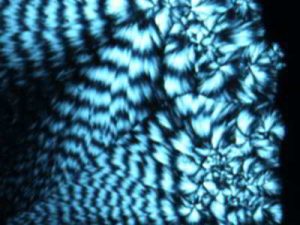 The work, published in Advanced Functional Materials (see below) and with a patent application filed, hinged on 2 materials, according to the researchers: synthetic DNA, or commercially available, chemically engineered molecules making up short genetic sequences designed to match the electronic device needs; and a semiconducting material called crystalline perovskite, commonly used in solar cells, lasers and data storage devices.
“Biology and electronics are different domains,” said Kavya S. Keremane, co-corresponding author and postdoctoral researcher in materials science and engineering, Penn State. “Bridging these two fields required developing an entirely new materials platform that allows them to function seamlessly together. By combining the information storage capabilities of DNA with the exceptional electronic properties of perovskite semiconductors, we created a bio-hybrid system that fundamentally changes how low-power memory devices can be designed.”
The researchers developed a memory resistor, or ‘memristor,’ that requires little energy to operate. Conventional resistors maintain a fixed resistance to current flow in electronic devices, from cell phones to space shuttles, but they lose all information once power is removed. Memristors, in contrast, can allow current flow even after its power source is turned off and it can remember the direction of prior current flow. This ability to store and process data in the same location mimics how neurons functions in the brain, potentially enabling simultaneous and more comprehensive data processing. However, the researchers said, it only works with enough storage and power — both of which would be too large for cost-effective commercial use without DNA’s capability to densely pack and store data with very little energy use.
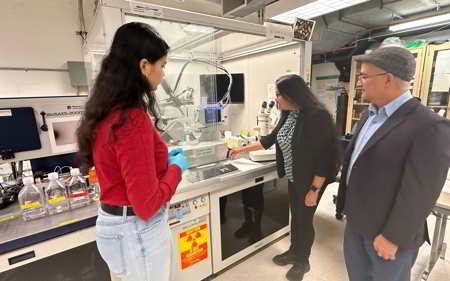
From left are Kavya S. Keremane, postdoctoral researcher in materials science and engineering;
Neela H. Yennawar, research professor and director, Penn State Huck Institutes of the Life Sciences’ Biomolecular Interactions Core Facility; and Bed Poudel, research professor of materials science and engineering.
Credit: Provided by the researchers. All Rights Reserved.
 To develop the device, the researchers applied silver nanoparticles to a layer of customized DNA sequences — specially designed to be of certain compositions and lengths — integrated along with thin films of perovskite. Known as ‘doping,’ this process of applying a small nanoparticle to another material allows the researchers to precisely facilitate specific properties in a material. In this case, it made the DNA capable of conducting electricity, as well as orienting its units in a more streamlined fashion.
Unlike natural DNA — long, entangled strands that behave like wet spaghetti when handled — short, rigid synthetic DNA fragments enable true architectural precision at the nanoscale. Molecularly engineered DNA achieves a level of structural order, tunable electrical conductivity and functional control that native DNA cannot deliver in thin films, according to co-author Neela H. Yennawar, research professor and director of the Penn State Huck Institutes of the Life Sciences’ Biomolecular Interactions Core Facility.
“We can computationally determine exactly which sequences we need and how long they should be, and then we can rationally design them with synthetic DNA,” Yennawar said. “These structures can be systematically doped with silver and other ions and engineered to interface seamlessly with perovskites — transforming DNA from a biological macromolecule into a programmable, multifunctional nanomaterials platform.”
Together, the DNA doped with silver nanoparticles and perovskite developed bio-hybrid channels to funnel current flow. When the team applied less than 0.1 volt — for comparison, standard U.S. outlets have 120 volts — electrons reliably moved through the device. When the current was switched, the device responded in kind. The device, stabilized by the precise DNA composition and structures linked to perovskite, could consistently perform up to almost 250 degrees Fahrenheit and at room temperature for more than six weeks far exceeding the performance standards of current perovskite-based memory storage devices, the researchers said. They explained that their device could performs the same memory function of similar existing technologies, but only uses one-tenth of the power, making it far more suitable for next-gen, energy-efficient electronics.
“Using just the DNA or just perovskite alone did not produce near as robust a result as the combination,” Keremane said. “It’s this combination that enables a very high memory storage density that requires very little power.”
Next, the researchers plan to refine their approach and investigate other bio-inspired electronic applications.
“Nature has the solution — we just have to find it and apply it,” Poudel said. “This work of integrating DNA into electronics to do amazing things gives a glimpse into what is possible.”
In addition to Keremane, Yennawar and Poudel, other Penn State co-authors include co-corresponding author Luyao Zheng, postdoctoral research in materials science and engineering; Haodong Wu, doctoral student in materials science and engineering; Jiamao Zheng, who was a master’s student in materials science and engineering at the time of research and has since graduated from Penn State; Shashank Priya, who was a professor of materials science and engineering at the time of research; and Chiranth C. Ravi, who was a master’s student in the Huck Institutes of the Life Sciences at the time of research and has since graduated from Penn State. Abhinav Gorthy and co-corresponding author Rashmi Jha, chemical engineering and materials science, University of Minnesota, also contributed.
The U.S. National Science Foundation, the National Institutes of Health, Penn State and the University of Minnesota supported this research.
Article: Molecularly Engineered Highly Stable Memristors with Ultra-Low Operational Voltage: Integrating Synthetic DNA with Quasi-2D Perovskites
Advanced Functional Materials has published an article written by Kavya S. Keremane, Department of Materials Science and Engineering, Pennsylvania State University, University Park, Pennsylvania, USA, Abhinav Gorthy, Department of Electrical and Computer Engineering, University of Cincinnati, Cincinnati, Ohio, USA, Luyao Zheng, Engineering, Pennsylvania State University, University Park, Pennsylvania, USA, and Optoelectronic Materials and Devices Laboratory, Ningbo Institute of Materials Technology and Engineering, Chinese Academy of Sciences (CAS), Ningbo, Zhejiang, China, Chiranth C Ravi, The Huck Institutes of the Life Sciences, Pennsylvania State University, University Park, Pennsylvania, USA, Haodong Wu, Jiamao Zheng,Department of Materials Science and Engineering, Pennsylvania State University, University Park, Pennsylvania, USA, Neela H. Yennawar, The Huck Institutes of the Life Sciences, Pennsylvania State University, University Park, Pennsylvania, USA, Shashank Priya, Department of Materials Science and Engineering, Pennsylvania State University, University Park, Pennsylvania, USA, and Chemical Engineering and Materials Science, University of Minnesota, Minneapolis, Minnesota, USA, Rashmi Jha, Department of Electrical and Computer Engineering, University of Cincinnati, Cincinnati, Ohio, USA, and Bed Poudel, Department of Materials Science and Engineering, Pennsylvania State University, University Park, Pennsylvania, USA.
Abstract: “Innovative data storage and processing technologies have attracted tremendous attention alongside the rapid advancement of artificial intelligence (AI) in recent years. The growing demands drive various sectors to explore emerging semiconducting materials beyond conventional silicon and metal oxide-based non-volatile memories. Bio-derived materials such as deoxyribonucleic acid (DNA) present unique opportunities for next-generation non-volatile memory (NVM) due to their programmable architecture and exceptional information density, enabling new possibilities for biogenetic data storage. However, the electronic-biogenetic interface remains largely unexplored. Herein, we report the synthetic DNA-assisted hybrid memory devices combining quasi-2D halide perovskites (OHPs) (PEA)2(MA)n-1PbnI3n+1 (n = 2) and Ag nanoparticle (NP) embedded synthetic 22-mer DNA (Ag-synDNA) composite, demonstrating remarkable resistive switching (RS) performance. The robust Ag/(PEA)2(MA)Pb2I₇/AgNP-DNA/Pt memristor arrays demonstrate exceptional characteristics, including ultra-low operation voltage (<0.1 V), record-low power density (0.01 W/cm2), forming-free operation, stable endurance (103 cycles), and excellent retention (4 × 10³ s), maintaining a high ON/OFF ratio (>105) for more than 6 weeks under ambient conditions, outperforming pristine 2D OHP and unmodified DNA-based counterparts. This synergistic integration of customized DNA and 2D OHP enhances charge transport, reduces variability, and significantly boosts storage performance, establishing hybrid DNA-perovskite memristors as promising candidates for future energy-efficient data storage applications.“








 Subscribe to our free daily newsletter