Nvidia: Fiscal 4Q26 and FY26 Financial Results
Generating $215.9 billion, up 65% YoY
This is a Press Release edited by StorageNewsletter.com on March 4, 2026 at 2:02 pmSummary:
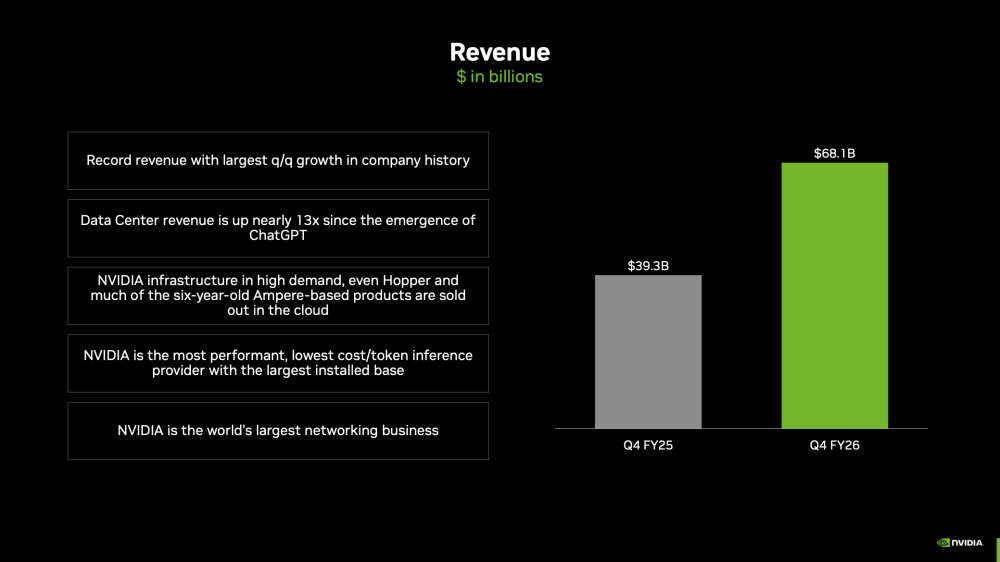
- Record quarterly revenue of $68.1 billion, up 20% from Q3 and up 73% from a year ago
- Record quarterly Data Center revenue of $62.3 billion, up 22% from Q3 and up 75% from a year ago
- Record full-year revenue of $215.9 billion, up 65%
Nvidia Corp. reported record revenue for the fourth quarter ended January 25, 2026, of $68.1 billion, up 20% from the previous quarter and up 73% from a year ago. For fiscal 2026, revenue was $215.9 billion, up 65% from a year ago. For the quarter, GAAP and non-GAAP gross margins were 75.0% and 75.2%, respectively. For fiscal 2026, GAAP and non-GAAP gross margins were 71.1% and 71.3%, respectively.
For the quarter, GAAP and non-GAAP earnings per diluted share were $1.76 and $1.62, respectively. For fiscal 2026, GAAP and non-GAAP earnings per diluted share were $4.90 and $4.77, respectively.
“Computing demand is growing exponentially – the agentic AI inflection point has arrived. Grace Blackwell with NVLink is the king of inference today – delivering an order-of-magnitude lower cost per token – and Vera Rubin will extend that leadership even further,” said Jensen Huang, founder and CEO, Nvidia. “Enterprise adoption of agents is skyrocketing. Our customers are racing to invest in AI compute – the factories powering the AI industrial revolution and their future growth.”
During fiscal 2026, Nvidia returned $41.1 billion to shareholders in the form of shares repurchased and cash dividends. As of the end of the fourth quarter, the company had $58.5 billion remaining under its share repurchase authorization.
Nvidia will pay its next quarterly cash dividend of $0.01 per share on April 1, 2026, to all shareholders of record on March 11, 2026.
Q4 Fiscal 2026 Summary
Click to enlarge
| GAAP | ||||||||||||||
| ($ in millions, except earnings per share) | Q4 FY26 | Q3 FY26 | Q4 FY25 | Q/Q | Y/Y | |||||||||
| Revenue | $68,127 | $57,006 | $39,331 | 20% | 73% | |||||||||
| Gross margin | 75.0% | 73.4% | 73.0% | 1.6 pts | 2.0 pts | |||||||||
| Operating expenses | $6,794 | $5,839 | $4,689 | 16% | 45% | |||||||||
| Operating income | $44,299 | $36,010 | $24,034 | 23% | 84% | |||||||||
| Net income | $42,960 | $31,910 | $22,091 | 35% | 94% | |||||||||
| Diluted earnings per share | $1.76 | $1.30 | $0.89 | 35% | 98% | |||||||||
| Non-GAAP | ||||||||||||||
| ($ in millions, except earnings per share) | Q4 FY26 | Q3 FY26 | Q4 FY25 | Q/Q | Y/Y | |||||||||
| Revenue | $68,127 | $57,006 | $39,331 | 20% | 73% | |||||||||
| Gross margin | 75.2% | 73.6% | 73.5% | 1.6 pts | 1.7 pts | |||||||||
| Operating expenses | $5,102 | $4,215 | $3,378 | 21% | 51% | |||||||||
| Operating income | $46,107 | $37,752 | $25,516 | 22% | 81% | |||||||||
| Net income | $39,552 | $31,767 | $22,066 | 25% | 79% | |||||||||
| Diluted earnings per share | $1.62 | $1.30 | $0.89 | 25% | 82% | |||||||||
Fiscal 2026 Summary
| GAAP | ||||||||||||||||
| ($ in millions, except earnings per share) | FY26 | FY25 | Y/Y | |||||||||||||
| Revenue | $215,938 | $130,497 | 65% | |||||||||||||
| Gross margin | 71.1% | 75.0% | (3.9) pts | |||||||||||||
| Operating expenses | $23,076 | $16,405 | 41% | |||||||||||||
| Operating income | $130,387 | $81,453 | 60% | |||||||||||||
| Net income | $120,067 | $72,880 | 65% | |||||||||||||
| Diluted earnings per share | $4.90 | $2.94 | 67% | |||||||||||||
| Non-GAAP | ||||||||||||||||
| ($ in millions, except earnings per share) | FY26 | FY25 | Y/Y | |||||||||||||
| Revenue | $215,938 | $130,497 | 65% | |||||||||||||
| Gross margin | 71.3% | 75.5% | (4.2) pts | |||||||||||||
| Operating expenses | $16,694 | $11,716 | 42% | |||||||||||||
| Operating income | $137,300 | $86,789 | 58 % | |||||||||||||
| Net income | $116,997 | $74,265 | 58% | |||||||||||||
| Diluted earnings per share | $4.77 | $2.99 | 60% | |||||||||||||
Outlook
Beginning in the first quarter of fiscal 2027, Nvidia will include stock-based compensation expense in non-GAAP financial measures. Stock-based compensation is a foundational component of Nvidia’s compensation program to attract and retain world-class talent.
Nvidia’s outlook for the first quarter of fiscal 2027 is as follows:
- Revenue is expected to be $78.0 billion, plus or minus 2%. Nvidia is not assuming any Data Center compute revenue from China in its outlook
- GAAP and non-GAAP gross margins are expected to be 74.9% and 75.0%, respectively, plus or minus 50 basis points, inclusive of a 0.1% impact from stock-based compensation expense
- GAAP and non-GAAP operating expenses are expected to be approximately $7.7 billion and $7.5 billion, respectively, inclusive of $1.9 billion of stock-based compensation expense
For the full year fiscal 2027, GAAP and non-GAAP tax rates are expected to be between 17.0% and 19.0%, excluding any discrete items and material changes to Nvidia’s tax environment
Highlights
Data Center
- Fourth-quarter revenue was a record $62.3 billion, up 22% from the previous quarter and up 75% from a year ago, driven by the major platform shifts – accelerated computing and AI. Full-year revenue rose 68% to a record $193.7 billion
- Unveiled the Nvidia Rubin platform, comprising six new chips to deliver up to a 10x reduction in inference token cost, compared with the Nvidia Blackwell platform; cloud providers AWS, Google Cloud, Microsoft Azure and Oracle Cloud Infrastructure will be among the first to deploy Vera Rubin-based instances
- Announced that the Nvidia BlueField-4 data processor powers the Nvidia Inference Context Memory Storage Platform, a new class of AI-native storage infrastructure for the next frontier of AI
- Announced a multiyear, multigenerational strategic partnership with Meta spanning on-premises, cloud and AI infrastructure, including the large-scale deployment of Nvidia CPUs, networking and millions of Nvidia Blackwell and Rubin GPUs
- Revealed that Nvidia Blackwell Ultra delivers up to 50x better performance and 35x lower cost for agentic AI compared with the Nvidia Hopper platform, according to new SemiAnalysis InferenceX benchmark results
- Expanded AWS partnership with new technology integrations across interconnect technology, cloud infrastructure, open models and physical AI
- Revealed that leading inference providers, including Baseten, DeepInfra, Fireworks AI and Together AI, cut AI costs by up to 10x with open source models on Nvidia Blackwell
- Debuted the Nvidia Nemotron 3 family of open models, data and libraries designed to power transparent, efficient and specialized agentic AI development across industries; released new open models, data and tools for agentic AI, physical AI and autonomous vehicle development
- Announced an investment and deep technology partnership with Anthropic, which is scaling its Claude model on Microsoft Azure, powered by Nvidia systems
- Entered into a non-exclusive licensing agreement with Groq to accelerate AI inference at global scale
- Strengthened a collaboration with CoreWeave to accelerate the buildout of more than 5 gigawatts of AI factories by 2030
- Announced an expanded strategic partnership with Synopsys to revolutionize engineering and design across industries
- Announced a co-innovation AI lab with Lilly to reinvent drug discovery in the age of AI
- Announced a major expansion of Nvidia BioNeMo, an open development platform that enables lab-in-the-loop workflows to develop breakthroughs in AI-driven biology and drug discovery
- Joined the U.S. Department of Energy’s Genesis Mission as a private industry partner to support U.S. AI leadership in key areas including energy, scientific research and national security
- Launched the Nvidia Earth-2 family of open models – the world’s first fully open, accelerated set of models and tools for AI weather
- Revealed that India’s global systems integrators Infosys, Persistent, Tech Mahindra and Wipro are building the next wave of enterprise agents with Nvidia AI
- Partnered with global industrial software leaders Cadence, Siemens and Synopsys and India’s largest manufacturers to drive India’s AI boom using applications accelerated by Nvidia CUDA-X and Nvidia Omniverse libraries
Gaming and AI PC
- Fourth-quarter Gaming revenue was $3.7 billion, up 47% from a year ago, driven by strong Blackwell demand, and down 13% from the previous quarter as channel inventory naturally moderated following a season of strong holiday demand. Full-year revenue rose 41% to a record $16.0 billion
- Announced Nvidia DLSS 4.5, delivering major AI-powered advances in graphics quality
- Launched Nvidia G-SYNC Pulsar, extending the ultimate gaming display platform with new levels of motion clarity in esports
- Advanced Nvidia RTX AI performance and adoption, delivering up to 35% faster large language model inference in leading AI PC frameworks and up to 3x performance in AI-generated visuals
Professional Visualization
- Fourth-quarter revenue was $1.3 billion, up 74% from the previous quarter and up 159% from a year ago, driven by exceptional demand for Blackwell. Full-year revenue rose 70% to a record $3.2 billion
- Launched the Nvidia RTX PRO 5000 72GB Blackwell GPU to power larger models and agentic workflows
- Expanded global availability of Nvidia DGX Spark for the latest open models and delivered updates for improved performance
Automotive and Robotics
- Fourth-quarter Automotive revenue was $604 million, up 2% from the previous quarter and up 6% from a year ago, driven by continued adoption of Nvidia’s self-driving platforms. Full-year revenue rose 39% to a record $2.3 billion
- Unveiled the Nvidia Alpamayo family of open AI models, simulation tools and datasets designed to accelerate the next era of safe, reasoning‑based autonomous vehicle (AV) development
- Partnered with Mercedes-Benz on the all-new Mercedes-Benz CLA, which introduces enhanced level 2 driver assistance powered by Nvidia DRIVE AV software, AI infrastructure and accelerated compute
- Announced that the Nvidia DRIVE Hyperion ecosystem is expanding to include tier 1 suppliers, automotive integrators and sensor partners including Aeva, AUMOVIO, Astemo, Arbe, Bosch, Hesai, Magna, Omnivision, Quanta, Sony and ZF Group
- Announced new Nvidia Cosmos and Nvidia Isaac GR00T open models, frameworks and AI infrastructure for physical AI; global industry leaders including Boston Dynamics, Caterpillar, Franka Robotics, Humanoid, LG Electronics and NEURA Robotics are using the Nvidia robotics stack
- Expanded a strategic partnership with Siemens to build the industrial AI operating system
- Announced a strategic partnership with Dassault Systèmes to build an industrial AI platform powering virtual twins
Comments
Q4 was outstanding, and the revenue trend over the past few years confirms the strong demand for GPUs, CPUs, memory, storage, and networking solutions. This momentum is driving activity across the entire IT sector, delivering positive business outcomes for a wide range of companies.
The curve has accelerated further - $68.1 billion in Q4 alone is roughly twice the annual revenue of AMD or HPE and about equal to Lenovo’s yearly revenue. On an annual comparison basis, this remarkable Nvidia figure represents
- 6 times AMD
- 4 times Intel
- 6 times HPE
- almost 2 times Dell
- almost 3 times IBM or Lenovo
You could even say that Dell, IBM, and HPE combined roughly equal Nvidia, which offers another perspective on the scale.
Click to enlarge
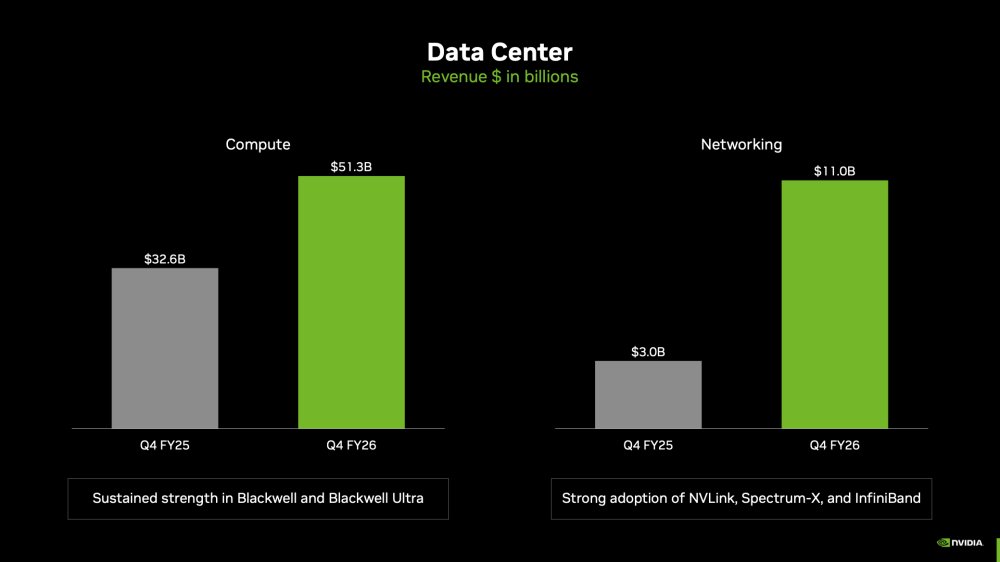
The Data Center business alone generated $62.3 billion in Q4 and $193.7 billion for the full year. Networking delivered $11 billion in Q4, up 34.5%, while compute reached $51.3 billion, up 19.3%. Beyond processors and accelerators, Nvidia confirms its global leadership in networking. In total, gross profit for the year reached $153.4 billion.
Having actively taken part in the AI surge creates a strange feeling, as the amounts being raised are unlike anything we have seen before. When you read that OpenAI raised $110 billion, the atmosphere feels different - it’s not $10 billion or even $1 billion; it’s on an entirely different scale.
The upcoming GTC will also unveil new products, as the company continues its intense race to design, develop, and deliver new iterations driven by the AI ecosystem and competitive pressure from Asia - particularly China. Nvidia cannot afford to slow the pace, as it could be interpreted as a negative signal across multiple fronts: for the country, its customers, partners, and the broader industry.








 Subscribe to our free daily newsletter