



Company Profile: VergeIO
Confirming its momentum in VMware-based environment replacement
By Philippe Nicolas | February 12, 2026 at 2:01 pmCompany name:
VergeIO, Inc. (operates as Verge.io)

HQ and offices:
Headquarters: Ann Arbor, Michigan, USA
Website:
verge.io
Date founded:
2010
Founders:
 Greg Campbell, founder and CTO, responsible for the core architecture and technical
LinkedIn profile
 Yan Ness, CEO, focused on company strategy and execution
LinkedIn profile
Click to enlarge
Financial funding:
Privately held and privately funded
Employee numbers:
<100
Revenue:
Privately held. Not disclosed
Technology:
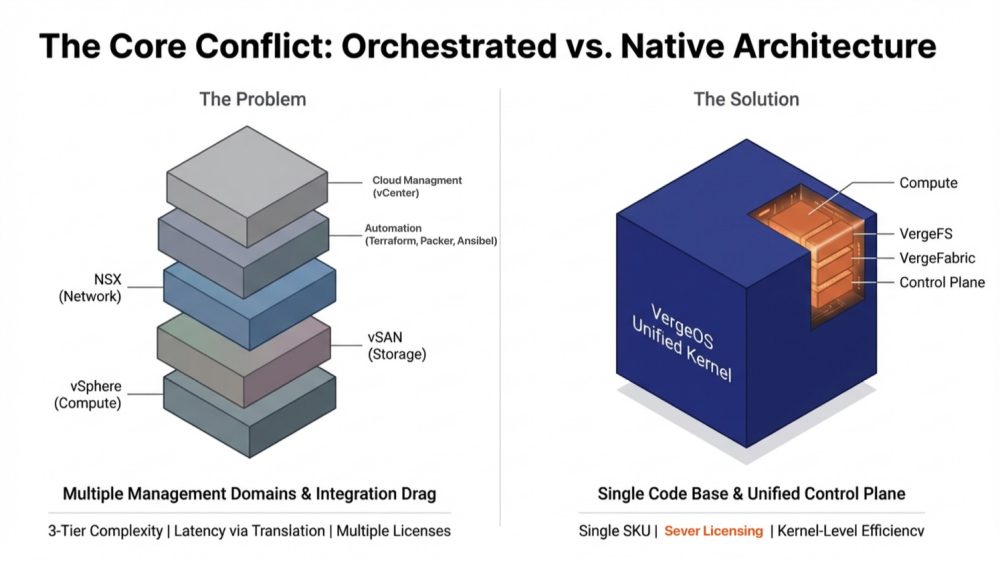
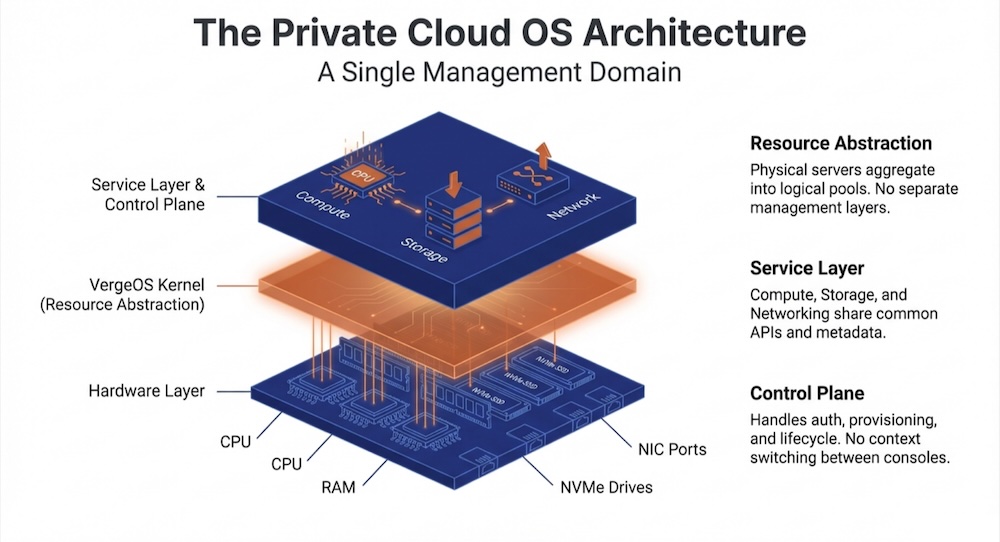
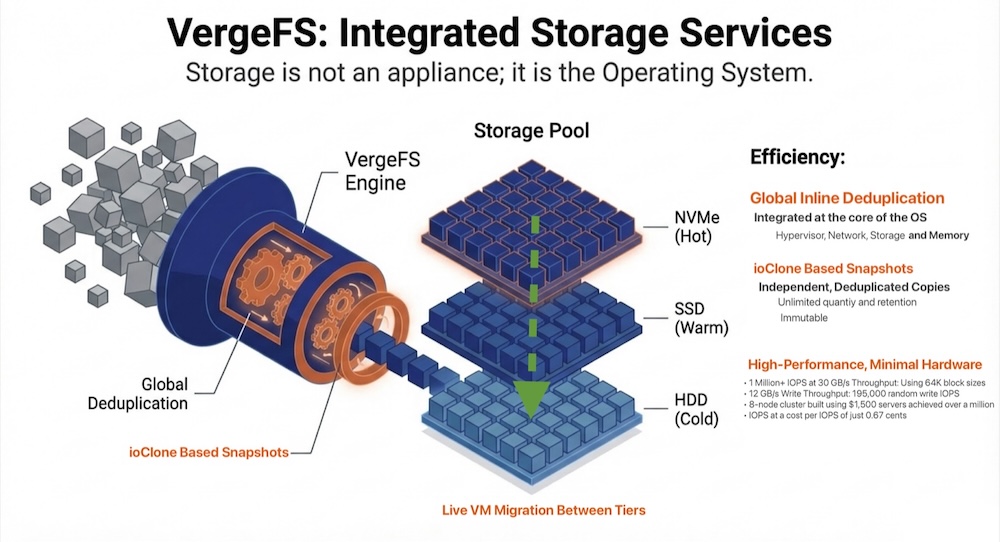
VergeIO positions its platform as a Private Cloud Operating System that unifies virtualization, storage, networking, and data protection into a single software platform. The architecture is designed to replace fragmented, multi-product infrastructure stacks with one integrated system operated through a single control plane
Click to enlarge
Products:
VergeOS – core complete private cloud operating system
Click to enlarge
Release and roadmap:
Current major release: VergeOS 26
Public roadmap: Two major releases per year
Pricing model and price:
Pricing model: Simple per-node pricing model, independent of CPU cores, RAM, or storage capacity
Go-To-Market:
Combination of direct sales and partner-led motion. Strong emphasis on technical education, webinars, and VMware-alternative positioning
Customers:
Publicly referenced customers include:
- Topgolf
- St. Clair County RESA
Workloads / use cases / applications:
- VMware replacement and infrastructure modernization
- Virtual Desktop Infrastructure (VDI)
- Multi-tenant environments
- Private cloud and private AI deployments
- Consolidation of compute, storage, networking, and data protection
Target market:
- Mid-market and enterprise IT organizations
- Cloud providers, MSPs, and service providers requiring multi-tenant infrastructure
- Organizations pursuing VMware exit strategies
Competition:
- VMware vSphere / vSAN / NSX stacks
- Nutanix AHV
- Proxmox
- Other hyperconverged and private cloud platforms
Comments
VergeIO is experiencing rapid growth, posting 80% year-over-year expansion and exceeding its 2025 ARR target by more than 25%. As a private company, it does not publicly disclose revenue figures, and no external funding has been identified. This raises questions around capital structure, control, and potential dilution concerns. While remaining independent may be strategic, access to venture capital could have accelerated its growth trajectory - something that could still evolve over time.
VMware has long dominated the server virtualization and workload consolidation market for many years, leaving little room for competitors to gain meaningful traction. Several visible players faced financial challenges - some of which shifted abruptly following the VMware–Broadcom acquisition. Timing played a significant role.
That merger caught the market by surprise and had a major impact on both customers and the channel. Licensing models changed dramatically, and more broadly, the move served as a wake-up call for users. It highlighted VMware’s market supremacy, the degree of vendor lock-in, and the associated costs - while still being perceived as a form of insurance. As a result, customers and partners alike began to seriously explore alternative solutions.
Over several quarters, small and mid-sized organizations began migrating to alternatives, while large enterprises took a more cautious approach, recognizing the cost, complexity, and risk involved in large-scale migrations.
Click to enlarge
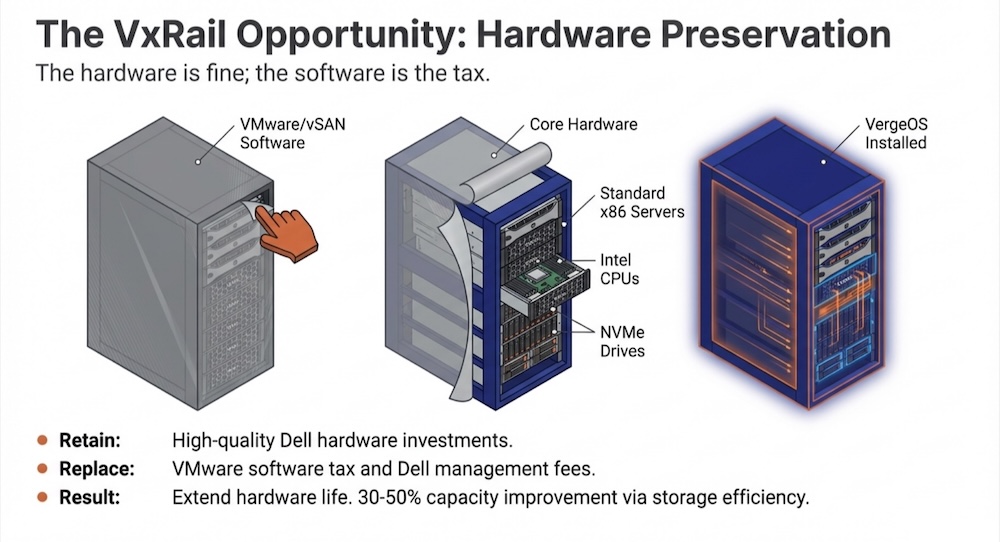
VergeIO encourages customers and partners to rethink their IT infrastructure, potentially reorganizing, redesigning, refactoring, or replatforming their environments.
VergeOS, built on KVM/QEMU, takes a differentiated approach by offering a fully integrated stack that decouples software from hardware and applies a cloud operating model to private and on-premises deployments.
The platform includes foundational services such as VergeFS, VergeFabric, and built-in data protection, along with advanced capabilities like transparent tiering, global deduplication, ioClone, ioGuardian, and ioReplicate for snapshots and remote replication. These features help maintain SLA commitments while delivering an attractive total cost of ownership. With a single SKU and a pricing model independent of hardware, VM count, or resource consumption, adoption momentum in 2025 has been exceptional.
Click to enlarge
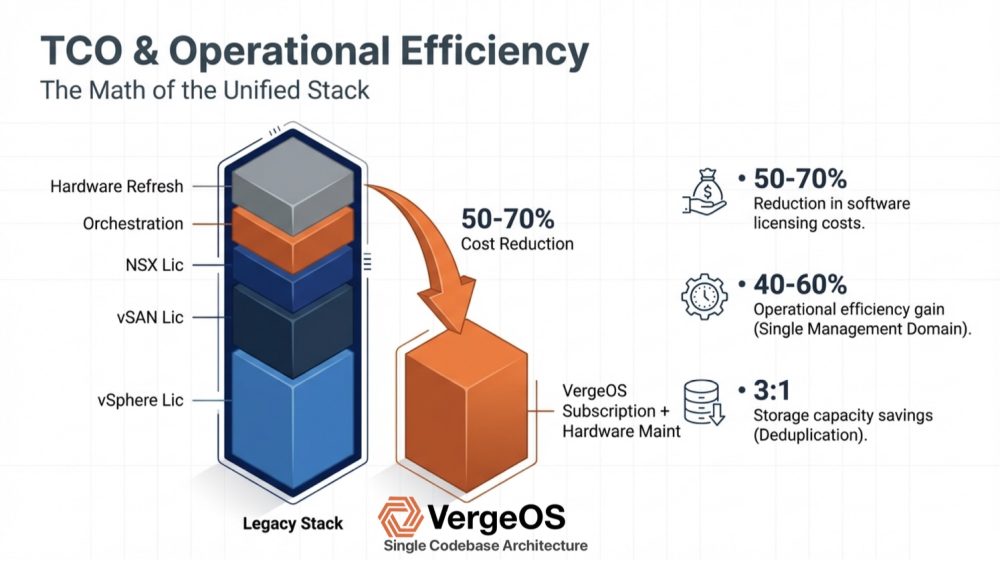
From a go-to-market perspective, partnerships with major server vendors could significantly expand VergeIO’s market presence.






 Subscribe to our free daily newsletter