




Startup Profile: Ewigbyte
Developing a photonics-based long-term data storage on glass
By Philippe Nicolas | January 23, 2026 at 2:02 pmCompany name:
ewigbyte (ewigbyte GmbH)
HQ and offices:
HQ: Feichtetstraße 29, 82343 Pöcking, Germany
Office: ewigbyte, c/o Wayra, Georg-Brauchle-Ring 50, 80992 Munich, Germany
Website:
ewigbyte.com
Date founded:
July 31, 2025
Founders:
 Dr. Steffen Klewitz, co-founder & CEO
Linkedin profile
Physicist and photonics expert with a background in ultrafast laser systems and deep-tech venture building. Responsible for technology vision, photonics innovation, and enterprise strategy.
 Dr. Ina von Haeften, co-founder & head of operations
LinkedIn profile
Background in psychology, strategy, and organizational design. Leads operations, funding strategy, partnerships, communications, and institutional positioning.
 Philipp Wittwer, MBA, co-founder & head of technology
LinkedIn profile
Expert in system architecture, electronics, and complex data infrastructures. Translates advanced R&D into reliable, industrial-grade systems.
 Dr. Christian Marquardt, co-founder
LinkedIn profile
Legal expert with deep experience in governance, IP strategy, and regulatory frameworks in high-stakes deep-tech environments.
Financial funding:
Pending funding round
Employee numbers:
5
Revenue:
Pre-revenue, obviously in the design and development phase.
Technology:
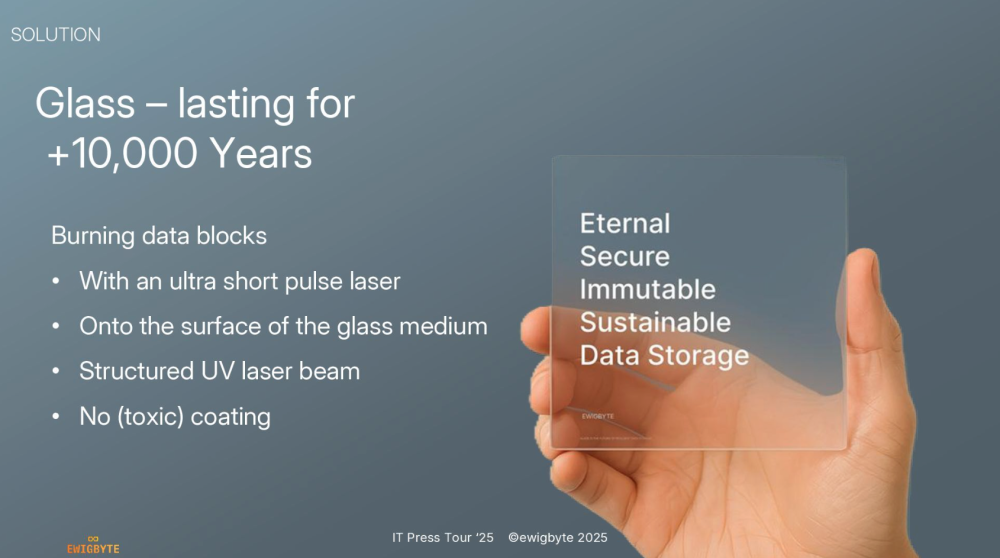
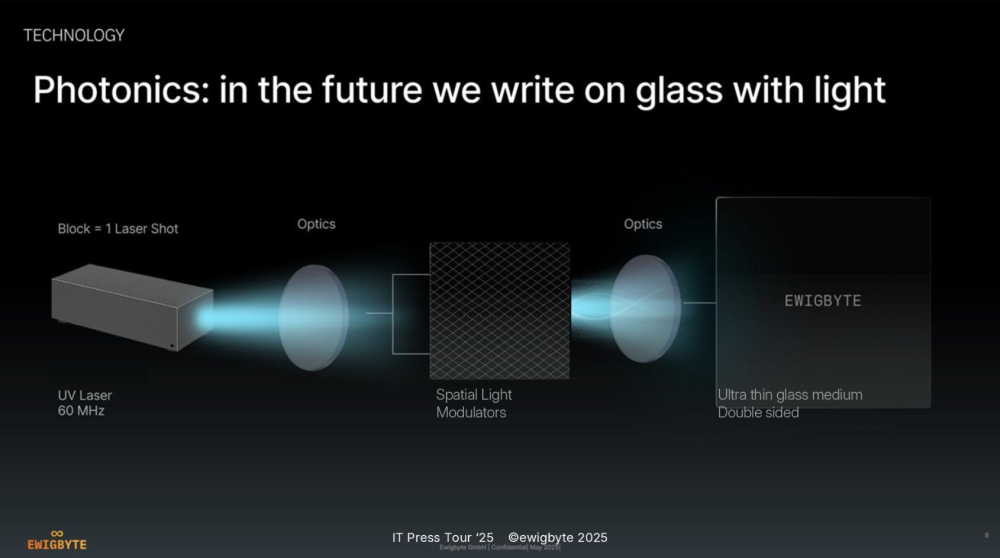
ewigbyte develops photonics-based long-term data storage on glass.
Data is written as physical nanostructures onto the surface of glass using ultrafast laser pulses. Once written, the data is stored without ongoing power, electronics, or active hardware and can be read optically with deterministic accuracy.
The approach targets long-term (“cold”) data where durability, integrity, and energy independence are critical.
Click to enlarge
Products:
ewigbyte offers long-term data storage as a service, built on photonic writing to glass.
The service includes:
- photonic writing of data as physical nanostructures on glass
- secure, off-cloud and off-grid physical storage of the written data
- and deterministic optical readout for reliable data retrieval
ewigbyte does not sell standalone writing or reading machines as products. The focus is on providing a managed, long-term storage service for data that must remain intact and accessible over decades or longer.
Click to enlarge
Release and roadmap:
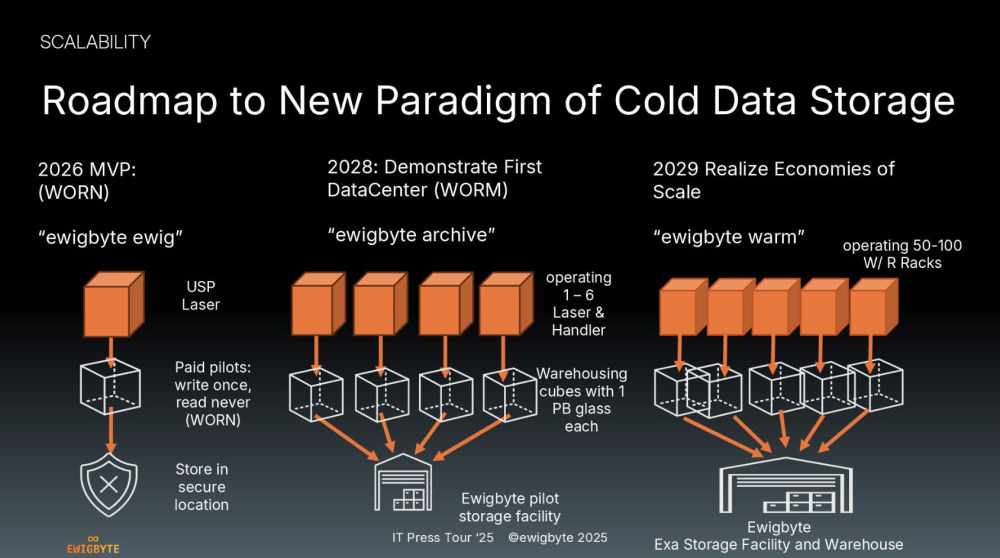
ewigbyte is currently developing its first industrial prototype for writing, storing, and reading data on glass.
- 2026: Prototype completion and pilot projects with selected partners
- Following phases: Gradual transition from pilot deployments to production-ready systems for institutional customers
Pricing model and price:
Pricing is expected to follow a project- and volume-based model, tailored to institutional and enterprise use cases.
Final pricing will be defined together with pilot customers.
Go-to-Market:
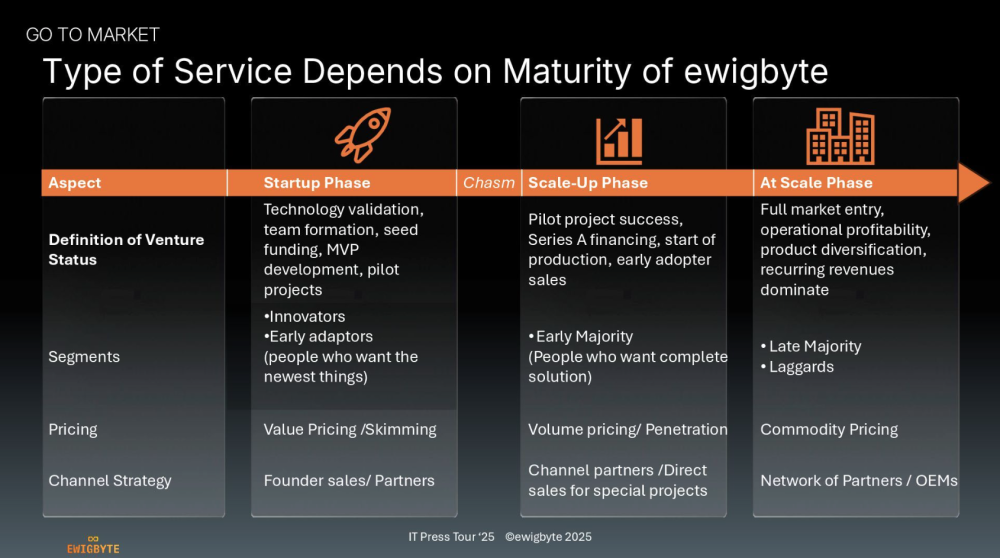
ewigbyte follows a partnership-driven, enterprise-first GTM strategy, working closely with:
- public institutions,
- research infrastructures,
- and strategic industry partners
Initial deployments focus on pilot projects and long-term partnerships, rather than mass-market rollout.
Click to enlarge
Customers:
Currently in early engagement and pilot discussions with institutional and enterprise partners.
No commercial customers yet obviously.
Workloads / use cases / applications:
- Long-term digital archives (cultural heritage, public records)
- Scientific and research data (e.g. astronomy, physics, climate data)
- Sovereign and regulatory data requiring long-term integrity
- Cybersecurity, backup, and disaster-recovery use cases
- Industrial cold data with long retention requirements
Target market:
Institutions and organizations with critical long-term data retention and resilience requirements, including:
- archives, libraries, and museums,
- research institutions and large scientific infrastructures,
- governments and public-sector organizations,
- regulated industries (energy, finance, healthcare),
- cybersecurity, backup, and disaster-recovery providers,
- resilience and dual-use applications, including defense and security-related organizations
The common denominator is data that must remain available, authentic, and recoverable under adverse conditions, including infrastructure failures, cyber incidents, or geopolitical disruption.
Competition:
ewigbyte operates in the emerging field of next-generation long-term data storage.
Alternative approaches include magnetic tape, optical media, and experimental glass-based storage concepts. ewigbyte differentiates through its photonics-based writing approach, system architecture, and focus on energy-independent, long-term storage.
Comments
We met Ewigbyte during the recent European edition of The IT Press Tour in Athens, Greece, and it was opportunity to better understand the genesis of the project, the background of founders, the technology behind and the ambition of the team.
And it was the right place to address such industry challenge with all monuments in stone, a few hundreds meters from the Acropolis, with text on them that are still readable 2000 years later.
This new project illustrates the market dynamism around secondary storage dedicated to long-term data preservation, we should say deep archive. We see other initiatives in optical with Cerabyte, Folio Photonics, HoloMem, Optera, SPhotonix and project Microsoft Silica. We also remember Optical Archive Inc., initiated at Facebook that finally ended in 2015 in the arms of Sony and its ODA product line who later stopped it. We also saw PowerFile and its DVD and CD-ROM MFX library systems, Sony with its PetaSite library, Panasonic with its Freeze-Ray solution, Digistore Solutions Holdings, an Australian company with the Centurion iHub, Plasmon or more recently Zerras, with ideas to leverage Dacal Technology, who ceased operations. There are of course others.
DNA storage also started to popup in different places and even some companies with spin-down and zero watt disk like Disk Archive or Leil Storage with the goal to make modern MAID systems.
And obviously tape is one of the preferred media for archive, proven for decades and largely adopted, with advanced developments and interesting roadmap touching very high capacity. Tape still is a very compelling media at a very low $/TB.
Click to enlarge
We expect to see and attend some prototype demonstration soon. The key point here is focus and execution and of course funding to maintain the project alive and active.
It is interesting to see that Europe is very active in the secondary storage area with several projects listed above.






 Subscribe to our free daily newsletter