





From University of Konstanz: Controlling Magnetic Materials
Progress for magnetic data storage
This is a Press Release edited by StorageNewsletter.com on January 20, 2026 at 2:00 pmFrom University of Konstanz
Physicist Davide Bossini from the University of Konstanz demonstrates how to change the frequency of the collective magnetic oscillations of a material by up to 40% – using commercially available devices at room temperature. “We now have a full picture“, Davide Bossini says.
For years, the physicist from the University of Konstanz has studied how to use light to control the collective magnetic oscillations of a material – known as magnons. In the summer of 2025, he was finally able to show how to change the ‘magnetic DNA’ of a material via the interaction between light and magnons. He now demonstrates how the frequency of oscillations can be controlled quasi instantly and on demand by means of a weak magnetic field and intense laser pulses. In this way, he can increase or decrease frequencies by up to 40%. The effect is due to the interaction of the optical excitation, magnetic anisotropy (directional dependence) and the external magnetic field. To get the ‘whole picture’, the method and its effect were studied systematically – both theoretically and experimentally – in collaboration with scientists from the ETH Zurich, the RPTU University Kaiserslautern-Landau and with 2 Italian research teams at the Polytechnic University of Bari and the University of Messina.
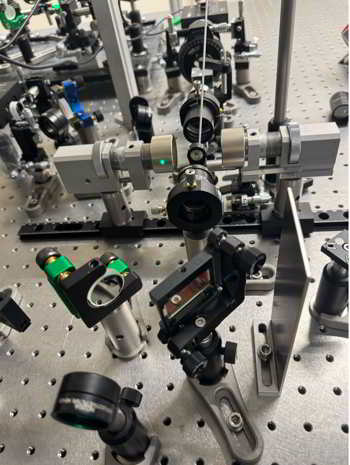
Why is this important? By far the majority of digital data in the cloud is stored magnetically. Control of the frequency of magnetic oscillations means controlling the rate of data writing and transfer. Possible future data technologies will store and transfer data using ‘spin waves’. This is the starting point for Bossini’s method that shows how the frequency of such spin waves can be increased or decreased by up to 40%.
Using everyday equipment at room temperature
For Davide Bossini, it is important for his methods to work with everyday equipment and materials. “We don’t need a self-developed custom laser“, Bossini emphasizes.
His experiments were conducted using a commercially available laser system. He also used conventional permanent magnets to generate the magnetic field. “We did everything at room temperature“, Bossini adds. By contrast, magnetic materials are often studied at low temperatures of 80 degrees Kelvin (-193.15°C) or colder. “At 20 nanometres thick, the material we used is thus suitable for computer chips“, Bossini explains.
The experiments were conducted by the research team led by Davide Bossini at the University of Konstanz. The sample materials were prepared by ETH Zurich, and the theoretical foundations were laid by the Italian partners at the Polytechnic University of Bari and the University of Messina. The research findings were published in Nature Communications.
Key facts:
- Original publication: Volker Wiechert, Hanchen Wang, William Legrand, Pietro Gambardella, David Breitbach, Philipp Pirro, Michaela Lammel, Andrea Meo, Giovanni Finocchio and Davide Bossini, On demand laser-induced frequency tuning of coherent magnons in a nanometer-thick magnet at room temperature, Nat Commun 17, 145 (2026)
- Research project of the University of Konstanz in collaboration with ETH Zurich, RPTU University Kaiserslautern-Landau, Polytechnic University of Bari and the University of Messina
- Funding provided by the German Research Foundation (DFG), the ETH Zurich Postdoctoral Fellowship programme, the Italian Ministry of University and Research as well as the Petaspin Association
Article: On demand laser-induced frequency tuning of coherent magnons in a nanometer-thick magnet at room temperature
Nature Communications has published an article written by Volker Wiechert, Department of Physics and Center for Applied Photonics, University of Konstanz, Konstanz, Germany, Hanchen Wang, William Legrand, Pietro Gambardella, Department of Materials, ETH Zurich, Zurich, Switzerland, David Breitbach, Philipp Pirro, Fachbereich Physik and Landesforschungszentrum OPTIMAS, Rheinland-Pfälzische Technische Universität Kaiserslautern-Landau, Kaiserslautern, Germany, Michaela Lammel, Department of Physics and Center for Applied Photonics, University of Konstanz, Konstanz, Germany, Andrea Meo, Department of Electric and Information engineering, Politecnico di Bari, Bari, Italy, Giovanni Finocchio, Department of Mathematical and Computer Sciences, Physical Sciences and Earth Sciences, University of Messina, Messina, Italy, and Davide Bossini, Department of Physics and Center for Applied Photonics, University of Konstanz, Konstanz, Germany.
Abstract: “The collective vibrational and magnetic response of a solid to external stimuli is encoded in the dispersion relations of phonons and magnons, respectively. Recently, the coherent drive and nonlinear manipulation of collective lattice and magnetic excitations via laser pulses has been explored, as a route to control the non-equilibrium properties of quantum materials. Device concepts that leverage coupled multiphysical dynamics must exhibit laser-induced frequency tunability controllable through external parameters. Although previous works have shown that optically driven excitations in the midinfrared can manipulate magnon frequencies, inducing deterministic red- or blue-shifts of the magnon frequency in the same material is still elusive. Here we demonstrate this concept in a nanometer-thick magnet at room temperature. Visible light pulses in combination with an external magnetic field (<200 mT) can either raise or lower the magnon frequency by up to 40% of its original value. This effect results from the interplay of the optical excitation, magnetic anisotropy and external magnetic field. Our results show how an efficient manipulation of magnons can be achieved by light and provide perspectives for the realization of logic devices optically reconfigurable on the nanosecond timescale.“









 Subscribe to our free daily newsletter