








Novachips Unveils Self-Encrypting P2-series SSDs Compliant with CNSA 2.0
Including NV7X processor and available in various form factors of 2.5-inch SATA, U.2 / M.2 for PCIe, and USB flash drive with user capacity ranging from 500GB to 16TB
This is a Press Release edited by StorageNewsletter.com on January 9, 2026 at 2:01 pmNovachips Co., Ltd., innovator in flash storage solutions, introduced the new P2-series SSDs, which will allow the embedded system developers and system integrators to meet PQ (Post-quantum) cryptography security requirements by adopting general-purpose QR (Quantum-resistant) algorithms recommended by CNSA 2.0.
NV7X processor
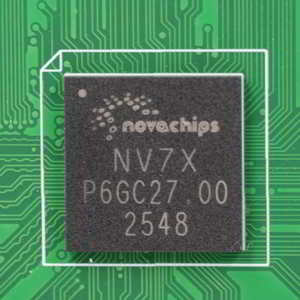
The P2-series is a new family of self-encrypting SSDs based on an in-house NV7X processor. Compared to its predecessor (the P-series), it offers upgraded RW bandwidth, new QR algorithms, and improved power efficiency. The P2-series supports ML-KEM-1024 (FIPS 203), ML-DSA-87 (FIPS 204), and other general-purpose post-quantum algorithms (NIST Cert #A7341). It also includes a physical entropy source accessible via its Crypto API, enabling host systems to migrate to post-quantum cryptographic standards without requiring additional hardware or software components.
“PQ algorithms such as ML-KEM and ML-DSA, compared to the classical asymmetric algorithms, require 5 ~ 20 times longer processing time to complete key establishment or to generate/verify the signature,” said Sejong Yoo, GM, Novachips. “By adopting P2-series SSDs, the customers not only use it as the encrypted storage but also execute the general-purpose QR algorithms without occupying the host CPU resources. This will be an efficient solution for edge computing devices pursuing the PQ cryptographic standard without compromising the quality of service.”
P2-series SSDs are available in various form factors of 2.5-inch SATA, U.2 / M.2 for PCIe, and USB flash drive with user capacity ranging from 500GB to 16TB. These products are designed to operate in extreme shock, vibration, humidity, temperature, and high-altitude environments to meet MIL-STD-810G standard. FIPS-140-3 and Common Criteria security validation are planned to be completed as its predecessor (the P-series) has already been completed.







 Subscribe to our free daily newsletter