





Goodram Introduced a 122TB QLC SSD PCIe Gen5
Coming from Poland
By Philippe Nicolas | January 6, 2026 at 2:00 pmWilk Elektronik SA is a European manufacturer of memory and storage products and the company behind the Goodram and IRDM brands. Its data-center division, Goodram Enterprise, has quietly expanded its lineup with a massive 122.88TB PCIe 5.0 SSD. As the company has a deal with Phison it appears that this drive is pretty similar to the Pascari D205V..
The new model is part of the DC25F series and uses QLC NAND in both E3.S and E3.L form factors. These variants are designed specifically for servers intended for direct liquid immersion cooling rather than traditional air-cooled environments. Somewhat amusingly, the company also offers a product called “DataCore,” stylized with a capital “C” in the middle, as shown on its enterprise SSD products page.
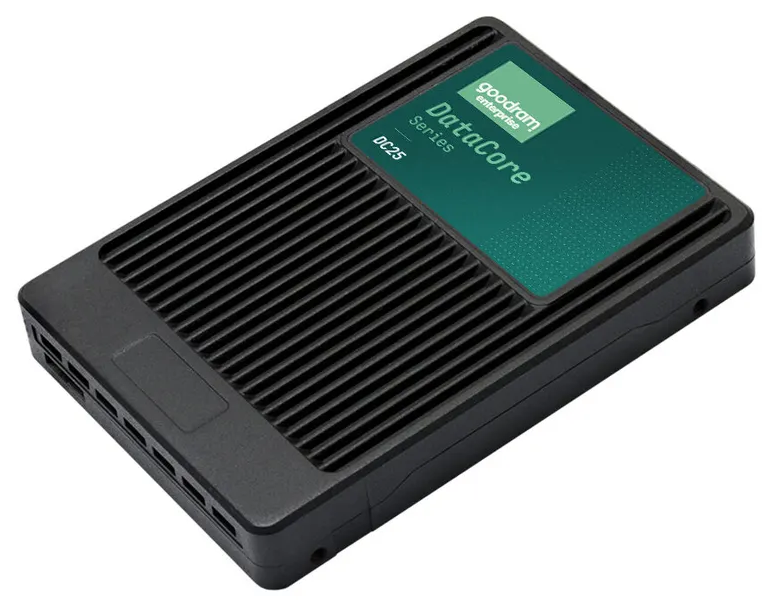
According to specifications, the drive delivers sequential read speeds of up to 14.6GB/s and write speeds of up to 3.2GB/s. Random performance is rated at roughly 3 million IOPS for reads and 35,000 IOPS for writes, underscoring that this SSD is optimized for capacity rather than peak performance.
Endurance is specified at 0.3 drive writes per day over a five-year lifespan, aligning it with other ultra-high-capacity enterprise QLC SSDs aimed at cold and warm data storage tiers.
Immersion cooling is a key aspect of the design. Goodram Enterprise says its SSDs have been validated for use with common dielectric fluids found in immersion tanks, including formulations from Shell and Chevron. Such environments subject hardware to chemical, thermal, and material stresses not encountered in air-cooled racks, and the company claims its drives are engineered to withstand long-term submersion without electrical degradation.
The 122.88TB model complements a broader portfolio of PCIe Gen4 and Gen5 enterprise SSDs, with capacities ranging from under 2TB to beyond 120TB across both TLC and QLC options.
Although immersion cooling remains a niche outside hyperscale and research deployments, interest is increasing as rack power densities rise. PCIe 5.0 SSDs further intensify thermal demands, making liquid-based cooling solutions more appealing.
What’s most striking is the lack of attention this release has received. Despite combining an extremely high capacity with a PCIe 5.0 interface—placing it among the largest SSDs of its kind—the drive arrived with little fanfare and no major announcement cycle.








 Subscribe to our free daily newsletter