





From Japan: New Magnetic Material for AI Era
Joint research team demonstrated that thin films of Ruthenium dioxide (RuO₂) exhibit altermagnetism, 3rd fundamental class of magnetic behavior, distinct from ferromagnetism and antiferromagnetism
This is a Press Release edited by StorageNewsletter.com on December 31, 2025 at 2:00 pmA joint research team from the National Institute for Materials Science (NIMS), the University of Tokyo, Kyoto Institute of Technology, and Tohoku University has demonstrated that thin films of ruthenium dioxide (RuO₂) exhibit altermagnetism, a 3rd fundamental class of magnetic behavior, distinct from ferromagnetism and antiferromagnetism.
(Source: Tohoku University)
Magnetic materials play a central role in modern information technology, particularly in memory devices. Conventional ferromagnetic materials allow data to be written easily using external magnetic fields, but they are vulnerable to interference from stray fields, which can cause errors as device density increases. Antiferromagnetic materials are resistant to such disturbances, yet their canceling spin structure makes it difficult to electrically read stored information.
Altermagnets offer an alternative. They possess no net magnetization, like antiferromagnets, while still allowing electrical readout of spin-dependent properties. This combination has attracted interest for applications such as high-speed and high-density memory. However, experimental results on whether RuO₂ truly exhibits altermagnetism have varied, partly due to challenges in fabricating high-quality samples.
To address this issue, the research team fabricated RuO₂ thin films with a single crystallographic orientation on sapphire substrates. By carefully selecting the substrate and fine-tuning growth conditions, the researchers were able to control how the atomic lattice aligned during film formation. This control was essential for obtaining consistent and interpretable magnetic behavior.
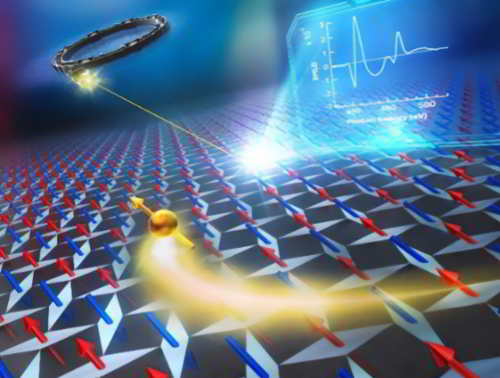
Using X-ray magnetic linear dichroism, the team directly identified the spin arrangement in the films and confirmed that the magnetic poles cancel each other out. They also observed spin-split magnetoresistance, meaning that the electrical resistance depends on spin orientation. This provided electrical evidence of a spin-split electronic structure, supporting the presence of altermagnetism.
The relationship between crystallographic orientation and magnetic behavior can be compared to laying tiles on a floor. If the tiles are placed at random angles, patterns are difficult to recognize. When they are aligned in a single direction, the overall structure becomes clear. In a similar way, aligning the crystal axes of RuO₂ made its underlying magnetic properties observable.
“These results show that controlling crystallographic orientation is key to revealing and utilizing altermagnetism in RuO₂ thin films,” said a member of the research team. “This approach allows us to connect theoretical predictions with experimental observations.”
Schematic illustration of altermagnetism in a single-orientation RuO₂ thin film,
depicted based on X-ray magnetic linear dichroism and spin orientations.
(© Tohoku University)
The experimental findings were consistent with first-principles calculations, strengthening confidence in the interpretation. Together, the results identify RuO₂ thin films as a practical platform for studying altermagnetism and evaluating its suitability for device applications.
Looking ahead, the team plans to explore memory devices that use RuO₂ thin films to achieve efficient, high-speed information processing. The synchrotron-based magnetic analysis techniques developed in this work can also be applied to other candidate altermagnetic materials, supporting broader research in spintronics.
The study was published online in Nature Communications on September 24, 2025 (see below).
This project was carried out by a research team led by Zhenchao Wen (senior researcher, Spintronics Group (SG), Research Center for Magnetic and Spintronic Materials (CMSM), NIMS), Cong He (postdoctoral researcher, SG, CMSM, NIMS at the time of the research), Hiroaki Sukegawa (group leader, SG, CMSM, NIMS), Seiji Mitani (managing researcher, SG, CMSM, NIMS), Tadakatsu Ohkubo (deputy director, CMSM, NIMS), Jun Okabayashi (associate professor, School of Science, The University of Tokyo), Yoshio Miura (professor, Kyoto Institute of Technology) and Takeshi Seki (professor, Tohoku University).
This work was supported by the JSPS Grants-in-Aid for Scientific Research (grant numbers: 22H04966, 24H00408); the MEXT Initiative to Establish Next-Generation Novel Integrated Circuits Centers (X-NICS) (grant number: JPJ011438); the GIMRT Program of the Institute for Materials Research, Tohoku University; and the Cooperative Research Projects of the Research Institute of Electrical Communication, Tohoku University.
Article: Evidence for single variant in altermagnetic RuO2(101) thin films
Nature Communications has published an article written by Cong He, National Institute for Materials Science (NIMS), Tsukuba, Japan, Zhenchao Wen, National Institute for Materials Science (NIMS), Tsukuba, Japan, Jun Okabayashi, Research Center for Spectrochemistry, The University of Tokyo, Bunkyo, Tokyo, Japan, Yoshio Miura, National Institute for Materials Science (NIMS), Tsukuba, Japan, and Faculty of Electrical Engineering and Electronics, Kyoto Institute of Technology, Kyoto, Japan, Tianyi Ma, National Institute for Materials Science (NIMS), Tsukuba, Japan, Tadakatsu Ohkubo, National Institute for Materials Science (NIMS), Tsukuba, Japan, Takeshi Seki, Institute for Materials Research, Tohoku University, Sendai, Japan, and Center for Science and Innovation in Spintronics, Tohoku University, Sendai, Japan ; Hiroaki Sukegawa, National Institute for Materials Science (NIMS), Tsukuba, Japan, and Seiji Mitani, National Institute for Materials Science (NIMS), Tsukuba, Japan.
Abstract: “Altermagnetism presents intriguing possibilities for spintronic devices due to its unique combination of strong spin-splitting and zero net magnetization. However, realizing its full potential hinges on fabricating single-variant altermagnetic thin films. In this work, we present definitive evidence for formation of single-variant altermagnetic RuO2(101) thin films with fully epitaxial growth on Al2O3(1\(\bar{1}\)02) r-plane substrates, confirmed through rigorous structural analyses using X-ray diffraction, atomic-resolution transmission electron microscopy and X-ray magnetic linear dichroism. The mutual correspondence of the occupancy of oxygen atoms on the surfaces of RuO2(101)[010] and Al2O3(1\(\bar{1}\)02)[11\(\bar{2}\)0] plays a decisive role in the formation of the single-variant RuO2, which is also supported by our first-principles density functional theory calculations. We further observed spin-splitting magnetoresistance in the single-variant RuO2(101)/CoFeB bilayers, highlighting the characteristic effect of single variant on spin transport. The demonstration of single-variant RuO2(101) films marks a significant advancement in the field of altermagnetism and paves the way for exploring their potential applications“








 Subscribe to our free daily newsletter