






DapuStor and ZTE Partner to Build Green, High-Efficiency Data Centers with Immersion Cooling SSDs
Demo using J5 Series SSDs
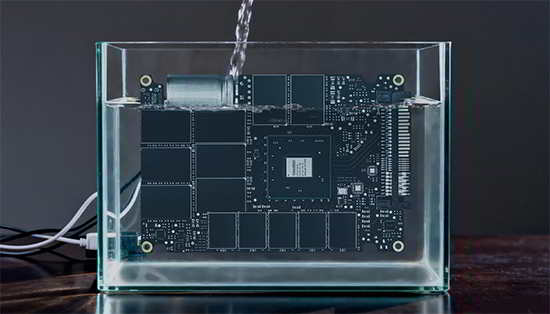
This is a Press Release edited by StorageNewsletter.com on December 30, 2025 at 2:01 pmAs data centers evolve toward higher density and extreme computing power, traditional air cooling is hitting its physical limits. Immersion cooling – where hardware is fully submerged in efficient, insulating dielectric fluid – is emerging as the new standard for thermal management, moving rapidly from pilot programs to large-scale deployment. Recently, DapuStor Corp. successfully deployed its customized liquid-cooled SSD solution (based on the J5 Series) within ZTE’s server infrastructure. Recognized as a premier ‘Green Data Center Demonstration Project,’ this collaboration sees ZTE Corp. providing the full-stack solution and DapuStor delivering the critical storage components, jointly setting a new benchmark for green computing.
The system is now fully operational with DapuStor J5 Series SSDs. The drives have demonstrated stability and reliability under continuous RW loads, marking a significant engineering breakthrough for enterprise SSDs in immersion environments.
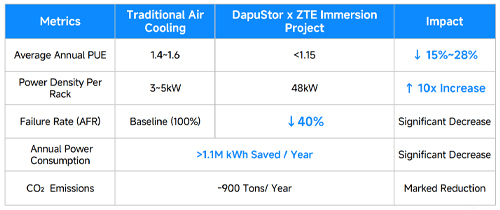 *Source: Public data. Configuration includes 24 liquid-cooled racks (48kW/rack),
6 CDUs, and 30,000 liters of eco-·friendly synthetic oil as the
cooling medium, supporting 200 ZTE immersion servers.
The Challenge: Reliability in Extreme Environments
Immersion cooling imposes rigorous reliability standards on storage hardware. While it offers superior heat dissipation, it creates a challenging environment for standard electronics. Long-term immersion in dielectric fluid exposes enterprise SSDs to multidimensional risks, including chemical erosion, thermal cycling, material incompatibility, and changes in dielectric properties.
- Microscopic Penetration: Coolant oil can penetrate microscopic structural gaps, potentially triggering corrosion or signal insulation decay
- Accelerated Aging: Under the combined stress of high temperatures and active electric fields, material aging accelerates significantly
For standard SSDs, these micro-changes can accumulate into systemic failures. Achieving long-term reliability requires a comprehensive system-level adaptation of underlying materials, structures, and manufacturing processes.
The Solution: J5 Liquid-Cooled eSSD
The J5 Liquid-Cooled eSSD deployed in ZTE’s system is engineered specifically for these extreme conditions. DapuStor implemented systematic reinforcements across material selection, structural layout, and manufacturing craftsmanship:
- Material Compatibility: All critical materials underwent rigorous screening to ensure no swelling, embrittlement, or precipitation after long-term contact with mainstream coolants
- Surface Integrity: PCBs and core components feature stabilized surface properties to effectively block fluid penetration and chemical erosion, guaranteeing signal integrity and long-term stability
- Rigorous Validation: Every unit passed strict validation protocols involving long-term full-load operation in simulated immersion environments, ensuring a ‘Plug-and-Play’ delivery capability
Fueling AI Era with High-Density Deployment
The explosion of AI is driving chip TDP (Thermal Design Power) sky-high, making liquid cooling an inevitable path for next-gen data centers. Beyond its superior thermal control, immersion cooling eliminates fan vibration and airflow disturbances, creating an ideal environment for storage stability.
However, traditional air-cooled SSDs – designed merely for basic dust and moisture resistance – cannot survive this transition. DapuStor’s innovation ensures that storage devices thrive in liquid environments. Even in high-load, high-density AI scenarios, the J5 SSD delivers consistent top-tier performance and low latency:
- Seq. R/W: up to 7.4 / 7 GB/s
- Random R/W: up to 1,750K / 340K IOs
- Latency: as low as 67 / 9 μs
Leading Industry Forward
DapuStor remains focused on advancing storage technologies for extreme operating environments. The successful deployment of this liquid-cooling solution reflects not only the company’s immersion-ready storage capabilities, but also the effectiveness of close system-level collaboration with ZTE. Through this partnership, advanced storage reliability is no longer a theoretical goal, but a proven engineering reality.










 Subscribe to our free daily newsletter