




HighPoint Launches MCIO-PCIEX16-G5 Bridge to High-Performance PCIe Gen5 Expansion
Device converts 2 high-density MCIO 8i ports into full-sized PCIe 5.0 x16 slot, enabling customers to install additional GPU, FPGA, I/O accelerator, or any high-performance PCIe Gen5 device into scalable switching fabric created by Rocket Gen5 adapters
This is a Press Release edited by StorageNewsletter.com on December 1, 2025 at 2:01 pmHighPoint Technologies, Inc. launches the MCIO-PCIEX16-G5 bridge card – a performance expansion component that enhances the flexibility and scalability of the company’s Rocket Series PCIe Switching Expansion adapters.
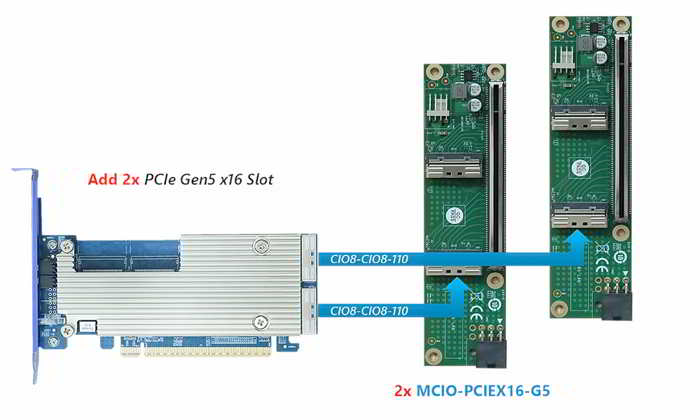 This device converts 2 high-density MCIO 8i ports into a full-sized PCIe 5.0 x16 slot, enabling customers to install an additional GPU, FPGA, I/O accelerator, or any high-performance PCIe Gen5 device into the scalable switching fabric created by the company’s Rocket Gen5 adapters. This capability enables the bridge card to serve as a flexible and modular hardware platform, enabling solution providers, system integrators and enterprise IT design, build and deploy next-gen expansion solutions to unify compute and NVMe storage through a single, high-bandwidth architecture.
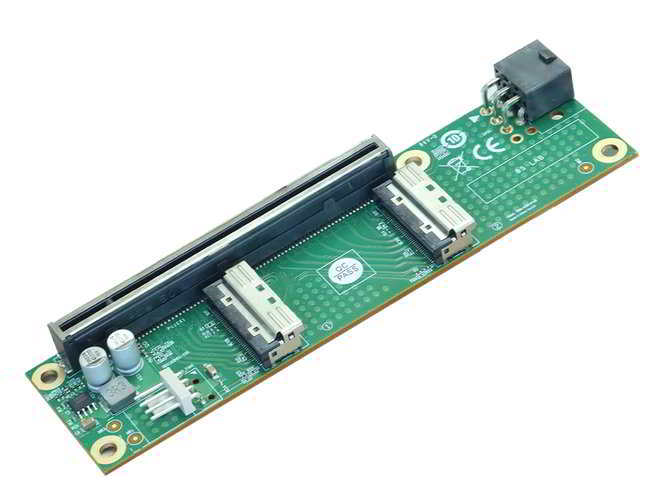 Building Foundation for Scalable, High-Bandwidth PCIe Gen5 Architectures
The company’s Rocket PCIe Switching Expansion adapters, when used in conjunction with the MCIO-PCIEx16-G5 bridge card, can be deployed to operate as centralized switch hubs for modern PCIe Gen5 hardware ecosystems. The modular, reconfigurable hardware platform allows integrators and enterprise IT architects to tailor NVMe storage and I/O device configurations for specialized workflows:
- Implement NVIDIA GPUDirect Storage (GDS) to consolidate compute and NVMe storage through a unified, single-adapter topology.
- Expand host computation with additional GPUs or Gen5 PCIe I/O devices for AI training, inference, simulation, and visualization workloads.
- Maximize bandwidth utilization and eliminate PCIe lane contention in data-intensive environments such as LLM training, edge inference, and multi-GPU rendering.
This flexible, unified PCIe Gen5 expansion platform enables system architects to design non-blocking, peer-to-peer PCIe infrastructures capable of sustaining the throughput and low latency required by modern AI, HPC, and data center workloads.
Driving Simplified PCIe Expansion and Integration
“Our goal is to simplify the design and implementation of high-performance PCIe expansion infrastructure,” said May Hwang, marketing director, HighPoint Technologies. “By standardizing MCIO connectivity across our Gen5 adapter family, we’re enabling integrators and OEMs to build scalable and customizable device and storage expansion solutions that maximize bandwidth and streamline the path between compute and storage.”
Key Benefits of HighPoint’s MCIO Connectivity and Expansion Architecture
The firm’s MCIO standardization strategy provides a robust, future-proof hardware foundation for data-centric and AI-driven environments – empowering integrators, OEMs, and enterprise IT engineers to scale with confidence.
- Universal Compatibility: The architecture has been standardized across all HighPoint Gen5 NVMe and Switch adapters for scalability with x86 (Intel/AMD) and ARM platforms, fully supported by all major operating systems.
- Dedicated Bandwidth: Proven PCIe Switching technology ensures non-blocking, dedicated throughput. Each MCIO x8 port provides up to 64GB/s (Gen5 x8) – preventing I/O contention and maintaining predictable performance.
- High Signal Integrity: Optimized for the demanding PCIe Gen5 32GT/s signaling rate, the architecture ensures minimal signal loss across 1-meter certified MCIO cabling for reliable high-speed communication between PCIe devices and NVMe storage media.
- Compact and Efficient: The low-profile form factors and standardized MCIO connectivity interface make it an expansion platform for dense rackmount, edge, and embedded systems where space, airflow, and modularity are critical.
- Flexible, Modular Approach to PCIe and Storage Expansion: The architecture is fully compatible with UBM/VPP storage backplanes, U.2/U.3/E3.S drive bays, MCIO mobile racks, and HighPoint MCIO-PCIEX16-G5 Bridge Cards, delivering a cohesive, open, and interoperable Gen5 hardware ecosystem.
Unified Hardware Backbone for the PCIe Gen5 Era
The company’s MCIO Connectivity Architecture establishes a robust, scalable, and standards-driven foundation for PCIe Gen5 storage, I/O, and compute ecosystems. Every HighPoint Gen5 Switch adapter leverages this unified MCIO framework – empowering system integrators, OEMs, and enterprise IT engineers to design and deploy high-bandwidth, low-latency compute and storage infrastructures for AI, HPC, cloud, and edge computing workloads.
The introduction of the MCIO-PCIEX16-G5 Bridge card extends this architecture even further by enabling direct, high-integrity GPU and accelerator expansion from any MCIO-equipped HighPoint adapter. This bridge card transforms the MCIO architecture into a truly modular, end-to-end Gen5 ecosystem, allowing builders to integrate additional GPUs, FPGAs, or specialized PCIe Gen5 devices without redesigning their system topology. Together, the Rocket PCIe Switching adapters and MCIO-PCIEX16-G5 Bridge card create a unified, flexible hardware backbone that scales from high-density NVMe storage to GPU-accelerated computing with uncompromised bandwidth, reliability, and design efficiency.
HighPoint PCIe Gen5 MCIO Solutions (Select Models and Components)
|
Model |
Ports / Interface |
Description |
|---|---|---|
|
4 × MCIO Ports |
PCIe Gen5 x16 Switch Adapter |
|
|
2 × MCIO Ports |
PCIe Gen5 x16 Switch Adapter |
|
|
1 × External CDFP + 2 × Internal MCIO 8i |
External PCIe Gen5 x16 Switch Adapter |
The company’s PCIe Gen5 MCIO Connectivity Solutions and certified cabling products – including the new MCIO-PCIEX16-G5 Bridge Card – are available through the company’s global distribution network.
|
Model |
Description |
Supported Devices |
Key Applications |
|---|---|---|---|
|
Dual MCIO 8i to PCIe Gen5 x16 Bridge Card |
Supports up to 1x PCIe 5.0 x16 or 2x PCIe 5.0 x8 devices |
Edge and Enterprise PCIe and NVMe storage expansion |
|
|
MCIO x8 (Host) to Dual SFF-8639 (Device) |
Directly supports to up to 2× U.2/U.3 NVMe SSDs (x4 lane per device) |
Internal enterprise or workstation storage |
|
|
MCIO x8 (Host) to Dual SFF-8639 (E3.S Device) |
Directly supports to up to 2× E3.S NVMe SSDs |
High-density Edge and datacenter applications |
|
|
MCIO x8 (Host) to MCIO Backplane Cable |
Up to 8x NVMe or PCIe devices via UBM or MCIO backplanes |
Modular rackmount or system integration use |







 Subscribe to our free daily newsletter