









Synology Security Advisory: Resolved SA-23:01 ClamAV
Concerning Antivirus Essential, Synology Mail Server, and MailPlus Server
This is a Press Release edited by StorageNewsletter.com on March 23, 2023 at 2:00 pmSynology, Inc. had published a security advisory concerning resolved vulnerabilities.
Publish time: 2023-02-22 15:13:35 UTC+8
Last updated: 2023-03-16 09:55:19 UTC+8
Severity: Critical
Status: Resolved
Abstract
Multiple vulnerabilities allow remote attackers to possibly execute arbitrary code or local users to obtain sensitive information via a susceptible version of Antivirus Essential, Synology Mail Server, and Synology MailPlus Server.
Affected products:
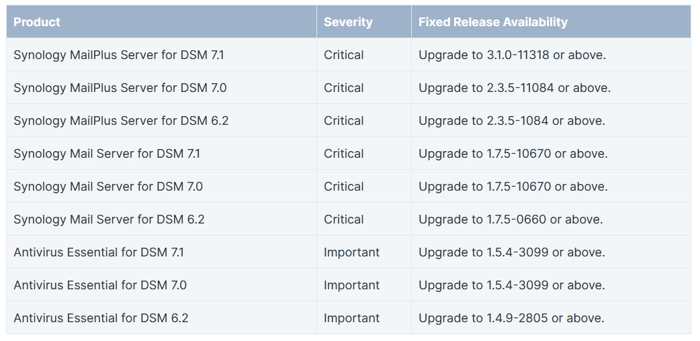 Mitigation : None
Detail :
-
CVE-2023-20032
- Severity: Critical
- CVSS3 Base Score: 9.8
- CVSS3 Vector: CVSS:3.1/AV:N/AC:L/PR:N/UI:N/S:U/C:H/I:H/A:H
- On February 15, 2023, the following vulnerability in the ClamAV scanning library was disclosed: A vulnerability in the HFS+ partition file parser of ClamAV versions 1.0.0 and earlier, 0.105.1 and earlier, and 0.103.7 and earlier could allow an unauthenticated, remote attacker to execute arbitrary code. This vulnerability is due to a missing buffer size check that may result in a heap buffer overflow write. An attacker could exploit this vulnerability by submitting a crafted HFS+ partition file to be scanned by ClamAV on an affected device. A successful exploit could allow the attacker to execute arbitrary code with the privileges of the ClamAV scanning process, or else crash the process, resulting in a denial of service (DoS) condition. For a description of this vulnerability, see the ClamAV blog [https://blog.clamav.net/].
-
CVE-2023-20052
- Severity: Low
- CVSS3 Base Score: 2.3
- CVSS3 Vector: CVSS:3.1/AV:L/AC:L/PR:H/UI:N/S:U/C:L/I:N/A:N
- On February 15, 2023, the following vulnerability in the ClamAV scanning library was disclosed: A vulnerability in the DMG file parser of ClamAV versions 1.0.0 and earlier, 0.105.1 and earlier, and 0.103.7 and earlier could allow an unauthenticated, remote attacker to access sensitive information on an affected device. This vulnerability is due to enabling XML entity substitution that may result in XML external entity injection. An attacker could exploit this vulnerability by submitting a crafted DMG file to be scanned by ClamAV on an affected device. A successful exploit could allow the attacker to leak bytes from any file that may be read by the ClamAV scanning process.
Reference
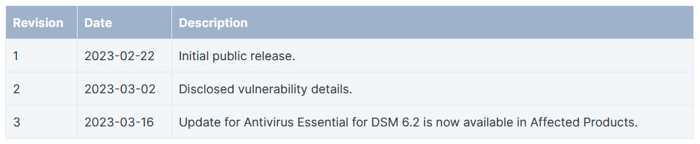
Revision:
Share this news :








 Subscribe to our free daily newsletter