



How Businesses Find Perfect SSDs for Business Applications?
Kioxia answers.
This is a Press Release edited by StorageNewsletter.com on January 21, 2022 at 2:02 pm By Frederik Haak, senior marketing manager, SSD product marketing, Kioxia Europe GmbH
Many modern data center applications require high throughput rates and low latencies, which is why SSDs are becoming the storage medium of choice. A wide product range is available on the market, with diverse form factors, interfaces and transmission protocols, as well as performance and endurance specs. But which specs do businesses have to watch out for when planning SSDs for specific activity fields?
With digitization forging ahead, growing data quantities have to be processed faster and faster, placing more demands on data centers. Characterized by high data throughput and low latency, SSDs are increasingly being used as storage media. By now, there is a massive selection of SSDs available on the market, suitable for an equally diverse range of applications. Consequently, businesses must take various factors into consideration when choosing a solution. On the other hand, this also enables them to use SSDs that seamlessly fit the planned application.
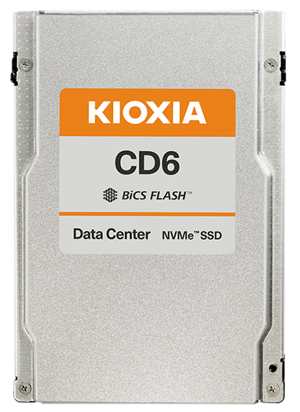
High-performance requirements of many data center applications can often only be met with SSDs that support NVMe – the protocol specifically developed for flash storage to fully leverage the speed benefits of fast media.
(Source: Kioxia)
The key parameters businesses should factor in are latency, write and read speed, form factor, interface standard and transmission protocol, as well as endurance, or the number of write cycles for which an SSD is designed. These must fit the planned application as well as the available and future infrastructure, while being technically and economically sensible. If businesses are looking, for example, to speed up the affordable mass storage of a server or storage system with an SSD cache, they will require SSDs that deliver great performance and last for many write cycles. SAS SSDs with a drive writes per day (DWPD) value of up to 10 are often combined as a cache with SAS HDDs. The DWPD value indicates how often the drive can be written per day, at full capacity, over its entire life cycle – usually the warranty period. If the system already has fast NVMe SSDs for mass storage, storage class memory (SCM) SSDs are more suitable for cache use, because they offer even greater performance and, depending on the model, more than 30 DWPD. These caching drives usually have a relatively low capacity – 400GB to 3.2TB – because they do not permanently store data, but rather serve as interim storage for faster provision.
SSDs can also speed up many systems as boot drives, in this case generally requiring smaller capacities and lower endurance, with the OS placing very low demands on the storage medium. Conversely, demands placed on SSDs that are used as storage in server and storage systems within data centers are usually much higher. They combine high storage capacities with performance. Here, the required endurance depends on the applications. For applications requiring a relatively small number of write activities – such as the provision of media, a web shop or a file server – SSDs with low DWPD values suffice. For write-intensive workloads, such as database and analytics applications, as well as HPC, companies need SSDs with higher DWPD values. Ideally, businesses are aware of the write loads and the data quantities that must be written onto the storage in a given day.
Future is PCIe and NVMe
Whereas SSDs with the PCIe interface have become standard in servers, SSDs with the SAS interface offer dual-port functionality, and thus redundancy, which is why they are still frequently used in storage systems. Here too, there is a trend toward PCIe, because this interface offers very low latencies with high write and read rates together with the NVMe protocol. High-performance and relatively affordable storage systems can be integrated through the NVMeoF network protocol, which can also be used in existing TCP Ethernet networks. This is why manufacturers such as Kioxia Corp. also offer PCIe SSDs with dual ports.
Even with many SSDs still supporting SATA, these models are virtually only suited to upgrading existing systems, because they cannot leverage the actual potential of flash storage. The standard is not being developed anymore, and many SSD manufacturers do not have any new SATA SSDs on their roadmap either. Therefore, there is no way around PCIe SSDs when developing new infrastructures. The slight uptick in SATA SSD sales figures over recent months is primarily attributable to many companies extending the life cycle of old systems as a result of the insecure economic situation brought about by the pandemic.
The same goes for the 2.5-inch form factor, still popular because of drive compatibility with existing systems. By now, the Enterprise and Data Center SSD Form Factor (EDSFF) is establishing itself for SSDs. They are optimized for flash storage and allow for superior heat dissipation from the SSD surface – which is most important with the high-performance specs of PCIe SSDs from the fourth gen up, as well as drives with high storage capacities. They consume more power because of their capacity, which is why they also produce more heat.
Consumer SSDs have no business in data centers
If there are no system restrictions, for example regarding the number of slots or controller ports, high-capacity drives are usually the more attractive choice because of the lower costs per capacity unit. However, with 15 or 30TB SSDs, the manufacturer might have specified lower write/read performances to avoid exceeding the specified maximum power consumption. Companies that need top-notch performance above all are therefore advised to opt for a larger number of smaller SSDs. Nevertheless, they should be aware that performance might deteriorate as the drive fills up, because the organization of the flash storage in pages and blocks requires the controller to clear up more to write data.
SSD manufacturers such as Kioxia, however, continuously improve the algorithms used for clearing up drives, counteracting performance drops through increased overprovisioning. Overprovisioning with storage cells is already standard in SSDs.
Because the cells wear out, algorithms try to distribute the data over the available cells as evenly as possible – if cells fail, the stored data is restored using correction processes and backed up on replacement cells. This is how enterprise SSDs manage to achieve higher DWPD values, and with that, a longer service life than consumer SSDs. Moreover, contrary to consumer SSDs, the former come with power loss protection (PLP) through internal capacitors, which still provide sufficient power in the event of a cut to the power supply to store all data from the SSD cache, preventing any data loss. This is another reason why more affordable consumer SSDs are not suited to use in data centers.







 Subscribe to our free daily newsletter