









Tape Storage Market in 2022
Had its ups and downs over last couple of decades.
This is a Press Release edited by StorageNewsletter.com on December 15, 2021 at 2:03 pm This report, published on December 6, 2021 by Enterprise Storage Forum, was written by Drew Robb currently working freelance for a number of IT publications, including eSecurity Planet and CIO Insight, and is also the editor-in-chief of an international engineering magazine.
Tape Storage Market in 2022
The tape storage market has had its ups and downs over the last couple of decades.
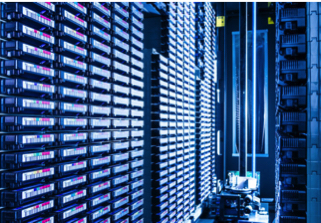
Tape supposedly perished about 15 years ago when de-dupe was being popularized. The storage brand Data Domain even ran a “Tape is Dead” campaign that successfully weaned people off tape as the primary medium being used for backup at the time. Disk-based backup rose to prominence.
For a while, it appeared that tape was indeed on the way out.
But like the mainframe computer, which “died” in the early nineties and is still in heavy use in large enterprise environments, tape found a new niche and quickly revived. Tape capacity shipments have been steadily rising for more than a decade. A record 114,079PB of total LTO tape capacity (compressed) shipped in 2019, about 4x more than shipped in 2009, according to the Tape Storage Council. And that number is expected to rise even further.
Tape Storage Features and Benefits
Tape continues to thrive due to a diverse collection of features and benefits.
• Tape offers an air gap: With data breaches and ransomware attacks escalating, tape provides an air gap between data and the network (i.e., archived tape is retained offline either at an offline facility or as part of an automatic tape library). If it’s offline, malware has no direct connection.
• Tape has high capacity: The newest LTO-9 tape cartridges hold 18TB native and 45TB compressed. One cartridge holds more than 60 years of video recording running 24 hours per day. Even larger cartridges are on the near horizon.
• Tape is green: While disk arrays are energy hogs, tape storage offers a way to greatly reduce power and cooling requirements. Unlike disk, tape cartridges sit idle in automated libraries, consuming no energy until the time they are accessed.
“Tape has a lower environmental impact as there is no need to have it constantly powered-on during storage, thereby reducing CO² emissions generated during its lifecycle by 95% compared to HDDs,” said Rich Gadomski, tape evangelist, FujiFilm Recording Media USA, Inc.
• Tape is cheaper: According to Gadomski, tape is 3x to 4x cheaper to use than disk for long-term storage. Economies of scale through tape enable cloud providers to offer their cheapest rates for lower-tier, tape-based archiving.
• Tape data transfers faster: Tape offers data transfer rates of 400MB/s, making it faster than disk.
• Tape lasts longer: Tape can be stored for up to 30 years. Most analysts say disk storage falters badly after 5 years.
• Tape is compact: Once you scale to hundreds of terabytes, disk storage loses feasibility. It eats up far more floor space than tape storage.
There are several use cases for tape storage:
• Long-term archiving: According to Fred Moore, president at Horison Information Strategies, data access again drops off rapidly after one month. After 100 days, it falls below 1%. While most enterprise data is soon forgotten, it often can’t be deleted for compliance reasons or due to its potential future value. Moore said at least 60% of all data can be classified as archival. That number could exceed 80% by 2025, he said. The best approach is to offload it to a tape archive.
• Tape backup: Many still use tape as a direct backup medium. Nightly, weekly, or incremental backups are made onto tapes stored onsite and offsite.
• Tape enables hyperscale: The big cloud providers rely on tape for high-volume, low-cost storage. They each have multiple PBs of data on tape, as do a great many large financial institutions.
• Object storage: Object storage has mushroomed in recent years. Those storing a lot of it on disk are now migrating some of it to tape to reduce costs. Appliances are even available to move native object files from disk to tape storage and back again.
Case in point: CERN (the European Organization for Nuclear Research) uses tape to store data collected in experiments using the Large Hadron Collider (LHC).
“Tape technology has been used at CERN for more than 5 decades, and we currently store around 400PB of data on tape,” said Vladimir Bahyl, senior storage engineer, CERN. “We have about 70PB of free space and expect to fill that up soon. The only cost-effective technology you can buy for large-scale, long-term storage is tape. Tape is also more secure due to its air gap. A copy of our data is retained offline but easily accessible.”
Tape Storage Manufacturers
There are plenty of vendors offering tape equipment and media.
The leading tape manufacturers include:
• IBM
• Hewlett Packard Enterprise (HPE)
• Quantum
• Spectra Logic
• FujiFilm
• Sony
• XenData
• Dell
• StarWind
• Strongbox Data







 Subscribe to our free daily newsletter