




Harvard University Chemists’ Dye Method Holds Promise for Long-Term Storage
Storing and reading information in mixtures of fluorescent molecules
This is a Press Release edited by StorageNewsletter.com on October 22, 2021 at 2:32 pmIn the digital age, every byte of data needs to go somewhere – and preferably stay there a long time. That last part is a major problem when it comes to storage systems, which typically last less than 20 years.
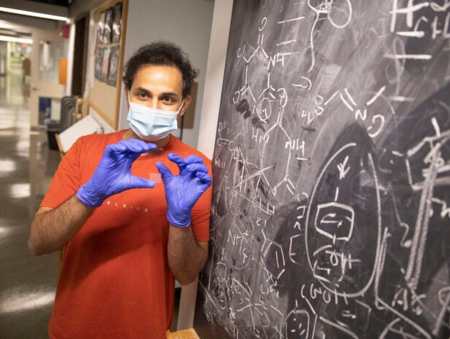
Amit Nagarkar helped develop storage system that uses fluorescent dyes.
(Photo: Kris Snibbe/Harvard staff photographer)
A group of Harvard University chemists is trying to solve the issue with an innovation that resembles tiny drops of ink.
In a paper in ACS Central Science, researchers from the George Whitesides lab describe a novel storage approach that uses mixtures of seven commercially available fluorescent dyes to save data files. The dyes are dropped by an inkjet printer and read with a microscope that can detect the different wavelengths of light each dye emits. The researchers then decode the binary message in the molecules back to documents, books, photos, videos, or anything else that can be digitally stored.
Theoretically, the data can be saved for a very long time – thousands of years or more. The long timeline of molecular storage options is superior to that of current media devices for storage, such as flash drives, Blu-rays, magnetic memory strips, and computer drives, which can store information for 40 years at most, have strict size limits, and are susceptible to water damage and hacking. Another shortcoming with traditional storage processes is that they gobble up energy. Even the cloud has a storage limit, requires huge and expensive physical servers, and is, of course, susceptible to being breached.
“This method could provide access to archival data storage at a low cost,” said Amit A. Nagarkar, co-lead author of the paper, who conducted the research as a postdoctoral fellow, Whitesides lab. “[It] provides access to long-term data storage using existing commercial technologies – inkjet printing and fluorescence microscopy.”
The dye method could be particularly helpful with information whose storage is regulated – financial and legal records, for example – and in cases in which long-term storage is crucial, as with satellite data. The dyes live outside the hackable internet, are relatively cheap to produce, and can’t be read without a special microscope. The technique uses no energy once the data is recorded.
Nagarkar displays tiny dye molecules used to store information.
(Photo: Kris Snibbe/Harvard staff photographer)
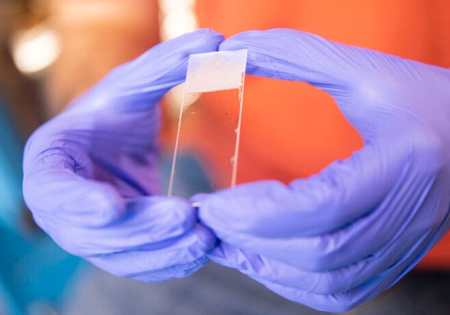
The dye molecules are dropped onto an epoxy surface to which they chemically bond, locking information in place. To translate the bits of information in the different dyes, the researchers used the American Standard Code for Information Interchange. Every number, letter, and pixel in the data they want to store is represented by a group of ones and zeros, depending on whether a particular dye is absent or present. The fluorescent microscope they use detects the presence or absence of the dye molecules. Knowing which dyes are there, they can decode the binary message. The researchers report that the information can be read with 99.6% accuracy, and in a 7.2-by-7.2mm surface they were able to write 1,407,542B of digital information with the dyes.
Harvard has licensed the technology to a new storage company co-founded by Nagarkar, Whitesides, the Woodford L. and Ann A. Flowers University Professor, and former postdocs Michael Fink and Alexei Ten, to develop the methods into a commercial product. Still in its early stages, the company is pursuing opportunities for partnerships with storage providers.
The recent paper builds on earlier work by the Whitesides lab in which researchers used peptides to store digital information.
For years, scientists have been exploring the use of different molecules and even synthetic DNA to store information, including GIFs, text, and music, only to be thwarted by factors like cost and the slow read and write speeds of those technologies. The dye method offers an enticing alternative because of its speed and cost. The system writes information at an average rate of 128b/s and reads it at a rate of 469. That is believed to be the fastest reported read speed of any molecular information storage method.
As a demonstration, the researchers stored a seminal paper by Michael Faraday, along with a JPEG image of the 19th-century English physicist and chemist. They chose Faraday because of his foundational work on electromagnetism and chemistry, which paved the way for electricity to become useful as a practical technology and ultimately led to the modern age of information, said Samuel Root, postdoctoral fellow, Whitesides lab, and co-author of the current paper.
The researchers believe storage methods like the dye innovation will become increasingly important in the 21st century.
“In the future, we will need to store large amounts of data as our society transitions to a digital society,” said Nagarkar.
This work was supported by the Defense Advanced Research Projects Agency.
Article: Storing and Reading Information in Mixtures of Fluorescent Molecules
ACS Central Science has published an article written by Amit A. Nagarkar, Samuel E. Root, Michael J. Fink, Alexei S. Ten, Brian J. Cafferty, Department of Chemistry and Chemical Biology, Harvard University, 12 Oxford Street, Cambridge, Massachusetts 02138, United States, Douglas S. Richardson, Harvard Center for Biological Imaging, 16 Divinity Avenue, Cambridge, Massachusetts 02138, United States, Milan Mrksich, Department of Chemistry and Department of Biomedical Engineering, Northwestern University, 2145 Sheridan Road, Evanston, Illinois 60208, United States, and George M. Whitesides, Department of Chemistry and Chemical Biology, Harvard University, 12 Oxford Street, Cambridge, Massachusetts 02138, United States.
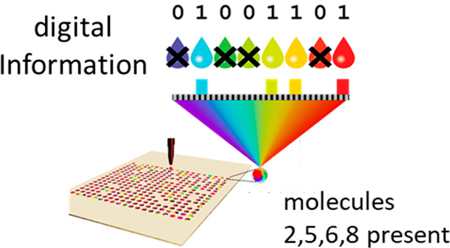
Abstract: “The rapidly increasing use of digital technologies requires the rethinking of methods to store data. This work shows that digital data can be stored in mixtures of fluorescent dye molecules, which are deposited on a surface by inkjet printing, where an amide bond tethers the dye molecules to the surface. A microscope equipped with a multichannel fluorescence detector distinguishes individual dyes in the mixture. The presence or absence of these molecules in the mixture encodes binary information (i.e., ‘0’ or ‘1’). The use of mixtures of molecules, instead of sequence-defined macromolecules, minimizes the time and difficulty of synthesis and eliminates the requirement of sequencing. We have written, stored, and read a total of approximately 400Kb (both text and images) with greater than 99% recovery of information, written at an average rate of 128b/s (16B/s) and read at a rate of 469b/s (58.6B/s).“








 Subscribe to our free daily newsletter