









History (1996): “The Sun Never Sets on Seagate’s Production of MR Heads”
One million units per week
By Jean Jacques Maleval | August 13, 2021 at 1:00 pmSeagate is now producing one million MR heads per week, and expects to reach two million heads weekly by the end of 1996.
Dr. Brendan Hegarty, executive VP and COO at Seagate Recording Heads Group (RHG), offered the following colorful adaptation of the old British Empire adage: “The sun never sets on Seagate’s production of MR heads.”
Whatever Seagate’s geopolitical designs may be, MR wafers are produced at fabrication facilities in Minnesota and Northern Ireland, sliders in Malaysia and HGAs in Thailand.
RHG has over 34,000 employees involved in the development and production of both MR and thin-film inductive magnetic recording heads (including proximity thin-film heads) at its 9 facilities worldwide.
Based in Normandale, MN, RHG has expanded its WW facilities by one million square feet over the past year, and its operations in Minnesota, California, Northern Ireland, Malaysia and Thailand now occupy over 2.6 million square feet.
The company has produced 600 million heads to date, with a current rate of 250 million units per year.
“Seagate is now supplying over 40% of the world market for thin-film heads, and MR heads make up nearly 25% of that total,” said Pat Bonnie, SVP, RHG.
Seven recently introduced Seagate HDDs are in volume production with MR heads, while 6 additional models utilizing these heads are currently in pilot production.
Analysts from Peripheral Research (Santa Barbara, CA) expect shipments of 297 million thin-film inductive heads as well as 170 million MR heads in 1996, compared to 280 million and 57 million units, respectively, in 1995.
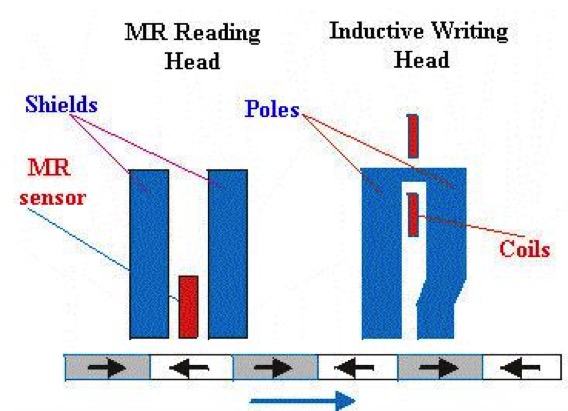
MR head technologies manufactured by RHG include SAL (Soft Adjacent Layer) and DSMR (Dual Stripe Magneto-Resistive) heads.
In 1995, Seagate obtained a license for DSMR technology from Headway Technologies, a company founded in 1994 by Hewlett-Packard, Komag and Asahi Glass.
Seagate is also presently developing giant magnetoresistive (GMR) spin-valve head technology, which should pave the way for even greater recording densities.
This article is an abstract of news published on the former paper version of Computer Data Storage Newsletter on issue 106, published on November 1996.








 Subscribe to our free daily newsletter