









RSC Technologies: Four Storage Systems Represent Russia in Global IO500 Rating
Current IO500 list includes new segment based storage on-demand solution with support of Intel AOS open source storage system.
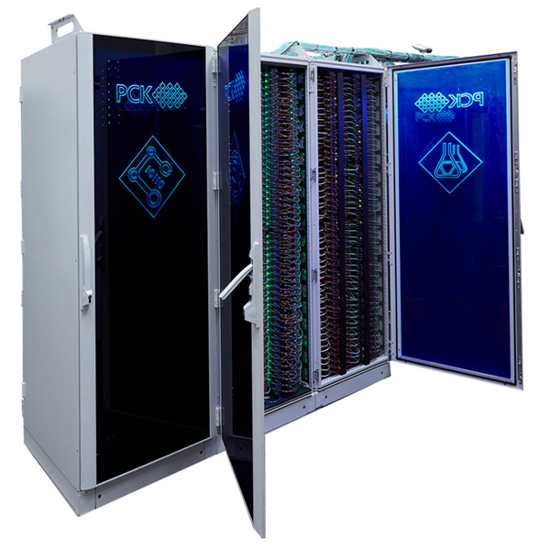
This is a Press Release edited by StorageNewsletter.com on July 15, 2021 at 2:01 pmFour storage systems have been installed by RSC Technologies, the Russian developer and integrator of high-dense energy-efficient solutions for HPC, data centers, cloud platforms and storage-on-demand. They are the only Russian systems in the global IO500 rating of the best performing HPC-grade storage (announced at ISC 2021, the European HPC exhibition).
The company has increased its presence in this list by 33% (from three systems in the previous rating).
Storage on-Demand solutions
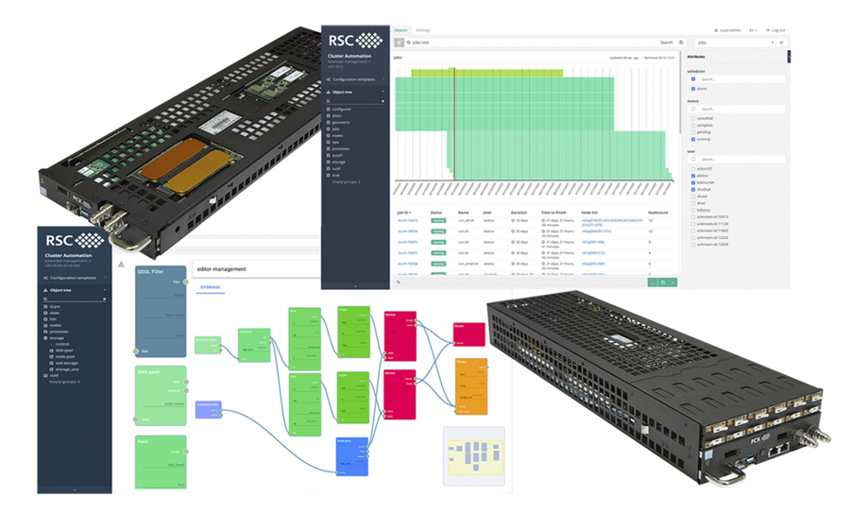
The current IO500 list includes a new segment based on the firm’s Storage on-Demand solution with support of Intel Corp.‘s DAOS open source storage system, which has been implemented at the Joint Institute for Nuclear Research (JINR, Dubna). It is the leading Russian system in the rating on the 27th position. This pilot project with DAOS support has been created for data processing purposes within the scope of NICA mega project. JINR’s Lustre based storage system is also a part of IO500 on 31st place. Storage system of MVS-10P OP2 HPC (Joint HPC Center of the Russian Academy of Sciences, JSCC RAS) holds 27th position in the list, and the storage system of Polytechnic RSC Tornado HPC (Saint Petersburg State Polytechnic University, SPbPU) stays on 36th place.
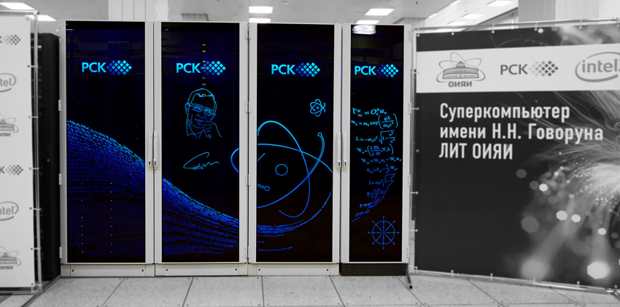
When Govorun HPC was just deployed at JINR in June 2018, it occupied the 9th place in the global IO500 rating.
DAOS support in the RSC Storage-on-Demand solutions
In addition to NFS and Lustre file systems, the company’s Storage on-Demand solutions now support Intel’s distributed open-source object storage system, DAOS (Distributed Asynchronous Object Storage). It provides highest processing speeds for various types of data in the distributed storage system.
Govorun HPC’s high-speed storage system is based on the firm’s disaggregated composable storage architecture.
This solution is for AI (ML/DL) segment. It enables multi-layered storage systems based on Lustre file system within Disaggregated Composable Infrastructure and flexible management of NVMe drive pools as well as DAOS-based storage systems with external distributed NVMe drive pool. This approach to DAOS realization enables performance storage with flexible capacity ratios between Intel Optane DC Persistent Memory modules and NVMe drives connected to DAOS server. This effectively provides flexible ‘on-demand’ configurations for specific user workloads. The ccompany‘s specialists used their experience in composable disaggregated solutions for DAOS management. It is now possible to use convenient RSC BasIS orchestration platform’s UI for DAOS-based systems.
DAOS provides performance increase with number of architectural principles:
-
Maximum efficiency of CPU/OS core resources, interrupts, context switching when data is moved from storage to the point of processing;
-
Storage of data with on-demand availability (metadata and data caches) on Storage Class Memory devices with efficient support of Byte Level Access;
-
Most transparent streaming of continuous and block-based R/W operations in NVMe-based devices.
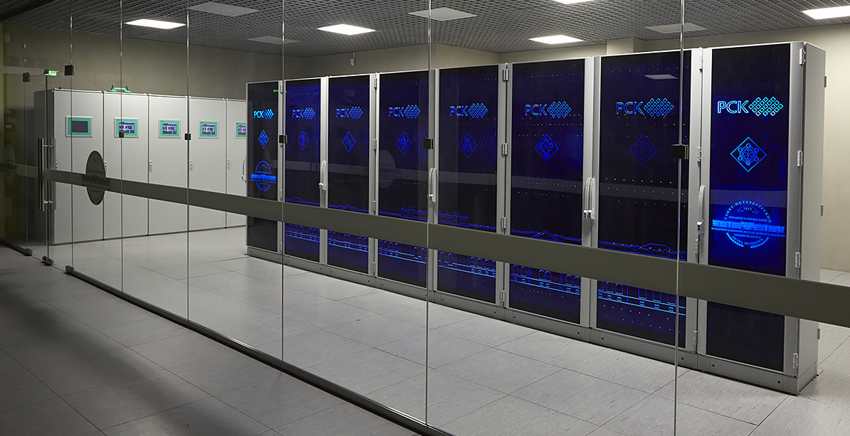
Storage on-Demand user interface
The firm‘s specialists have developed Storage on-Demand user interface that enables on-demand creation of complex multi-layered composable storage systems. This UI supports creation of parallel NFS, Lustre file systems, distributed DAOS storage systems and their combinations. These approaches have been described in JINR’s, RSC’s and Intel’s keynote at ISC 2021 on June 29.
HPC named after N. N. Govorun in JINR
Govorun HPC of the Joint Institute for Nuclear Research is a joint project of the Theoretical Physics Laboratory (TPL) named after N.N. Bogolyubov and Laboratory of IT (LIT) supported by JINR board. It was deployed in 2018 with help of specialists from RSC Group and Intel.
The initial installation the Govorun HPC in 2018 enabled a lot of complex and resource-intensive simulations in the field of quantum chromodynamics patterns for research of hadronic matter properties at high energy density and barion charge and in presence of extra strong electromagnetic fields/ It also accelerated gen and reconstruction of events for planned experiments for coming NICA ion collider. HPC boosted calculation speed of radiation safety of experimental JINR units; accelerated radiation biology research and other applied science problems at JINR; supported in international collaborations. Research results were published in over 50 leading global science journals, including Nature Physics.
JINR HPC was upgraded in 2019. The hyper-converged and software-defined system has total theoretical peak performance of 860 TFLOPS with double precision. It’s novel approach has features to make it adaptable for specific user workloads and maximize utilization of HPC’s resources.
Hyper-converged approach resulted in high-speed storage system for ‘Govorun’ with leading characteristics and cost-efficiency.
An implementation of ‘storage-on-demand’ approach in JINR HPC enables re-configuration of a specific storage system for each user or application with all required properties (capacity, speed, file system, persistence, reliability and security), which would also be impossible to achieve with standard, monolithic approach to HPC storage.
MVS-10P OP2 HPC at JSCC RAS
The Joint HPC Center of the Russian Academy of Sciences is one of the powerful Russian HPC centers in the field of science and high education. Over 150 research groups use HPC resources of JSCC RAS for solving fundamental and applied tasks.
Total peak performance of JSCC RAS systems deployed by RSC based on ultrahigh-dense and energy efficient RSC Tornado and RSC PetaStream solutions with 100% ‘hot water’ liquid cooling is currently 1.7 petaflops.
MVS-10P OP2 HPC at JSCC RAS had undergone another scheduled upgrade in 2020. Its peak performance has been increased by almost two times by 93% and is currently 823.91 teraflops.
‘Polytechnic – RSC Tornado’ HPC at SPbPU
St. Petersburg Polytechnic State University named after Peter the Great started creating one of a powerful and innovative HPC centers (SCC) in Russia with peak performance over 1.1 petaflops back in 2014, and ‘Polytechnic’ SCC has been commissioned successfully in 2015.
SPbPU HPC center is focused on solving inter-disciplinary natural science research tasks and design of complex technical systems for hi-tech segments of local industries and science. The overall peak performance of SPbPU HPCs has been increased by 23% in 2020 and currently amounts 1.6 petaflops.
After scheduled upgrade of ‘Polytechnic – RSC Tornado’ HPC in 2020 its peak performance has increased by 29% to 1.309 petaflops.








 Subscribe to our free daily newsletter