








R&D: Robust High-Performance Storage Through Magnetic Anisotropy
Observed experimentally for first time how special spin-lattice interaction in iron-platinum thin films cancels out thermal expansion of crystal lattice.
This is a Press Release edited by StorageNewsletter.com on July 29, 2020 at 2:02 pmFrom Helmholtz-Zentrum Berlin für Materialien und Energie, Berlin, Germany.
The latest generation of magnetic hard drives is made of magnetic thin films, which are invar materials.
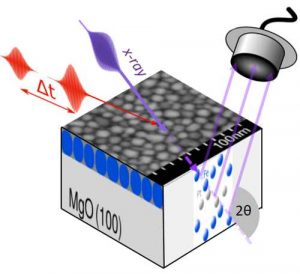
This is how the experiment went: Two laser pulses hit the thin film of iron-platinum nanoparticles at short intervals:
The first laser pulse destroys the spin order, while the second laser pulse excites the now unmagnetised sample.
An X-ray pulse then determines how the lattice expands or contracts.
(photo: © M. Bargheer/ Uni Potsdam)
They allow extremely robust and high data storage density by local heating of ultrasmall nano-domains with a laser, so called heat assisted magnetic recording or HAMR. The volume in such invar materials hardly expands despite heating. A technologically relevant material for such HAMR data memories are thin films of iron-platinum nanograins. An international team led by the joint research group of Prof. Dr. Matias Bargheer, HZB (Helmholtz-Zentrum Berlin) and University of Potsdam has now observed experimentally for the first time how a special spin-lattice interaction in these iron-platinum thin films cancels out the thermal expansion of the crystal lattice.
In thermal equilibrium, iron-platinum (FePt) belongs to the class of invar materials, which hardly expand at all when heated. This phenomenon was observed as early as 1897 in the nickel-iron alloy ‘Invar’, but it is only in recent years that experts have been able to understand which mechanism are driving it: Normally, heating of solids leads to lattice vibrations which cause expansion because the vibrating atoms need more space. Surprisingly, however, heating the spins in FePt leads to the opposite effect: the warmer the spins are, the more the material contracts along the direction of magnetisation. The result is the property known from Invar: minimal expansion.
A team led by Prof. Matias Bargheer has now experimentally compared this fascinating phenomenon for the first time on different iron-platinum thin films. Bargheer heads a joint research group at Helmholtz-Zentrum Berlin and the University of Potsdam. Together with colleagues from Lyon, Brno and Chemnitz, he wanted to investigate how the behavior of perfectly crystalline FePt layers differs from the FePt thin films used for HAMR memories. These consist of crystalline nanograins of stacked monatomic layers of iron and platinum embedded in a carbon matrix.
The samples were locally heated and excited with two laser pulses in quick succession and then measured by X-ray diffraction to determine how strongly the crystal lattice expands or contracts locally.
“We were surprised to find that the continuous crystalline layers expand when heated briefly with laser light, while loosely arranged nano grains contract in the same crystal orientation,” explains Bargheer. “HAMR data memories, on the other hand, whose nano-grains are embedded in a carbon matrix and grown on a substrate react much weaker to laser excitation: They first contract slightly and then expand slightly.“
“Through these experiments with ultrashort X-ray pulses, we have been able to determine how important the morphology of such thin films is,” says Alexander von Reppert, first author of the study and PhD student, Bargheer’s group. The secret is transverse contraction, also known as the Poisson effect. “Everyone who has ever pressed firmly on an eraser knows this,” says Bargheer. “The rubber gets thicker in the middle.” And Reppert adds: “The nanoparticles can do that too, whereas in the perfect film there is no room for expansion in the plane, which would have to go along with the spin driven contraction perpendicular to the film.”
So FePt, embedded in a carbon matrix, is a very special material. It not only has exceptionally robust magnetic properties. Its thermomechanical properties also prevent excessive tension from being created when heated, which would destroy the material – and that is important for HAMR!
Article: Spin stress contribution to the lattice dynamics of FePt
Science Advances (AAAS) has published an article written by A. von Reppert, Institute of Physics and Astronomy, University of Potsdam, Karl-Liebknecht-Str. 24-25, 14476 Potsdam, Germany, L Willig,J.-E. Pudell, P. Zeuschner, Institute of Physics and Astronomy, University of Potsdam, Karl-Liebknecht-Str. 24-25, 14476 Potsdam, Germany, and Helmholtz-Zentrum Berlin für Materialien und Energie GmbH, Wilhelm-Conrad-12 Röntgen Campus, BESSY II, Albert-Einstein-Str. 15, 12489 Berlin, Germany, G. Sellge, Institut für Physik, Technische Universität Chemnitz, Reichenhainer Str. 70, 09126 Chemnitz, Germany, and Institut für Ionenstrahlphysik und Materialforschung, Helmholtz-Zentrum Dresden-Rossendorf, Bautzner Landstrasse 400, 01328 Dresden, Germany, F. Ganss, Institut für Physik, Technische Universität Chemnitz, Reichenhainer Str. 70, 09126 Chemnitz, Germany, O. Hellwig, Institut für Physik, Technische Universität Chemnitz, Reichenhainer Str. 70, 09126 Chemnitz, Germany, and Institut für Ionenstrahlphysik und Materialforschung, Helmholtz-Zentrum Dresden-Rossendorf, Bautzner Landstrasse 400, 01328 Dresden, J. A. Arregi, CEITEC BUT, Brno University of Technology, Purky?ova 123, 612 00 Brno, Czechia, V. Uhlí, CEITEC BUT, Brno University of Technology, Purky ova 123, 612 00 Brno, Czechia, and Institute of Physical Engineering, Brno University of Technology, Technická 2, 616 69 Brno, Czechia, A. Crut, FemtoNanoOptics Group, Institut Lumière Matière, Université de Lyon, CNRS-Université Lyon 1, 69622 Villeurbanne, France, and M. Bargheer, Institute of Physics and Astronomy, University of Potsdam, Karl-Liebknecht-Str. 24-25, 14476 Potsdam, Germany, and Helmholtz-Zentrum Berlin für Materialien und Energie GmbH, Wilhelm-Conrad-12 Röntgen Campus, BESSY II, Albert-Einstein-Str. 15, 12489 Berlin, Germany.
Abstract: “Invar-behavior occurring in many magnetic materials has long been of interest to materials science. Here, we show not only invar behavior of a continuous film of FePt but also even negative thermal expansion of FePt nanograins upon equilibrium heating. Yet, both samples exhibit pronounced transient expansion upon laser heating in femtosecond x-ray diffraction experiments. We show that the granular microstructure is essential to support the contractive out-of-plane stresses originating from in-plane expansion via the Poisson effect that add to the uniaxial contractive stress driven by spin disorder. We prove the spin contribution by saturating the magnetic excitations with a first laser pulse and then detecting the purely expansive response to a second pulse. The contractive spin stress is reestablished on the same 100-ps time scale that we observe for the recovery of the ferromagnetic order. Finite-element modeling of the mechanical response of FePt nanosystems confirms the morphology dependence of the dynamics.“








 Subscribe to our free daily newsletter