









History (1992): By Acquiring Archive for $151 Million, Conner Closer to Seagate
Will weigh $2.6 billion, approaching $3 billion of archrival Seagate.
By Jean Jacques Maleval | July 29, 2020 at 2:03 pmConner, ≠2 in HDDs, is going to buy Archive, ≠2 in tapes.
The new drive-tape company will weigh close to $2.6 billion this year, approaching the $3 billion of its archrival Seagate.
“Last Monday (October 19), I was in Costa Mesa, and I saw all the executives of Archive arriving by plane. A few days after, I understood why,” said Daniel Grausse, GM of Archive South Europe.
It’s the biggest event this year for the storage industry. The news hadn’t leaked out and everything went pretty fast.
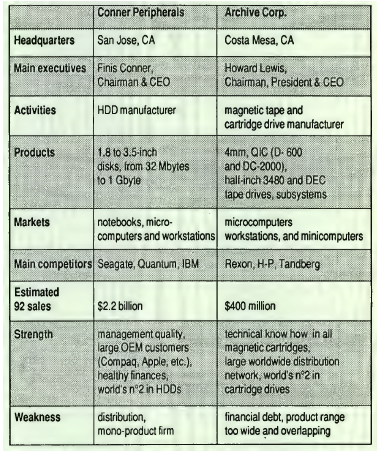
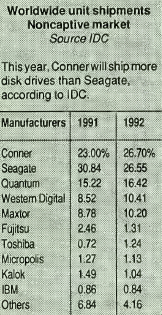
Conner Peripherals (San Jose, CA) and Archive Corp. (Costa Mesa, CA) announced jointly, on October 22, the signing of a letter of intent for Conner to acquire Archive, Conner is ≠2 in HDDs behind Seagate, and recently IDC even positioned it before its competitor in number of units throughout tlie world (see below).
Without counting StorageTek that is only involved in tape solutions for high-end computers, Archive is the WW leader in magnetic tapes, especially if you consider all the QIC formats, and second or third in 4mm DATs behind the undeniable leader Hewlett-Packard.
The two entities merged into a group that should reach $2.6 billion this year, if you count on a $2.2 billion forecast for Conner and a $400 million one for Archive.
The agreement Conner has signed a letter of intent for Conner to acquire the $13.4 million outstanding shares of Archive for a cash purchase price of $11.25, which means $151 million. But there are in fact 18. 7 million shares fully diluted, which brings it to $210million. And like usual in this type of negotiation, the acquisition is subject to the final approval by the respective boards of directors.
The parties were expected to sign the definitive agreement in the beginning of November.
Archive has agreed to cancel its pending public offering of common stock. However, in the event Conner terminates the letter of intent or does not enter into a definitive agreement, except under “certain circumstances,” it has agreed to purchase approximately 1.9 million newly-issued shares of Archive’s common stock at $6.75 per share.
Finis Conner, chairman of the company, set up in San Jose, CA, had already announced last June, that his company was going to operate a strategic change, it was no longer going to just manufacture disk drives but get completely involved in all data storage solutions.
The first tangible sign was the announcement of the agreement with 3M to develop a QIC minicartridge but with a new rotating head that allows the storage of several gigabytes.
By acquiring Archive, Conner will now have access to almost all the technologies used with magnetic tapes.
Its divisions Archive Software, Archive Technology, Ardat, Cipher, Maynard and ex-Irwin are involved in half-inch 3480 and DEC cartridges, QICs, and 4mm.
Maynard also sells subsystems based on Exabyte’s 8mm drives.
“The Maynard division will materially strengthen our efforts to market products through the retail and reseller channels,” adds Conner.
After closing down Optimem, an optical digital disk actor, and then acquiring Cipher in 90 and Maynard in 88, the Archive group had completely reorganized its company.
“The result was a 3,000 to 2,000 staff reduction,” according to Fred Richardson, VP and GM of Cipher, and “ first profitable results despite a heavy financial debt,” adds Grausse.
Conner Peripherals has no equivalence in the world in terms of growth. It is going to reach $2.6 billion in less than 6 years of existence, and it is even very close to its ever-lasting competitor, Seagate, that is going to approach $3 billion this year.
For its annual sales, as of 91, Conner was ranked 248th US company in the Fortune magazine.
The success story is continuing.
But how will the company swallow the biggest fish it ever struck. Additionally, it will have to cope with a magnetic tape market, less competitive than disks, but with a lower growth rate.
And finally, it will have to choose among some of these magnetic cartridge formats that have overlapping markets and where users get completely lost.







 Subscribe to our free daily newsletter