









4% Y/Y Growth for Smartphone NAND Flash Chip Revenue
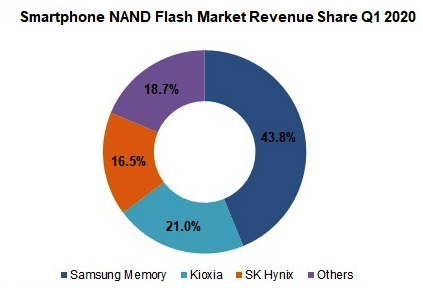
Market led by Samsung Memory (44%), Kioxia (21%) and SK Hynix (16%)
This is a Press Release edited by StorageNewsletter.com on July 3, 2020 at 2:30 pmThe global smartphone memory market registered a total chip revenue of $9.4 billion in 1Q20, according to the Strategy Analytics, Inc.‘s Handset Component Technologies service report, Smartphone Memory Market Share Q1 2020: Revenue Sees Modest Decline as Samsung Memory Dominates (13 pages).
This research finds that Samsung Memory, SK Hynix and Micron captured almost 84% revenue share in the global smartphone memory market in 1Q20. Samsung Memory maintained its lead in the smartphone memory market with 50% revenue share in 1Q20, followed by SK Hynix and Micron.
NAND Market
The smartphone NAND flash chip revenue observed 4% Y/Y growth driven by price stabilization and higher capacity flash demand in 1Q20. The market was led by Samsung Memory with a revenue share of 44% followed by Kioxia with 21% and SK Hynix with 16%.
DRAM Market
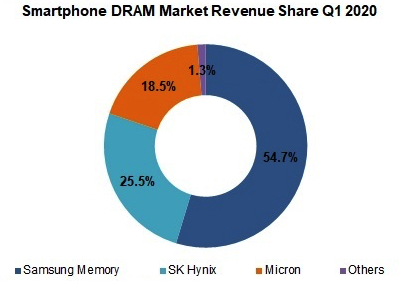
The total DRAM market revenue for smartphones registered a decline of 4% Y/Y due to the seasonality and demand shift to other categories. In terms of market share, Samsung Memory registered a revenue share of 55% followed by SK Hynix and Micron each having a share of 25% and 19% respectively in the smartphone DRAM market in 1Q20.
Jeffrey Mathews, analyst, said: “The smartphone memory market experienced only a modest decline in revenue as the memory chip market rebounded from previous levels of decline owing to the correction of inventory and early chip orders from customers in order to manage future Covid-19 disruptions. Samsung Memory continued to witness traction for its UFS 3.0 flash and LPDDR5 DRAM memory chips and managed design wins with leading smartphone OEMs in 1Q20.”
Stuart Robinson, executive director of the Strategy Analytics handset component technologies service, commented: “The smartphone memory market will continue to be challenged by the fall in smartphone memory demand on the back of Covid-19 pandemic disruptions on global smartphone production and also causing demand for smartphones to drop. However, the demand for high density memory chips featuring UFS 3.0 and LPDDR5 remains upbeat among smartphone OEMs.”







 Subscribe to our free daily newsletter