









4Q19 NAND Flash Revenue Grows 8.5% Q/Q Reaching $12.5 Billion
Driven by strong demand from data center clients
This is a Press Release edited by StorageNewsletter.com on March 11, 2020 at 2:12 pmAccording to the DRAMeXchange research division of TrendForce, Inc., 4Q19 NAND flash bit shipment increased by nearly 10% Q/Q thanks to demand growth from data center clients.
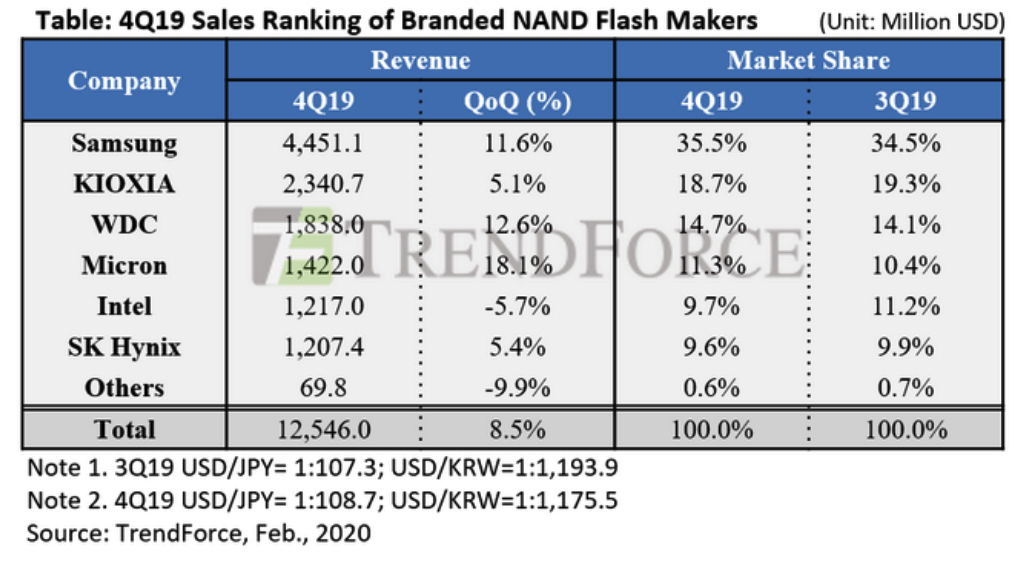
On the supply side, contract prices made a successful rebound due to shortages caused by the power outage at Kioxia’s Yokkaichi production base in June. In sum, 4Q19 NAND flash revenue reached $12.5 billion, an 8.5% increase Q/Q.
The stronger-than-expected 4Q19 performance from the demand side helped improve supplier inventory back to normal levels. In response, NAND suppliers were able to reduce their allocations to the wafer market and instead focus on shipping products with comparatively higher margins.
In 1Q20, the COVID-19 outbreak may have an impact on the consumer electronics supply chain, including smartphones and NBs; therefore, total quarterly bit shipment is projected to possibly post a minor decline or flat trend. Even so, this may be offset by the large increase in contract prices, so NAND flash revenue is expected to at least maintain the same level as 4Q19.
Samsung
Owing to the growing demand from data center companies in 4Q19, the demand for Samsung’s SSDs far exceeded its supply; as such, Samsung’s bit shipment increased by almost 10% Q/Q. On the other hand, the company also posted an increase in ASP because of the increase in contract prices and the reduction of NAND flash supply in the channel markets. With the simultaneous increase of ASP and shipment, its 4Q19 NAND flash revenue reached $4.451 billion, an 11.6% increase Q/Q. In terms of capacity planning, it is continuing to decrease the planar NAND production capacity at Line 12. Its newly-expanded second semiconductor plant in Xi’an is operating on schedule and without production delays for now despite potential issues in expansion schedule due to the COVID-19 outbreak.
SK Hynix
Owing to growing demands in the mobile storage and data center markets, firm’s bit shipment grew by 10% Q/Q in 4Q19. However, the increase in its product storage density offset the increase in contract prices and resulted in a flat ASP. Its NAND flash revenue reached $1.207 billion, a 5.4% increase Q/Q. In terms of capacity planning, its cutbacks in planar NAND capacity and the corresponding addition in 3D NAND capacity are expected to result in a lower year-end production capacity compared to the start of 2020. In terms of architecture, 128L products are expected to enter mass production in 1Q20. The company is also planning to release QLC products this year, but it will take longer to see client adoption of QLC SSDs, since its product mix is still primarily targeted at the mobile market.
Kioxia
Kioxia’s bit shipment increased by almost 10% Q/Q thanks to its capacity recovery after the Yokkaichi power outage and to growing demands for data center and PC SSDs. Its ASP also saw a near-5% increase, due to increases in contract prices caused by product shortages. In terms of financials, the power outage affected only 3Q19 operations, without any adjustments to 4Q19 performance; Revenue reached $2.341 billion, a 5.1% increase Q/Q. In terms of capacity expansion, the company’s Iwate-based K1 fab will begin operations in 1H20 and produce 96L/112L products. The added production capacity will be used to compensate for capacity losses from raising the number of cell layers in its Yokkaichi site. Therefore, total wafer starts will remain unchanged.
Western Digital
Owing to the demand placed by Apple’s new iPhones and the surge in data center SSD demand, WD’s 4Q19 bit shipment increased by 24% Q/Q. However, the company’s ASP dropped by about 8% Q/Q because of its higher-density product mix. Its 4Q19 NAND flash revenue reached $1.838 billion, a 12.6% increase Q/Q. In terms of production capacity, it is continuing to invest in its Iwate-based K1 fab. But the primary function of the added capacity from K1 is meant to offset capacity loss from the Yokkaichi fab’s process nodes and layer improvements, so total output will remain unchanged.
Micron
Maintaining its 3Q19 growth momentum in the mobile storage market, its shipment of MCP products continued to grow. At the same time, the strong demand for SSDs helped increase 4Q19 bit shipment by almost 15%. Also, it saw a minor growth in ASP due to the increase in market prices and the adoption of a more profitable product mix. Revenue grew by 18.1% Q/Q and reached $1.422 billion. In terms of production capacity, its capacity planning in 2020 is relatively conservative. The clean rooms in its new Singapore-based fab are primarily intended to maintain its current production capacity. It is focused on improving its process nodes and microarchitectures this year; its 128L products are expected to enter mass production in 2H20.
Intel
Like its competitors, the company benefitted from the strong SSD demand from data centers. It responded to its clients’ preemptive pull-in demand with existing stock in 3Q19, in turn raising its 3Q19 bit shipment considerably, by over 50% Q/Q. This destocking effort means the firm needed to rely on fab production capacity for its product shipments in 4Q19, during which its bit shipment fell by over 10%. On the other hand, as Intel faced a severe supply shortage, its ASP saw a corresponding increase of over 10% Q/Q. Intel’s 4Q19 NAND flash revenue reached $1.217 billion, a 5.7% decrease Q/Q. Its Dalian fab is currently maintaining normal capacity, as the outbreak did not impact fab production. In terms of process nodes, Intel is continuing to develop 144L products, expected to enter mass production in 2H20.







 Subscribe to our free daily newsletter