









University of Stuttgart Inaugurates Hawk HPC
With 25PB of disk storage supplied by DDN
This is a Press Release edited by StorageNewsletter.com on February 26, 2020 at 2:06 pmThe new Hawk HPC was inaugurated, on February 19, 2020, in a ceremony at the HPC Center of the University of Stuttgart (HLRS).
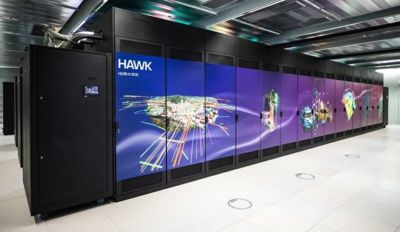
Officials, scientists and other stakeholders celebrated the new system, which is among the fastest in Europe and in the world.
Hawk, an HPE Apollo 9000 system, is equipped with 5,632 nodes-each with two AMD Epyc R, 7742 CPUs-housed inside 44 cabinets. The system sports a total memory of 1.44PB, Mellanox IB HDR200 interconnection, and 25PB of disk storage, supplied by DataDirect Networks, Inc.. Under normal operations, HLRS reports a typical power envelop of 3.5MW for Hawk, rising to about 4.1MW while running Linpack.
With a peak performance of 26 petaflops, the new HPC is 3.5 times more powerful than the Hazel Hen system that it is replacing. Installed in late 2014, this later ranks at ≠35 on the current Top500 list with 5.6Linpack Petaflops. Hawk is undergoing testing ahead of acceptance and production but it will likely appear within the top 20 of the next list, due out in June. Funding for Hawk totaling €76 million (~$82 million) was jointly provided by the Baden-Württemberg Ministry for Science, Research and Art and the German Federal Ministry for Education and Research.
“Hawk expands the University of Stuttgart’s already excellent research infrastructure with an additional flagship system,” said Wolfram Ressel, rector, HLRS. “It will enable cutting edge academic and industrial research in a wide range of contexts where simulation and big data play important roles. In this way the new high-performance computer also makes an important contribution to realizing the HLRS’s vision, intelligent systems for a sustainable society.”
Hawk is also the beginning of a supercomputing collaboration between HLRS and HPE. Through this partnership, the two will develop new software and tools for HPC, AI, optimization and other applications in preparation for the exascale era.
Heiko Meyer, HPE’s chief sales officer, said the company is looking forward to “a long-term development partnership with HLRS in which we optimize applications, test future technologies, and bring them to a mature, market-ready state.“
In terms of applications, HLRS emphasized sustainability fields, ranging from optimizing wind turbines and power plants to improving the aerodynamics of aircrafts and automobiles.
“Hawk allows us to better understand the environment, and use these new technologies more effectively,” said Michael Resch, director, HLRS. “We want to give every citizen an opportunity to be a part of these changes. With Hawk, we can digitalize the future in a sustainable way.“
Beyond supporting a range of open science goals, up to 10% of Hawk’s cycles will be available for private industry in Germany.








 Subscribe to our free daily newsletter