









Nagoya University Information Technology Center Chooses Fujitsu HPC Using Fugaku Technology
With 36PB on DDN storage and Sony optical discs
This is a Press Release edited by StorageNewsletter.com on February 10, 2020 at 2:16 pmFujitsu Limited received an order for the next gen of HPC system from Nagoya University’s Information Technology Center scheduled to start operation in July 2020.

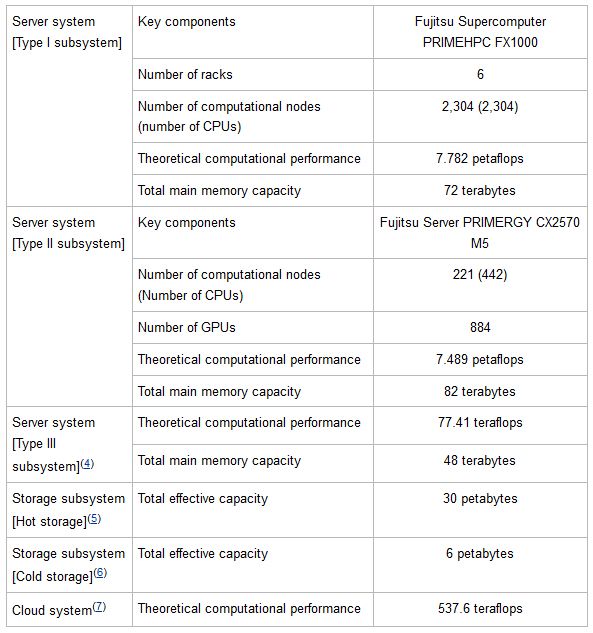
For the first time, this system will adopt 2,304 nodes of the Fujitsu HPC PRIMEHPC FX10001, which utilizes the technology of the HPC Fugaku developed jointly with Riken in Japan. In addition, a cluster system, connecting 221 nodes of the latest x86 servers Fujitsu Server PRIMERGY CX2570 M52 in parallel, as well as storage systems are connected by a high-speed interconnect. The sum of the theoretical computational performance of the entire system is 15.88 petaflops3, making it one of the highest performing systems in Japan.
As a national joint usage/research center, the IT Center of Nagoya University provides computing resources for academic use to researchers and private companies nationwide. It is currently operating a HPC system consisting of Fujitsu HPC PRIMEHPC FX100 and other components. This time, the center is planning to innovate the system in order to fulfill the large-scale calculation demand from researchers in joint usage nationwide, as well as the new calculation requirement for HPCs represented by data science. Fujitsu won the order for this system in recognition of its proposal that concentrates the technical capabilities of Fujitsu and Fujitsu Laboratories Ltd.
With the new system, the center will contribute to various R&D activities. These include the conventional simulation of numerical computation to unravel the mechanism of typhoons and design new drugs. Moreover, the new system will develop a technology in the medical field that support diagnoses and treatment, while apply AI in developing automatic driving technology.
Fujitsu will continue to support the activities of the center with its technology and experience nurtured through the development and offering of HPCs. By providing PRIMEHPC FX1000 worldwide, the company will also contribute to solving social issues, accelerating research, and strengthening corporate advantages.
Main configuration of the new system
Kensaku Mori, director, the Information Technology Center, Nagoya University, commented: “In recent years, the digitization of university education and research activities has increased the demand for computing. In addition to such areas as extreme weather including super typhoons, earthquakes and tsunamis, which are closely related to the safety and security of people’s lives, chemical fields such as molecular structure and drug discovery, and simulations in basic sciences such as space and elementary particles, there is an ever-increasing demand for computing in the fields of medicine and mobility, including AI and ML. Also important are the data consumed and generated in computing, the networks that connect them, and the visualization of knowledge discovery from computing and data. Equipped with essential functions for such digital science in universities, the new HPC will be offered not only to Nagoya University, but also to universities and research institutes nationwide, contributing to the further development of academic research in Japan.“
1 Fujitsu HPC PRIMEHPC FX1000: Features the CPU A64FX adopting Scalable Vector Extension (SVE) which is an extension of the Armv8-A architecture for HPCs. It achieves performance per power as well as high computational efficiency due to the high memory bandwidth of HBM2 (High Bandwidth Memory), a high-performance stacked memory.
2 Fujitsu Server PRIMERGY CX2570 M5: Fujitsu’s latest x86 server. It has a 2nd gen Intel Xeon Scalable Processors and the NVIDIAV100 Tensor Core GPU that is ideal for AI and deep learning applications, with a high bandwidth, energy efficient interconnect NVIDIA NVLink between the GPUs. PRIMERGY CX 2570 M5 is equipped with up to 4 GPU computing cards per server and connects them via NVIDIA NVLink for ultra-fast communication.
3 Petaflops : Short for peta floating point operations per second. Peta is an SI prefix indicating one quadrillion, or 10 to the power of 15, indicating performance of one quadrillion floating-point operations per second.
4 Type III subsystems: The main configuration product is a large SMP (Symmetric Multiprocessing) server HPE Superdome Flex (Hewlett-Packard Enterprise).
5 Storage subsystem [hot storage]: The main components are SFA18KE (DataDirect Network Japan Inc.) which is a parallel file system integrated storage, and Fujitsu’s large-capacity, high-performance, highly-reliable distributed file system Fujitsu Software FEFS. FEFS stands for Fujitsu Exabyte File System.
6 Storage subsystem [cold storage]: The main components are Optical Disc Archive (Sony Corporation). Comprised of optical disc, it achieves low power consumption, high durability, and permanent retention of research data. It is suitable for long-term cold archive storage such as research data for an extended period of time, as falsification is difficult with the write-once recording method that prevents data rewrite.
7 Cloud systems: The main components are Fujitsu Technical Computing Solution UNCAI and HPE ProLiant DL560 (Hewlett-Packard Enterprise). UNCAI is a package that integrates the functions necessary to use and operate a server as a private cloud.







 Subscribe to our free daily newsletter