




History (1991): Jukeboxes Expected to Clash
Half-inch cartridge, 8mm tape and rewritable optical discs to be winners
By Jean Jacques Maleval | February 6, 2020 at 2:25 pmThe WW market for removable-media mass storage products will grow to $2.1 billion in 1995, a 22% CAGR from the $787 million value of the 1990 market according to Mass Storage Outook (307 pages, $1,595), a new market analysis published by Freeman Associates, Inc. (Santa Barbara, CA).
“Advances in drive, media, and robotics technologies coupled with declining components costs have enabled cost-effective designs and new market opportunities for very large automated storage subsystems,” declares Robert C. Abraham and Raymond C. Freeman Jr., authors of the report.
“The market for removable-media mass storage products has finally caught hold after 3 decades of halting market development. The market is driven by mushrooming memory requirements for imaging, CAD/CAM, and archiving applications. New higher-capacity libraries utilizing half-inch cartridge tape, 8mm tape, and rewritable optical disks will be the big winners,” Freeman said.
Mass storage subsystems, as defined in the report, include all known automated tape libraries and automated optical disc libraries, sometimes called jukeboxes. These two major categories of mass storage products are expected to clash as users and integrators weigh storage performance requirements vs. storage costs.
Four categories of tape libraries and 4 categories of optical disc libraries are analyzed, and market sizes are forecast through 1995.
The report is based upon research with 41 companies known to be producing or planning 119 models of libraries, 8 companies known to be involved in tape stacker/loaders or multidisk optical cartridge drives, and 38 manufacturers of related media.
The authors predict combined shipments of all classes of automated tape and optical disc libraries to grow from 5,400 units in 1990 to 41,200 in 1995, a 50% annual rate.
Strong growth for tape libraries
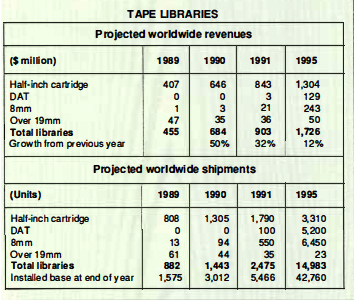
Demand for all types of tape libraries is forecast to grow from 1,443 units in 1990 to nearly 15,000 in 1995, a CAGR of 60%.
Libraries using industry standard half-inch cartridges already dominate the tape library market, with 1,300 units shipped in 1990 and 3,300 units predicted for 1995, a growth rate of 20%.
“This class of library has become the number one choice for most commercial and scientific mass storage requirements,” observes Abraham.
These high-performance libraries are oriented towards mainframe computer environments, but smaller, lower-capacity, lower-cost versions are expected to emerge to serve mid-range and high-end desktop and deskside systems.
Demand for libraries using DAT drives and media is expected to be strong throughout the forecast period. Shipments of DAT libraries will start in 1991 and will increase to 5,200 units in 1995. This device category utilizes the smallest media package of any library product class.
Shipments of libraries using 8mm cartridges are forecast to grow from 94 units in 1990 to 6,450 units in 1995, a CAGR of 133%. These mid-range libraries will benefit from the rapidly growing installed base of 8mm drives and media, particularly in networked systems.
Unit shipments of higher-capacity/higher-performance tape libraries – including those libraries using VHS cassettes, 19mm D-1 andD-2 cassettes, and proprietary 2.7-inch wide tape cylinders – are expected to occur during the forecast period, but in limited quantities. These segments include the highest-performance, highest-capacity, and highest-cost devices with transfer rates in the 15MB/s range, capacities in the tens of terabytes, and prices in the tens of millions of dollars.
Demand for optical libraries lead by rewritable multifunction
The market for optical disc libraries – served until 1989 exclusively by write-once products – will be strengthened by the availability of rewritable and multifunction products.
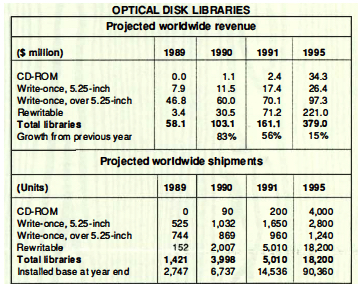
Unit shipments of all classes of optical libraries will grow from 4,000 units in 1990 to over 26,000 units in 1995, a growth rate of 45%.
Unit shipments of CD-ROM libraries – a new class of optical library – are forecast to grow at a rate of 114%, from 90 units in 1990 – their first year of shipment – to 4,000 units in 1995. These libraries will automate the handling and searching of CD-ROM discs containing vast amounts of reference information.
Write-once optical libraries using 5.25-inch media will continue to serve deskside and desktop document imaging applications and will grow in shipments from 1,000 units in 1990 to 2,800 units in 1995, a CAGR of 22%.
The report foresees only modest market acceptance for optical disc libraries that use 12-inch and 14-inch write-once media. Demand for these libraries will grow at a 7% rate, from 869 units shipped in 1990 to 1,240 units in 1995. These products will maintain a capacity and performance edge over smaller 5.25-inch libraries, but these advantages will be accompanied by a higher price. The fastest growing segment of optical libraries will be rewritable multifunction segment.
“Demand for these libraries benefits from their small form factor, from intense competition in 5.25-inch drive and media segments which is expected to enhance performance and keep price down, and from the multifunction nature of these devices,” Freeman stated.
Unit growth is forecast to grow from 2,000 units in 1990 to 18,200 units in 1995, a growth rate of 55%.
This article is an abstract of news published on the former paper version of Computer Data Storage Newsletter on issue 39, published on April 1991.








 Subscribe to our free daily newsletter