






EU Publications Office Based Long-term Preservation Service on International Archiving Standards
eArchiving is service package complete with sample software, technical specs, support services and community.
This is a Press Release edited by StorageNewsletter.com on December 20, 2019 at 1:08 pmFrom CEF Digital
Chosen standards are considered best practice and are supported by the European Commission.
 ©Adobe Stock
They help organisations to save time and resources, increase interoperability and enhance security, while guaranteeing the trustworthiness of a digital archive.
Quick facts:
-
Project: EUDOR
-
Organisation: , Luxembourg
-
Challenge: How to preserve electronically EU information for the long term whilst ensuring conformity with applicable legislation?
-
Solution: Implement relevant archiving standards thus benefitting from community-based development
-
CEF building block: eArchiving
Pioneer in digital archiving
The European Union’s Publications Office (OP) implemented their first electronic archiving system already in 1987. This first system, called Arcdon, digitally preserved data using optical disks as storage media to support paper archives. While Arcdon was fairly simple, its creators recognised the value of digital preservation in supporting paper-based archiving systems, which are inherently space-consuming and vulnerable to wear and tear.
Since 1987, applicable legislative requirements have increased, users have become more demanding and technology has advanced. Consequently, Arcdon has been replaced in 1996 by a new system called the European Union DOcument Repository, or EUDOR for short. It has evolved over the years and in 2015, a public call for tender was published to find a partner for upgrading EUDOR v2 to v3. Requirements for the service included, among others, archiving electronically signed PDFs and increasing security to establish a trusted document management system.
Changes were driven by the rise of e-archiving standards and new requirements were triggered in particular by the change of the reference format of the Official Journal, as the PDF format became legally binding (Council Regulation (EU) No 216/2013). Today, the third generation of EUDOR ensures long-term digital preservation of law and publications associated with rich metadata on behalf of all European Institutions. The long-term preservation policy, service and activities are documented in the Publications Office’s Digital Preservation Plan.
Standards as deciding factor
The call for tender resulted in a service contract (2016-2022) with Intrasoft International. As a sub-contractor, Keep Solutions provides software development and maintenance. Keep Solutions’s digital archiving solution, RODA, matched well with OP’s technical requirements. Furthermore, RODA’s foundation on open standards and technical specs was appraised positively. Examples of these standards include ISO 14721 and E-ARK, which are at the core of eArchiving – the digital archiving solution endorsed and offered by the European Commission’s Connecting Europe Facility (CEF) programme.
eArchiving: European Commission’s archiving solution
Earchiving is a service package complete with sample software, technical specifications, support services and a community. It is based on the global Open Archival Information System (OAIS) Reference Model (ISO standard 14721:2012), which is considered the main standard for creating digital archiving solutions. OAIS provides a common ground for understanding digital archiving concepts, strategies, techniques and more.
On top of the OAIS, eArchiving defines, for example, technical specs for:
-
data input to archive (Submission Information Package or SIPs),
-
long-term preservation of data in archive (Archival Information Package or AIPs), and
-
accessing data from archive (Dissemination Information Package or DIPs).
Keep Solutions were involved in defining these technical specifications, as they were a contributing member to E-ARK, the predecessor of eArchiving. Therefore, much of the eArchiving specifications are reflected in RODA, and parts of RODA are included in eArchiving (e.g. RODA repository). Furthermore, RODA has implemented standards supported by eArchiving, such as PREMIS (Preservation Metadata: Implementation Strategies) for preserving information packages; and METS (Metadata Encoding and Transmission Standard) for allowing the exchange of data between archives.
Today, the specifications of E-ARK are packaged, promoted and offered for free as CEF eArchiving to ensure that as many European organisations as possible can benefit from them. In line with the principles of open solutions, everyone is free to use them, and all contributions will be fed back to the benefit of everyone else.
Results and benefits
The OP has the mandate to ensure long-term preservation of all official publications published by the European Institutions (Decision 2009/496/EC, EURATOM), and the number of documents that need archiving is ever growing. As of August 2019, EUDOR v3 stores over 90 million files with texts dating back to 1951 – years before the European Commission existed. However, the European Coal and Steel Community was established in 1952, and the treaty was signed the year before. Within the 90 million files, nearly one million are unique publications that are provided in different European languages.
Following points outline how eArchiving is helping the OP achieve its objectives in digital archiving:
-
Save time and resources by not having to reinvent the wheel.
-
Open standards prevent vendor lock-in and facilitate future migrations, which are needed in order to preserve the content and avoid format or support obsolescence.
-
Establishes a common language to communicate within the archival community.
-
Having a standards-based solution enhances interoperability.
-
Standards invoke trust and credibility and are thus a good basis for a trustworthy archival repository.
-
Facilitates auditing and certification, which is particularly important for the OP, as it is aiming to obtain the ISO 16363 certificate for EUDOR.
EUDOR architectural set-up
Archiving is often considered an easy, straightforward task. Like dropping a file into folder. This is not the case. Data comes in diverse formats alongside complex metadata, and both need to be transferred and migrated across formats and technologies to stand the test of time. The illustration below shows how OP solved these challenges.
General document archiving flow with EUDOR v3
Click to enlarge
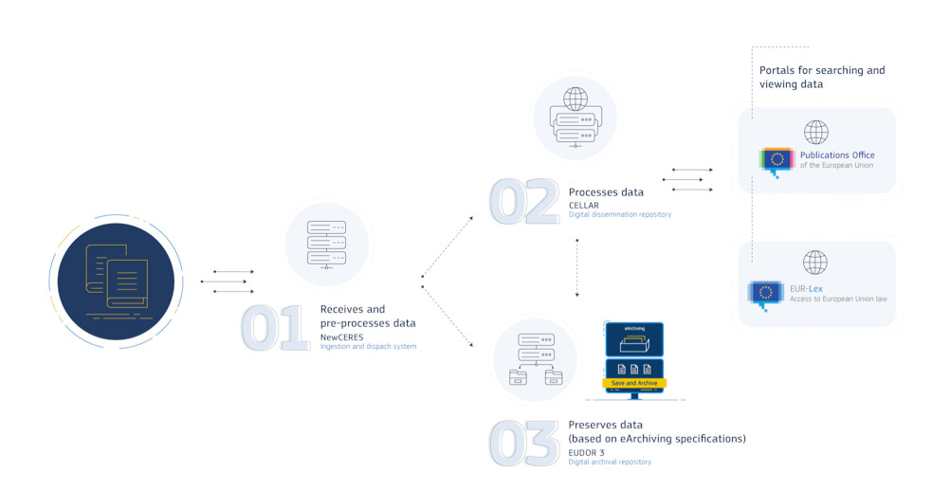
New CERES is a pre-processing and workflow system with data reception and dispatch functionalities. It validates and prepares data to be submitted to CELLAR for dissemination and to EUDOR v3 for archiving. CELLAR is a digital dissemination repository. It is accessed by EUR-Lex and the Publications Office’s portal for searching and viewing. EUDOR v3 receives the SIP packages and transforms them into AIPs. This converts data into the internal format of the archive in order to enable long-term preservation. EUDOR v3 currently stores data in two 175TB data centres, each connected to the OP via a private line. Some of the formats supported are TIFF, XML and PDF.
Next steps
Next, OP aims to get EUDOR ISO 16363 certified, which is a recognition for trustworthy digital repositories. OP is also looking into new collections to archive, such as tender notices and websites. Work will continue with the same standards, but specs will be amended as needs evolve. New technologies, such as blockchain and cloud storage, are of interest, too.
How can eArchiving help you?
If you are interested in using eArchiving for a project of your own. eArchiving is offered by the European Commission’s Connecting Europe Facility (CEF) programme, and the support services are described on website CEF Digital.
Resource:
eArchiving at CEF Digital






 Subscribe to our free daily newsletter