









History (1989): Peripheral Components International HDD Head Manufacturing Plant in Palmela (Portugal)
Division of Imprimis, now Seagate
By Jean Jacques Maleval | October 28, 2019 at 1:35 pmFor its 20th anniversary, Peripheral Components International (PCI), a division of Imprimis Technology Incorporated, offered the visit of its ferrite and thin-film head plant in Palmela (Portugal), 30-miles south of Lisbon.
According to Imprimis, recently acquired by Seagate, PCI is the world’s leading thin-film head supplier for the OEM market, and also of ferrite head components.
It operates in three main plants: Minnesota (USA), Penang (Malaysia) and Palmela (Portugal).
In 1969, what was in those days Control Data Portuguesa started modestly with 60 employees on 8,600 square feet to assemble printed circuit boards, taking advantage of low-cost labor and closeness of the European market. At the end of 1970, the Palmela facility assembled 180,000 PC boards. During 1971, the final plant was built: a 64,500 square foot building.
At the end of the year, it manufactured sub-assemblies for peripheral units. Four years later, it was renamed Magnetic Peripherals Inc. (MPI), a company where major shareholder were Control Data but also Honeywell, Bull and NCR that supervised together 2 facilities: in Palmela and in Heppenheim (West Germany).
MPI was the sole voice-coil drive manufacturer for Control Data Corporation European clients and built the largest annual quantity (3,582 pieces) of VCD (Voice-Coil Drive) disk drives. In 1979, the production expanded with new products: SMD (Storage Module Drives) of 40 and 80MB and the SMD magnetic heads. At the end of 1980, the facility total production figures were 16,000 peripheral units, 3,000 SMD units, 300,000 magnetic heads, 2,000,000 PCBs.
Control Data acquired then the totality of the Palmela plant from its partners who quit disk drive manufacturing and became a direct division of Imprimis, now Seagate.
Altogether, the Palmela plant has produced 56,000 units of 80MB SMDs and 17,000 units of 60MB VCDs. The actual staff counts 1,127 people and mainly produces magnetic heads that should reach a total of 1.3 million of 18 different types for Imprimis or OEM customers in a 118,400 square-foot plant on a 462,800 square-foot area.
According to a spokesman of Imprimis, the production can be divided into ferrite heads (35%) and thin-film heads (65%), 20% of these are for the European market and 80% are shipped to the U.S. Sales of the Palmela plant were not communicated.
Imprimis and now Seagate seem to want to continue the production probably on account of low-cost labor. The average salary of an operator is $380 to $400 and absenteeism is rather low (5 to 6%). According to Imprimis’ spokesman, you have to take under consideration that salaries and charges account for almost 50% of the disk head manufacturing.
“The average seniority of a full-time employee at this plant is 12 years,” said Caroline L. Fairbanks, director of plant operations in Palmela.
Concerning the thin-film heads, the thin-film itself comes directly from Imprimis production center in Minneapolis. In Palmela, there is no R&D going on.
It should be kept in mind that Seagate has shares in a thin-film head manufacturing plant, Lafe Magnetics in Hong Kong and that it assembles ferrite heads in Bangkok and Manilla. All this doesn’t seem to implicate the Portuguese plant.
“The Palmela plant has given our company a presence in Europe that will become increasingly more important as we approach 1992,” said David L. Riegel, VP, Imprimis components operations.
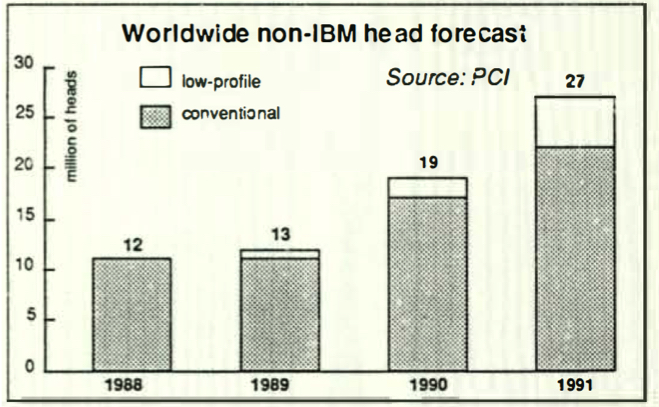
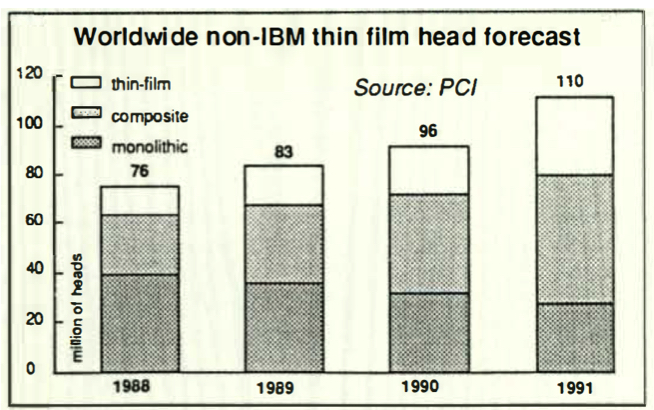
What do the 1.3 million disk heads manufactured in Portugal represent? Not very much if you compare them to the figures of PCl’s market report (see below) that estimates that 13 million thin-film heads are manufactured worldwide (without IBM) in 1989 and 83 million non-IBM heads including all technologies (thin-film, composite and monolithic heads)
According to PCI, the outlook for the head market is moderate growth vs. the rapid growth that was predicted in early 1988. Barry Rossum, marketing director PCI forecasts worldwide market demand to be 96 million heads shipped in 1989 and 110 million in 1990.
Demand for monolithic heads continues to decline.
Composite head demand is growing with the development of the metal-in-gap heads, which allows composite heads to be used in higher capacity applications. Composite head shipments will grow from 35 million in 1989 to 57 million by 1991.
The thin-film segment will grow the fastest, from 13 million in 1989 to 27 million in 1991 as they show reduced cost and improved performance.
This article is an abstract of news published on the former paper version of Computer Data Storage Newsletter on issue ≠23, published on December 1989.








 Subscribe to our free daily newsletter