









R&D: University of Alaska Fairbanks Discovery Could Mean Breakthrough in HDD
Way to control magnetization in nanoparticles that could allow more data in HDDs
This is a Press Release edited by StorageNewsletter.com on March 29, 2019 at 2:23 pm From Fritz Freudenberger, University of Alaska Fairbanks
A breakthrough by a University of Alaska Fairbanks researcher could lead to computer HDDs capable of storing much more data in a smaller space.
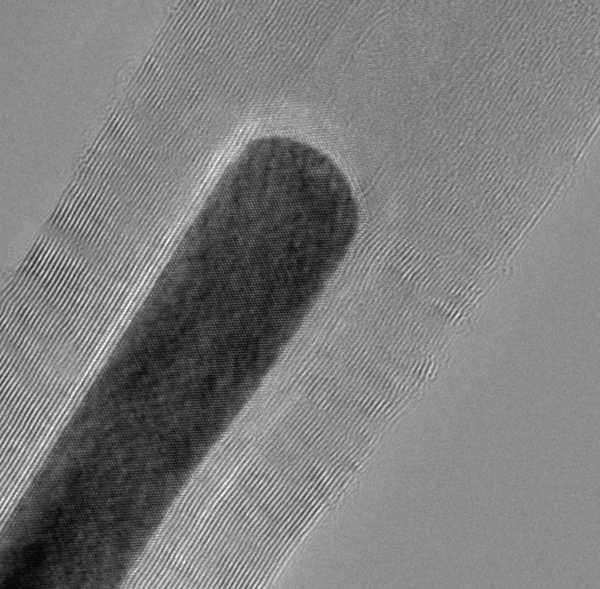
Microscopic image of a carbon nanotube with a magnetic nanoparticle inside.
The properties of the tubes and nanoparticles led to a breakthrough
that could lead to more storage in HDDs.
As file size and data needs increase, the future of storage is uncertain. In the past, the density of data that can be stored on HDDs has increased by 40% a year. But in the last five years, that rate, known as data scaling, has slowed to between 15 and 10%. Now, thanks to a breakthrough in magnetics, the rate may rise.
Gunther Kletetschka, a research professor at the UAF Geophysical Institute who specializes in magnetics, recently reported a way to control magnetization in nanoparticles that could allow more data in computer HDDs. The results were published with three co-authors in the peer-reviewed journal Nature Scientific Reports.
“What we have shown in this paper is that we have a way that we can erase magnetic memory and a way to stabilize it,” said Kletetschka. “It shows there is a new principle that has not been used. If we use this principle we can have a much larger density of memory storage than we had before.“
Bits of data are stored on a disk in a computer’s HDD by writing on particles when they are in a fluctuating magnetic state, then stabilizing them to store the written data. To record more data in a given area, you need to allot a smaller space to each bit. In turn, that reduces the signal when you read the data. If you reduce the signal too much, it gets lost in the magnetic noise that arises from the particles coating the disk.
It is possible to reduce that background noise by making the particles smaller. However, it is difficult to shrink them without compromising their ability to maintain a stable magnetic state. The smallest size that’s practical to use for magnetic recording is known as the superparamagnetic limit.
And, unknown to most consumers, disk manufacturers have reached it.
Until recently, the slowdown in data scaling was not obvious to users, because disk-drive manufacturers were able to compensate by adding more reading and writing parts in each unit, enabling higher data capacity in the same size package. But now the available space and cost of adding them is limiting the gains that manufacturers can make, and the plateau is starting to become apparent.
However, Kletetschka thinks he and his co-authors have found a way around it.
Carbon nanotubes, lab-made cylinders of carbon with unique properties, contain magnetic nanoparticles that are smaller than the particles currently used in HDDs.
Kletetschka’s research found that these nanoparticles can be controlled, and he wants to leverage this to use them to store data.
In their normal state, the magnetic energy in the nanoparticles fluctuates in all directions. However, when the nanoparticles are inside the carbon nanotubes, this energy can be aligned and stabilized. Then, when exposed to a frequency and amplitude of electromagnetic energy that matches that of the field around the carbon nanotube, the magnetic energy can be put back into the fluctuating state required for writing data.
In other words, the research showed that it’s possible to control the memory inside the nanoparticles and put them in a writable and storable state.
Kletetschka said that this research overcame hurdles, but there is still work that needs to be done before the technology can be used to write data. His work is a proof of concept that shows these nanoparticles can be used to store data, but what’s missing is how you actually record information inside the nanotube material.
“Right now, we can erase and lock data but we need a device that tells them how to do so,” he said.
The next step for Kletetschka is to write specific information into the nanoparticles.
“I want to move it a step further to see if I can write a specific memory to that forest,” he said. “Because no one has ever done it. I want to find out if I can use these particles in a unique way.“
Article: Magnetic tunneling with CNT-based metamaterial
Nature Scientific Reports has published an article written by Gunther Kletetschka, Institute of Geology, Czech Academy of Sciences, Rozvojova 269, Prague, Czech Republic, and Department of Applied Geophysics, Charles Univ, Albertov 6, Prague, Czech Republic, and Geophysical Institute, University of Alaska Fairbanks, 903 N Koyukuk Drive, Fairbanks, AK, USA, Yoku Inoue, Department of Electronics and Materials Science, Shizuoka University, 3-5-1 Johoku, Naka-ku, Hamamatsu, 432-8561, Japan, Jan Lindauer, High School (Gymnazium), Karlovy Vary, Czech Republic, and Zdeněk Hůlka, ZH Instruments Inc., Brno, Czech Republic.
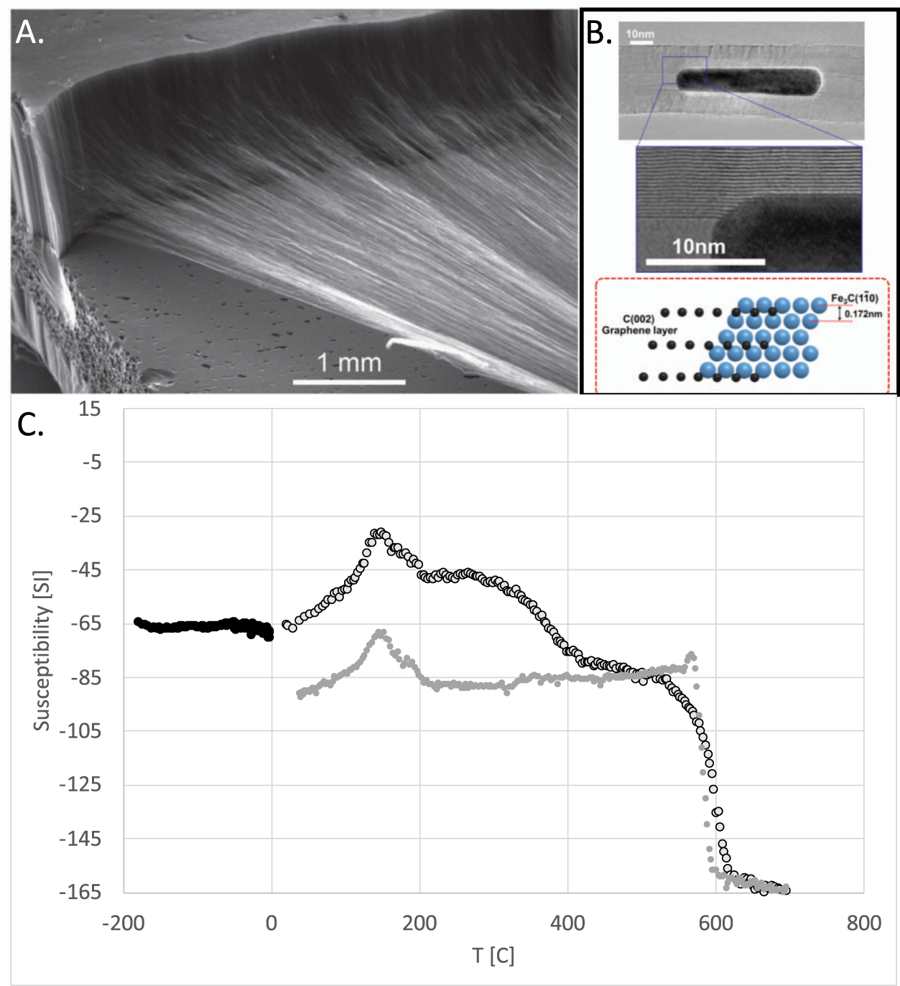
Multiwall Carbon Nanotubes (MWCNTs); (a) Drawing continuous field of filaments from vertically
aligned MWCNTs. (b) Nature of the contact between MWCNTs and iron rich nanoparticles.
Fe3C structures are visible inside MWCNTs. Lattice match relates to C(002) ~ 2xFe3C(110).
(c) Magnetic susceptibility of MWCNTs showing four drops in induced magnetization, at 230°C, 400°C, 580°C, Hematite 700°C.
Click to enlarge
Abstract: “Multiwall carbon nanotubes (MWCNTs) fabricated by chemical vapor deposition contain magnetic nanoparticles. While increasing frequency of electromagnetic field (EMF) exposure (up to <10 kHz) of MWCNTs resulted in slight induced magnetization decrease due to skin effect of the conducting carbon, we discovered that higher frequencies (>10 kHz) contained an exponential magnetization increase. We show that puzzling magnetization increase with decreasing magnetic field amplitude (less than 0.5 A/m for 512 kHz) is due to matching the field amplitudes of the magnetic nanoparticles inside nanotubes. This observation reveals a possibility of magnetic tunneling in MWCNTs (change of magnetic state of blocked magnetic moments). This interpretation is supported by observation of unblocking larger magnetic remanence (MR) portion from MWCNTs with progressively smaller amplitude of oscillating magnetic field.“








 Subscribe to our free daily newsletter