









R&D: Reduction of Recording Noise Caused by Nano-Scale Variations in Curie Temperature
Introducing design rules addressing importance of elevated Curie temperature in write layer and optimization of quantum mechanical coupling between two functional layers
By Francis Pelletier | March 5, 2019 at 2:31 pmApplied Physics Letters has published an article written by Zengyuan Liu, Electrical and Computer Engineering Department, University of Minnesota, Minneapolis, Minnesota 55455, USA and Center for Micromagnetics and Information Technologies, University of Minnesota, Minneapolis, Minnesota 55455, USA, Pin-Wei Huang, Ganping Ju, Fremont Research Center, Seagate Technology, Fremont, California 94538, USA, and R. H. Victora, Electrical and Computer Engineering Department, University of Minnesota, Minneapolis, Minnesota 55455, USA and Center for Micromagnetics and Information Technologies, University of Minnesota, Minneapolis, Minnesota 55455, USA.
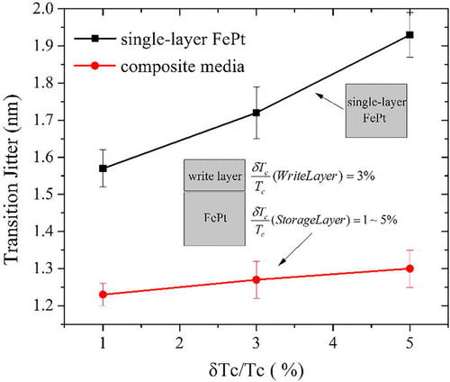
Transition jitter of two different media.
The black curve shows the transition jitter of single-layer FePt media
with various Curie temperature standard deviations.
The red curve shows the transition jitter of composite media
for the case of the 3% Tc standard deviation of the write layer and varying FePt δTc/Tc.
Abstract: “Heat-Assisted Magnetic Recording (HAMR) is expected to be the next-generation magnetic recording technology: it is designed to meet increasing higher areal density demands from cloud storage. Until now, there are no feasible solutions to address nm-scale Curie temperature variance in FePt-based single layer media. This variance is the leading noise source, and thus limits further development of HAMR technology. Here, we describe a superparamagnetic write process that can greatly mitigate the impact of Curie temperature variance by recording information at the blocking temperature of the magnetic material. To demonstrate the benefits of this write process, we employ a bilayer structure with a superparamagnetic write layer and FePt as a long-term storage layer. By developing the theory behind the recording mechanism, we are able to introduce design rules addressing the importance of elevated Curie temperature in the write layer and optimization of quantum mechanical coupling between the two functional layers.“








 Subscribe to our free daily newsletter