









Red Hat Enterprise Linux 7 Powers Network and Storage Performance
Enhancements built around performance, security and reliability, capabilities around Linux containers and IoT
This is a Press Release edited by StorageNewsletter.com on November 11, 2016 at 2:45 pmRed Hat, Inc. announced the availability of its Enterprise Linux 7.3, the latest version of its enterprise Linux platform.

This update to Linux OS includes new features and enhancements built around performance, security, and reliability. The release also introduces new capabilities around Linux containers and the IoT, designed to help early enterprise adopters use existing investments as they scale to meet new business demands.
Performance
From video conferencing technologies and voice over IP (VoIP) to web-based applications and services, the network demands of the enterprise can be substantial. Enterprise Linux 7.3 helps address this need for better networking with the addition of lightweight tunnels, enabling guest instances of Enterprise Linux 7.3 to be more secure, efficient, scalable and flexible. Additionally, enhancements to the bulk packet memory allocator improve performance for both 40 and 100GbE networking interfaces.
Meanwhile, high-transaction applications like databases, event processing, and VMs need improved IO rates and lower latencies to help enterprises realize their benefits. New hardware technologies like non-volatile memory address these concerns, and Enterprise Linux 7.3 expands support for high speed, low latency non-volatile memory devices. In addition, it makes performance-sensitive Parallel NFS (pNFS) clusters easier to manage with support for the Block SCSI layout format and the Flex Files layout format.
Security and identity management
IT security cannot remain static in the face of an ever-changing threat landscape, and a more secure datacenter begins with innovation at the OS level. Enterprise Linux 7.3 helps to drive this IT security evolution by introducing several new and enhanced security features, delivering a secure platform for mission-critical deployments and other essential workloads.
This includes:
-
Updates to SELinux, a mechanism for enforcing granular, system-level access control policies, for faster policy creation and improved overall ease of use.
-
Enterprise Linux 7.3 provides a consistent compliance checking mechanism across containerized and traditional non-container workloads for better overall operations efficiency. This is provided through enhancements to OpenSCAP, an open source implementation of the Security Content Automation Protocol (SCAP), which provides a standardized compliance checking solution for enterprise Linux infrastructure. Configuring SCAP-based policies with the OpenSCAP Workbench GUI is easier.
-
Improvements to company’s Identity Management solution, providing better performance for large installations, support for smart card authentication with Active Directory, and support for configurable authentication strength across individual hosts and services.
Reliability
Enterprise Linux 7.3 continues to provide a stable foundation for enterprise environments and workloads. Customers can now deploy an integrated, multi-site DR solution without having to also rely on custom or third-party solutions, resulting in potentially reduced costs and speedier times to deployment.
Specific enhancements in support of this include:
-
The ability to configure pacemaker to manage multi-site and stretch clusters across geo-locations for DR and scalability.
-
The ability to better configure and trigger notifications when the status of a managed cluster changes with the introduction of enhanced pacemaker alerts.
Linux containers
Linux containers provide a compelling mechanism to help enterprises scale to new levels of operational efficiency. They provide a packaging and management format that can speed application development and drive more flexibility in managing life cycles based on the application. The combined characteristics of containers increase application portability and infrastructure flexibility, and allow organizations to more clearly delineate the roles of developers and IT administrators. Enterprise Linux 7.3 bolsters support for Linux containers via numerous incremental improvements in addition to enhanced management tools (Atomic CLI/Cockpit) and an updated container runtime (docker engine). It also includes a container signing capability as a technology preview.
IoT
Industrial IoT implementations consist of vast connected networks of ‘smart’ edge devices feeding information in real-time to centralized datacenters, allowing for improved operational efficiency and reduced operating costs. These implementations need to be backed up by an enterprise-grade OS.
Presenting a platform upon which to run enterprise-scale IoT, RH Enterprise Linux 7.3 introduces two key features:
-
Support for communication with Bluetooth LE (Low Energy) devices – an extension of the Bluetooth standard, Bluetooth LE is designed for low energy devices like IoT sensors.
-
Kernel support for the Controller AreaNetwork bus (CANbus) protocol – CANbus is a controller area network used in automobiles and high-end industrial controllers.
Click to enlarge
Enterprise Linux variants
This launch also signifies updates to several Enterprise Linux variants. From powering massive container build-outs to delivering open innovation on new server architectures, Enterprise Linux 7.3 variants provide answers to some of the most specific enterprise architecture needs.
These variants include:
-
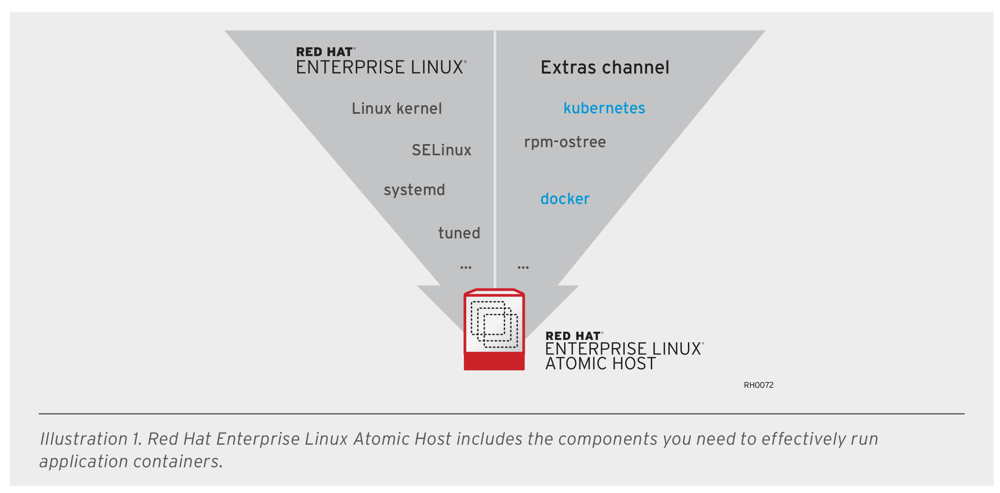
Enterprise Linux Atomic Host, a minimal footprint OS optimized to run Linux containers. Running applications in containers on top of RH Enterprise Linux Atomic Host provides application portability across the hybrid cloud. New to Enterprise Linux Atomic Host 7.3 as a technology preview is the capability for users to layer additional RPMs, providing additional flexibility often required by diverse environments.
-
Enterprise Linux for Applications, a variant optimized for running SAP environments, is supported on IBM Corp.‘ z Systems and Power, big endian.
-
Enterprise Linux Server for ARM 7.3 development preview, company’s OS designed for 64-bit ARM-based systems has been updated to include:
-
Single-host virtualization based on KVM, one of the leading open source virtualization technologies.
-
Ceph Storage for prototyping and deploying scale-out, software- defined storage for object, block, and file.
-
Initial support for RH Developer Toolset, which provides C and C++ developers with the latest stable open source tools to create, diagnose, and debug applications for 64-bit ARM platforms.
-
Jim Totton, VP and GM, platforms business unit, Red Hat, said: “As modern enterprise applications become increasingly resource intensive at both the network and storage levels, IT infrastructure must not just keep pace, but anticipate and adapt to these changing needs. Red Hat Enterprise Linux 7.3 delivers increased application performance and a more secure, reliable and innovative enterprise platform, well-suited for existing mission-critical workloads and emerging technology deployments like Linux containers and IoT.“








 Subscribe to our free daily newsletter