








Revisiting Local Structure in Ge-Sb-Te Based Chalcogenide Superlattices
Proposing consistent novel structure for phase-change materials
By Francis Pelletier | March 7, 2016 at 3:05 pmNature Scientific Reports has published an article written by Barbara Casarin, Università degli Studi di Trieste, Via A. Valerio 2, 34127, Trieste, Italy and Elettra-Sincrotrone Trieste S.C.p.A. Strada Statale 14-km 163.5 in AREA Science Park 34149, Basovizza, Trieste, Italy, Antonio Caretta, Elettra-Sincrotrone Trieste S.C.p.A. Strada Statale 14-km 163.5 in AREA Science Park 34149, Basovizza, Trieste, Italy, Jamo Momand, Zernike Institute for Advanced Materials, University of Groningen, Groningen 9747, AG, The Netherlands, Bart J. Kooi, Zernike Institute for Advanced Materials, University of Groningen, Groningen 9747, AG, The Netherlands, Marcel A. Verheijen, Department of Applied Physics, Eindhoven University of Technology, P. O. Box 513 5600, MB Eindhoven, The Netherlands, Valeria Bragaglia, Raffaella Calarco, Paul-Drude-Institut für Festkörperelektronik, Hausvogteiplatz 5-7 10117, Berlin, Germany, Marina Chukalina, Russian Academy of Sciences, Institute of Microelectronics Technology and High Purity Materials, Moscow, Russia, Xiaoming Yu, John Robertson, Engineering Department, Cambridge University, Cambridge CB2 1PZ, UK, Felix R. L. Lange, Matthias Wuttig, Institute of Physics, RWTH Aachen University, 52056, Aachen, Germany, Andrea Redaelli, Enrico Varesi, Micron Semiconductor Italia S.r.l., Via C. Olivetti, 2, 20864, Agrate Brianza, MB, Italy, Fulvio Parmigiani, Università degli Studi di Trieste, Via A. Valerio 2, 34127, Trieste, Italy, Elettra-Sincrotrone Trieste S.C.p.A. Strada Statale 14-km 163.5 in AREA Science Park 34149, Basovizza, Trieste, Italy and International Faculty, University of Cologne, 50937 Cologne, Germany, and Marco Malvestuto, Elettra-Sincrotrone Trieste S.C.p.A. Strada Statale 14-km 163.5 in AREA Science Park 34149, Basovizza, Trieste, Italy.
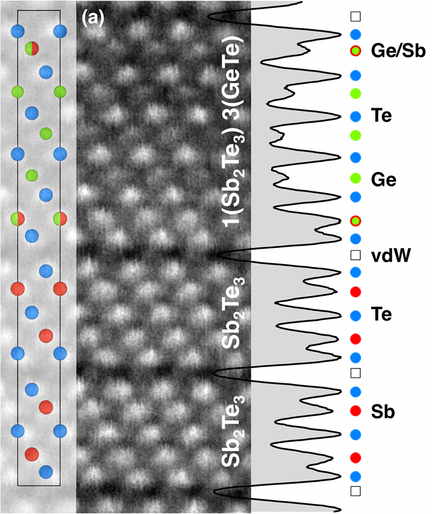
(a) High resolution TEM image of the CSL sample, with overlayed experimental-based
averaged structure model. Sb, Te and Ge atoms are denoted with red, blue and green
circles, respectively. Half-colored circles indicate an ideal 50% intermixing
of Sb and Ge atoms, as suggested by a quantitative analysis
of the present image (black profile).
Abstract : “The technological success of phase-change materials in the field of data storage and functional systems stems from their distinctive electronic and structural peculiarities on the nanoscale. Recently, superlattice structures have been demonstrated to dramatically improve the optical and electrical performances of these chalcogenide based phase-change materials. In this perspective, unravelling the atomistic structure that originates the improvements in switching time and switching energy is paramount in order to design nanoscale structures with even enhanced functional properties. This study reveals a high- resolution atomistic insight of the [GeTe/Sb2Te3] interfacial structure by means of Extended X-Ray Absorption Fine Structure spectroscopy and Transmission Electron Microscopy. Based on our results we propose a consistent novel structure for this kind of chalcogenide superlattices.”
Introduction: “The need for fast and efficient management of information stimulates research on materials that can be switched on nanometer length scales and sub-nanosecond time scales. Phase-Change materials (PCMs) possess a unique property portfolio, which is ideally suited for memory device applications1,2,3,4,5,6. A PCM is identified by its ability of switching rapidly and reversibly between a crystalline and an amorphous state, where the amorphous state is obtained by melting the crystalline state followed by rapid quenching. These two states significantly differ in their properties, such as the optical reflectivity as well as the electrical conductivity. The phase transformation is in general triggered by thermal heating, or by either electrical and optical pulses of different time duration and amplitude. The large contrast in reflectivity between these two states lays at the base of already working PCM-based optical rewritable media devices-like DVDs or Blu-Ray Disc-where information is encoded as amorphous marks in a crystalline background. The contrast in resistivity could be exploited in the next generation of electronic solid-state memories based on PCMs, which might replace the current leading storage technologies, namely flash and magnetic disks. Furthermore, these materials could be employed in displays or data visualization applications by combining both their optical and electronic property modulations7. Hence, a lot of interest and effort is currently devoted to uncover the complex physical origin of the high contrast between the two phases8,9,10, as well as of the atomistic representation of the switching mechanism11,12,13.»








 Subscribe to our free daily newsletter