Integral Crypto SSD With FIPS 140-2 Encryption
6Gb SATA 2.5-inch and mSATA formats with capacities up to 512GB
This is a Press Release edited by StorageNewsletter.com on May 21, 2014 at 2:52 pmIntegral Memory plc has launched an addition to its of Crypto SSD and Crypto USB flash drives, a new FIPS 140-2 validated series of SATA III 2.5″ SSD and FIPS 140-2 mSATA (MO-300) SSD featuring military-level, hardware encryption that protects every bit of addressable data on the drive, right down to the base-level OS files and secured with AES 256-bit algorithms, that are NIST approved.
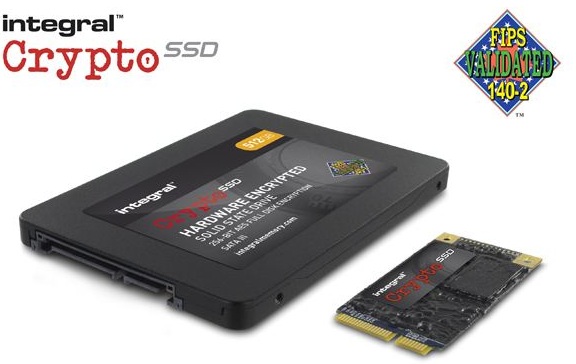
As well as the secure, convenient protection of sensitive data, the new drives offer all the speed and durability benefits of SSD, making this the preferred solution when compared to software encryption.
Protecting sensitive data through encryption is a mandatory requirement for a range of organisations, as government bodies impose increasingly penalties for data protection breaches resulting from lost and stolen computers. FIPS 140-2 validated Crypto SSDs are a ‘fit and forget’ solution with a low TCO that will allow banks, law firms, educational establishments, healthcare professionals, local government and a variety of other business and public sector organisations to meet their data protection obligations.
Developed in the UK and available in capacities from 64GB to 512GB (SATA III 2.5″) and 64GB to 256GB (mSATA), the high-speed SSDs can be installed in desktops, laptops, ultrabooks and small form-factor machines (for use as embedded secure storage). As well as quick configuration, Crypto SSD uses hardware-based FDE to offer a higher level of security than software-only encryption. Furthermore, unlike software, the disks place no additional overhead on the processor and with no requirement for on-going licence fees, a one-off investment delivers a lower TCO.
With Crypto SSD, all of the data on the drive including the OS is 256-bit AES hardware encrypted at system shutdown. The security system is BIOS-independent and a user can only access the disk and initiate Windows boot-up by entering the correct 8-16 character alphanumeric password. In the event of a brute force passwod attack, all encrypted data is automatically erased after a pre-set number of failed password attempts. The data and encryption key are securely destroyed and the Crypto SSD is reset. In addition, once encryption has been set, it is not possible to clone a Crypto SSD.
Offering a multi-lingual interface that simplifies global deployments, the SSDLock program supplied with Crypto SSD FIPS 140-2 provides an easy-to-use interface for system configuration. The Crypto SSD is a BIOS independent SED that offers both user and master passwords. Upon password setup, a unique ID can be set that enables Crypto SSDs to be linked to existing endpoint security systems.
Samik Halai Integral’s senior security product manager, comments: “In 2012, Integral Memory was first to market with true BIOS independent 256-bit hardware encrypted SSDs. I am delighted to announce we lead the way again in 2014 with the release today of the world’s first mSATA 6Gbps FIPS 140-2 validated self-encrypting solid state drive and alongside it, our new 6Gbps SATA III 2.5″ Crypto SSD also with FIPS 140-2 certification by NIST. Looking to the future, Integral is currently developing OPAL compliant spec drives to be released later this year, as well as a 1TB SATA III 2.5″ model“.
Crypto SSDs are compatible with Windows XP, Windows Vista, Windows 7 and Windows 8. A two-year warranty is standard across the range.
The Crypto SSD FIPS 140-2 range is available from IT resellers including Insight and Misco.
Prices for the Crypto SSD FIPS 140-2 (SATA III 2.5″) begin at around £193/$308 for the 128GB capacity drive.
Why hardware encryption over software encryption?
The major difference between hardware encryption and software encryption is that with hardware based encryption, the encryption and decryption processes are carried out by a dedicated processor (part of the Integral Crypto hardware). In software encryption, the resources of the device on which the software is installed are used for the encrypting and decrypting of data. This makes hardware encryption much faster. Another advantage of hardware encryption is that the cryptographic key is stored in a separate inaccessible portion of memory storage, making it more secure than software encryption.







 Subscribe to our free daily newsletter