




BlueArc in Flash SSD With Texas Memory
And its RamSan-500, up to 2TB
This is a Press Release edited by StorageNewsletter.com on October 14, 2008 at 3:46 pmBlueArc Corporation announced that Titan storage solutions have been certified for interoperability with RamSan-500 solid state devices from Texas Memory Systems, Inc.. BlueArc Dynamic Read Caching capabilities announced at Storage Networking World and Texas Memory Systems RamSan-500 storage can help companies harness hardware-accelerated server and disk technologies in the face of extreme data demand — without taxing assets or IT staff.
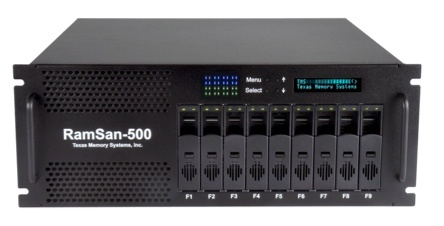
RamSan-500
"Texas Memory Systems and BlueArc have just made it easier for our customers who depend on read-intensive tasks like rendering, online transaction processing and streaming content to achieve dramatic performance gains," said Woody Hutsell, Executive Vice President for Texas Memory Systems. "What’s more, with some of the industry’s lowest price/performance ratios, Titan and RamSan-500 create an even greater value proposition together."
Titan storage technology offers the world’s fastest benchmarked network attached storage performance and highest capacity, and award-winning RamSan-500 is the fastest flash-based solid state device on the market. Instead of over provisioning more expensive storage media to reduce the risk unexpected demand will degrade application performance, storage administrators can configure policy-based BlueArc Dynamic Read Caching to copy data to a read-only cache on RamSan-500 devices. Together, Titan and RamSan-500 deliver sub-millisecond response times — much faster than Fibre Channel — for peak application performance.
Customers who choose to make RamSan-500 devices their tier-0 storage in conjunction with Titan gain exceptional responsiveness from an ultra-high-performance tier. The RamSan-500 offers sustained performance of 100,000 IOPS and up to 2 terabytes of data capacity, and BlueArc Dynamic Read Caching automatically copies data — for up to 500,000 cache-enabled files — to the optimal storage tier and format based on pre-defined policies. As a result, input/output operation-intensive tasks such as online transaction processing, modeling and high-volume data acquisition take place at top speeds while crucial storage functions such as snapshots, replication and deduplication continue without interruption.







 Subscribe to our free daily newsletter